
In today's competitive business landscape, choosing the right technology to manage your sales operations and revenue processes can make or break your growth trajectory. For companies leveraging the Salesforce ecosystem, two powerful solutions often come into consideration: Salesforce Sales Cloud and Salesforce Revenue Cloud.
While both platforms are designed to drive business growth and streamline operations, they serve distinctly different purposes. Many business leaders find themselves asking: "Which one do I actually need?" or "Are they the same thing with different names?"
The confusion is understandable. Both solutions live within the Salesforce universe, both deal with revenue-generating activities, and both promise to transform how your business operates. However, understanding the key differences between Revenue Cloud vs Sales Cloud is crucial for making an informed investment decision that aligns with your company's specific needs.
In this comprehensive guide, we'll break down everything you need to know about these two powerful platforms—from their core functionalities and key features to real-world use cases and integration possibilities. By the end, you'll have clarity on which solution (or combination of solutions) will best support your business objectives.
Understanding the Salesforce Ecosystem
Before diving into the specifics, it's helpful to understand that Salesforce offers a suite of cloud-based products designed to help businesses manage different aspects of their operations. From customer relationship management (CRM) to marketing automation, customer service, and analytics, Salesforce has become the go-to platform for companies of all sizes.
Sales Cloud and Revenue Cloud are two distinct products within this ecosystem, each addressing different stages and complexities of the revenue generation process. Think of them as specialized tools in a comprehensive toolkit—each excelling in its particular domain.
What is Salesforce Sales Cloud?
Definition and Purpose
Salesforce Sales Cloud is the world's #1 CRM platform, designed specifically to help sales teams close more deals, faster. Launched in 1999 as Salesforce's flagship product, Sales Cloud revolutionized how businesses manage customer relationships, track sales activities, and forecast revenue.
At its core, Sales Cloud is built to optimize the sales process—from the moment a lead enters your system to the final handshake (or digital signature) that closes the deal. It provides sales teams with the tools they need to manage prospects, nurture relationships, track opportunities, and collaborate effectively across the organization.
Key Features of Sales Cloud
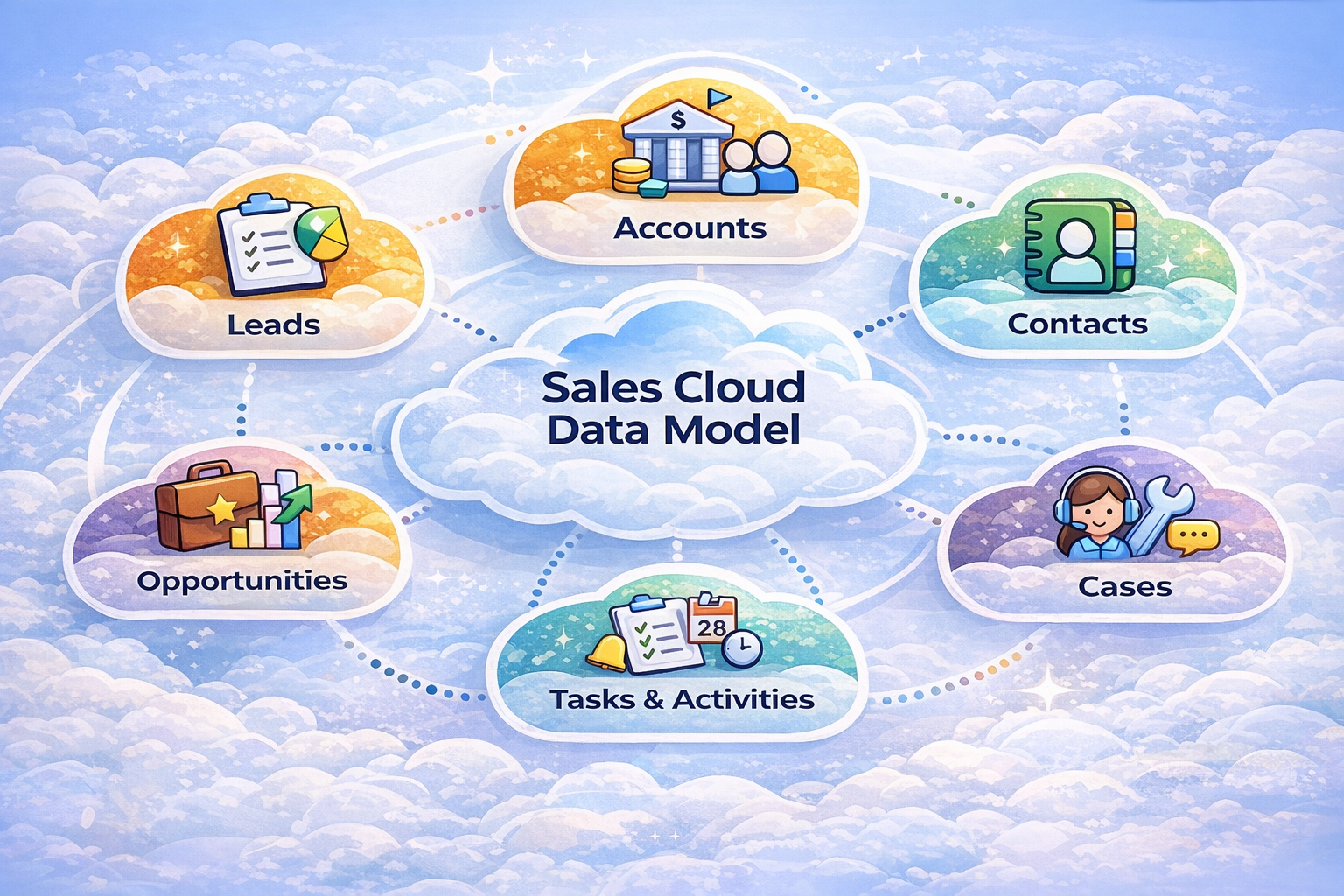
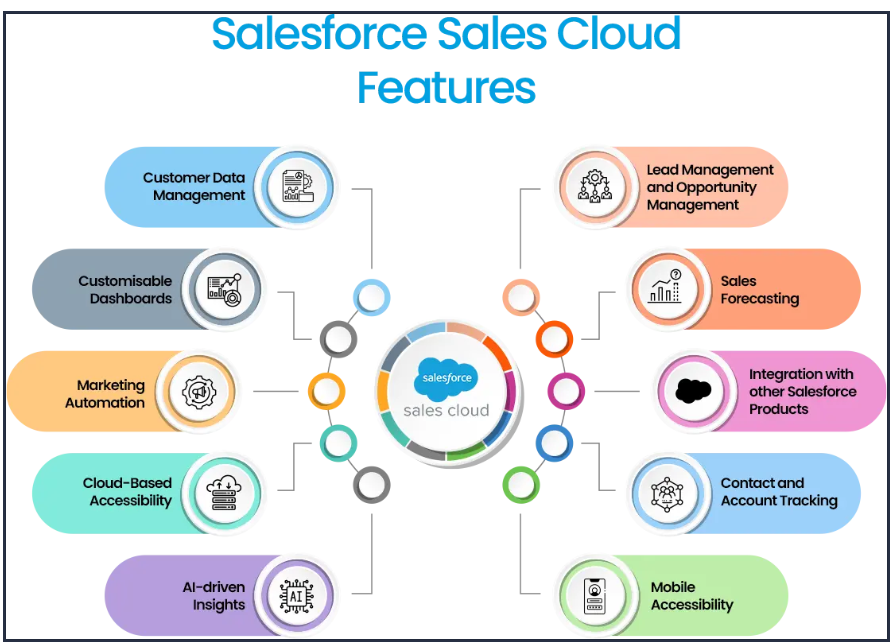
Sales Cloud comes packed with robust features designed to empower sales teams:
Lead Management
- Capture leads from multiple sources (web forms, events, social media)
- Automatic lead assignment and routing
- Lead scoring and qualification tools
- Convert qualified leads into opportunities seamlessly
Opportunity Tracking
- Visual sales pipeline management
- Real-time opportunity tracking
- Customizable sales stages
- Deal insights and recommendations
Sales Forecasting
- Predictive forecasting capabilities
- Territory and quota management
- Real-time visibility into pipeline health
- Collaborative forecasting across teams
Sales Automation
- Automated workflows and approval processes
- Email integration and tracking
- Task and activity automation
- Einstein AI for intelligent recommendations
Contact and Account Management
- 360-degree customer view
- Account hierarchy management
- Contact relationship mapping
- Interaction history tracking
Mobile CRM
- Full-featured mobile app
- Offline access to critical data
- Mobile-optimized dashboards
- On-the-go productivity tools
Analytics and Reporting
- Customizable dashboards
- Standard and custom reports
- Sales performance analytics
- Team productivity metrics
Ideal Use Cases for Sales Cloud
Sales Cloud is the perfect fit for businesses that need to:
- Streamline their sales processes and improve sales team productivity
- Gain better visibility into their sales pipeline and forecast accuracy
- Centralize customer information in a single, accessible location
- Automate routine sales tasks and workflows
- Scale their sales operations as the company grows
- Improve collaboration between sales, marketing, and customer service teams
Industries ranging from technology and manufacturing to financial services and healthcare rely on Sales Cloud to power their sales operations.
What is Salesforce Revenue Cloud?
Definition and Purpose
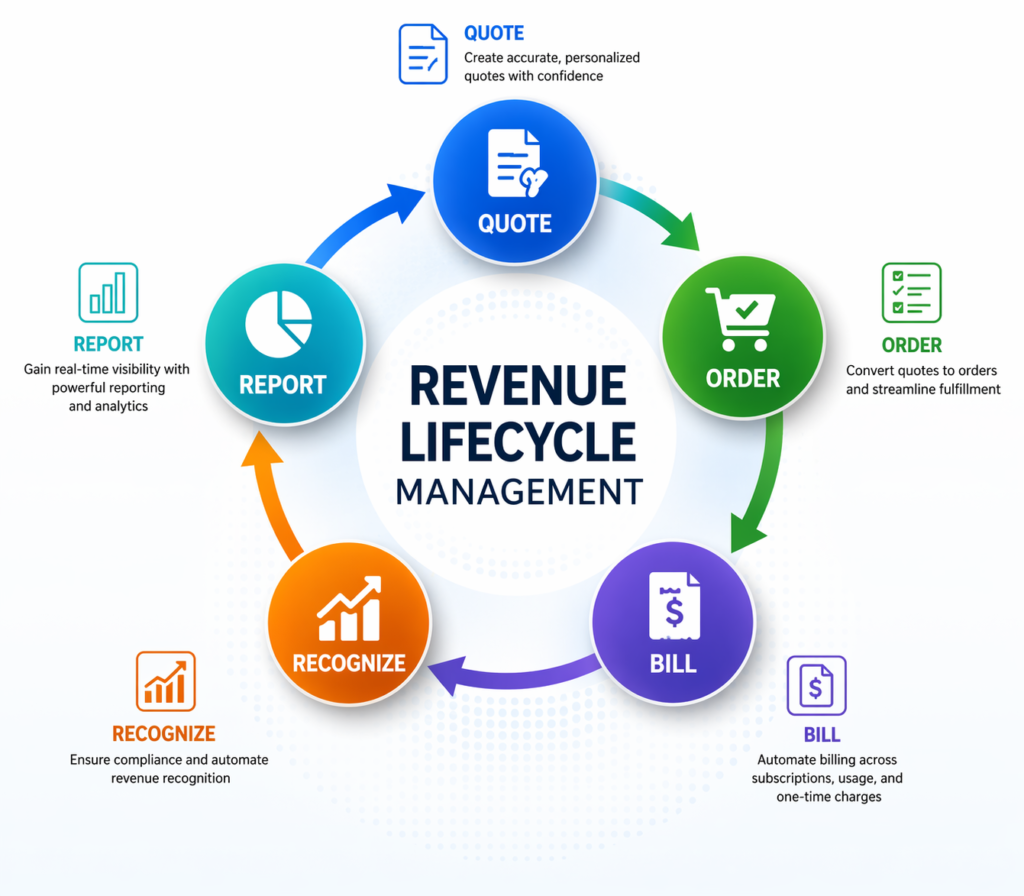
Salesforce Revenue Cloud is a more comprehensive solution that goes far beyond traditional sales management. Introduced more recently to address the complexities of modern revenue operations, Revenue Cloud manages the entire revenue lifecycle—from initial quote to final payment and renewal.
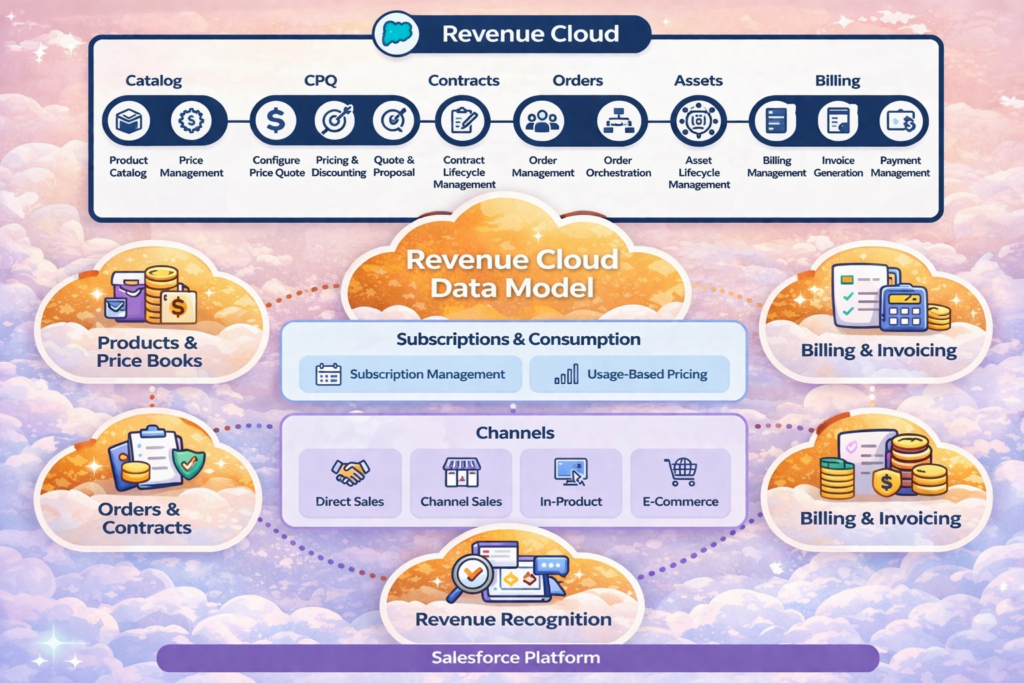
Revenue Cloud is particularly designed for businesses with complex pricing models, subscription-based services, usage-based billing, or those requiring sophisticated quote-to-cash processes. It brings together configure-price-quote (CPQ), billing, subscription management, and revenue recognition into a unified platform.
Think of Revenue Cloud as the evolution of the sales process into a complete revenue operations system. While Sales Cloud helps you close the deal, Revenue Cloud helps you maximize, manage, and recognize revenue throughout the entire customer lifecycle.
Key Features of Revenue Cloud
Revenue Cloud encompasses several powerful capabilities:
Configure, Price, Quote (CPQ)
- Guided selling with product recommendations
- Complex product bundling and configuration
- Dynamic pricing rules and discount management
- Professional quote generation
- Approval workflows for non-standard deals
Subscription Management
- Flexible subscription models (monthly, annual, usage-based)
- Automated renewal management
- Subscription amendments and upgrades
- Proration and mid-term changes
- Customer self-service portals
Advanced Billing
- Automated invoice generation
- Multiple billing schedules and frequencies
- Usage-based and consumption billing
- Complex revenue recognition rules
- Tax calculation and compliance
Contract Lifecycle Management
- Contract creation and negotiation
- Amendment and renewal management
- Contract compliance tracking
- Evergreen contract support
Revenue Recognition
- Automated revenue scheduling
- ASC 606 and IFRS 15 compliance
- Multi-element arrangement handling
- Deferred revenue management
Partner Relationship Management
- Channel partner portals
- Deal registration and collaboration
- Partner quoting capabilities
- Revenue sharing and royalty management
Ideal Use Cases for Revenue Cloud
Revenue Cloud is essential for businesses that:
- Offer subscription-based products or services (SaaS, membership programs)
- Have complex pricing structures with multiple variables
- Need to manage recurring revenue and renewals at scale
- Require sophisticated quote-to-cash automation
- Deal with usage-based or consumption billing models
- Must comply with revenue recognition standards (ASC 606/IFRS 15)
- Operate partner or channel sales programs
- Want to reduce revenue leakage and improve cash flow
Companies in SaaS, telecommunications, media, utilities, and professional services industries particularly benefit from Revenue Cloud's capabilities.
Key Differences: Revenue Cloud vs Sales Cloud
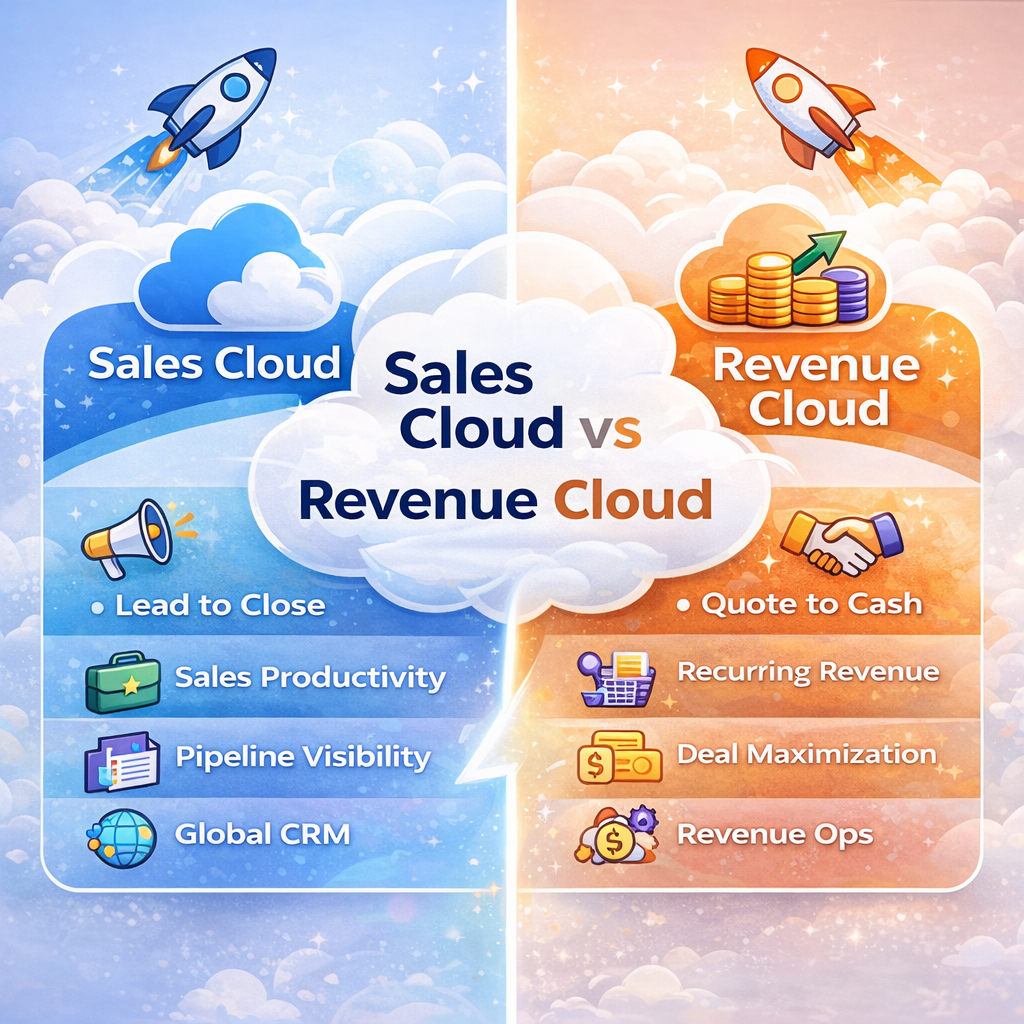
Understanding the distinction between these two platforms is crucial for making the right choice. Here's a comprehensive comparison:
Comparison Table: Revenue Cloud vs Sales Cloud
| Aspect | Sales Cloud | Revenue Cloud |
|---|---|---|
| Primary Focus | Managing the sales process | Managing the entire revenue lifecycle |
| Core Function | Lead-to-opportunity conversion | Quote-to-cash automation |
| Best For | Traditional B2B and B2C sales | Subscription and complex pricing models |
| Key Capabilities | CRM, pipeline management, forecasting | CPQ, billing, subscriptions, revenue recognition |
| Pricing Complexity | Basic pricing and discounting | Advanced configuration, dynamic pricing, bundles |
| Billing | Not included (external billing needed) | Built-in automated billing engine |
| Contract Management | Basic opportunity-related contracts | Advanced contract lifecycle management |
| Subscription Support | Limited | Comprehensive subscription management |
| Revenue Recognition | Not included | Built-in, compliance-ready |
| Ideal Company Stage | Startups to enterprises | Growth-stage to enterprises with complex needs |
| Typical Users | Sales reps, managers, executives | Sales, finance, billing, revenue operations teams |
| Implementation Complexity | Moderate | Higher (due to broader scope) |
The Core Distinction
The fundamental difference can be summarized as follows:
Sales Cloud focuses on the front end of the revenue process:
- Finding prospects
- Nurturing relationships
- Moving deals through the pipeline
- Closing sales
Revenue Cloud focuses on the complete revenue process:
- Configuring complex products and pricing
- Generating accurate quotes
- Managing contracts and subscriptions
- Billing customers accurately and on time
- Recognizing revenue properly for financial reporting
- Managing renewals and expansions
When to Choose Sales Cloud
Sales Cloud is the right choice when your business priorities include:
Scenarios Where Sales Cloud is Sufficient
1. Straightforward Sales Process
If your sales process is relatively linear—lead comes in, sales rep qualifies, opportunity is created, deal closes—Sales Cloud provides everything you need without unnecessary complexity.
2. Standard Pricing Models
When you have fixed product pricing or simple discount structures that don't require complex configuration, Sales Cloud's basic quoting capabilities are adequate.
3. One-Time Sales Focus
If your business model centers on one-time transactions rather than ongoing subscriptions or recurring revenue, Sales Cloud handles this beautifully.
4. Small to Mid-Sized Sales Teams
Companies with sales teams that need powerful CRM capabilities but don't yet have complex revenue operations requirements will find Sales Cloud perfectly suited to their needs.
5. Budget Consciousness
Sales Cloud typically has a lower total cost of ownership than implementing Revenue Cloud, making it ideal for companies watching their technology investment carefully.
6. Quick Implementation Needed
When you need to get up and running quickly without extensive customization around billing and revenue recognition, Sales Cloud offers faster deployment.
Example Scenario
Consider a manufacturing company selling industrial equipment. They have a 30-person sales team, sell primarily one-time purchases with occasional service contracts, and use standard pricing with occasional volume discounts. Sales Cloud would provide all the CRM capabilities they need—pipeline management, forecasting, customer relationship tracking—without the overhead of more complex revenue management features they wouldn't use.
When to Choose Revenue Cloud
Revenue Cloud becomes the better investment when your business faces these challenges:
Scenarios Where Revenue Cloud is Better
1. Subscription Business Model
If your revenue comes primarily from subscriptions (monthly, annual, or multi-year), Revenue Cloud's subscription management capabilities are essential for handling renewals, amendments, and customer lifecycle management.
2. Complex Product Configuration
When customers can choose from multiple product options, add-ons, tiers, and bundles, Revenue Cloud's CPQ ensures sales reps configure solutions correctly and price them accurately every time.
3. Usage-Based or Consumption Billing
If you charge based on usage, consumption, or variable metrics (API calls, data storage, active users), Revenue Cloud's advanced billing engine handles these complexities seamlessly.
4. Revenue Recognition Requirements
Companies that must comply with ASC 606 or IFRS 15 revenue recognition standards need Revenue Cloud's automated revenue scheduling and reporting capabilities.
5. High Volume of Contract Amendments
When customers frequently upgrade, downgrade, or modify their contracts, Revenue Cloud streamlines these changes and ensures billing accuracy.
6. Channel or Partner Sales
If you sell through partners or resellers who need to generate quotes and manage their own customers, Revenue Cloud's partner portals provide the necessary tools.
7. Revenue Operations Maturity
Organizations building dedicated RevOps teams that need to optimize the entire revenue lifecycle benefit from Revenue Cloud's comprehensive capabilities.
Example Scenario
Consider a SaaS company offering cloud-based project management software. They have three pricing tiers (Starter, Professional, Enterprise), multiple add-on modules, both monthly and annual billing options, and usage charges for storage beyond plan limits. Customers frequently upgrade tiers or add users mid-contract. The finance team needs accurate revenue recognition reporting for investors. For this company, Revenue Cloud is essential—Sales Cloud alone couldn't handle the configuration, billing, and revenue management complexities.
Can You Use Both Together?
The short answer: Absolutely, and many companies do.
Integration and Combined Value
Sales Cloud and Revenue Cloud aren't mutually exclusive—they're designed to work together seamlessly within the Salesforce ecosystem. In fact, Revenue Cloud is built on top of Sales Cloud, extending its capabilities rather than replacing them.
Here's how they complement each other:
The Integrated Workflow:
- Sales Cloud handles lead generation, opportunity management, and customer relationship building
- Revenue Cloud takes over when it's time to configure products, generate quotes, and close complex deals
- Sales reps work primarily in Sales Cloud for their daily activities
- When creating quotes for complex products, they access Revenue Cloud's CPQ capabilities
- After the deal closes, Revenue Cloud manages subscriptions, billing, and revenue recognition
- Sales Cloud continues to track the customer relationship, expansion opportunities, and renewals
Benefits of Using Both
Comprehensive Revenue Operations
- Complete visibility from first contact through renewal
- Seamless handoffs between sales and finance teams
- Unified data model ensuring consistency
Best of Both Worlds
- Powerful CRM and pipeline management from Sales Cloud
- Sophisticated quote-to-cash automation from Revenue Cloud
- Single platform eliminating integration headaches
Scalability for Growth
- Start with Sales Cloud for basic needs
- Add Revenue Cloud as business complexity increases
- Grow capabilities without platform switching
Team Efficiency
- Sales teams get user-friendly CRM tools
- Finance teams get sophisticated billing and revenue tools
- Everyone works in the same ecosystem with shared data
Investment Approach
Many companies take a phased approach:
Phase 1: Implement Sales Cloud to establish CRM foundation and optimize sales processes
Phase 2: Add Revenue Cloud's CPQ as pricing and product complexity increases
Phase 3: Implement full Revenue Cloud with billing and subscription management as recurring revenue becomes significant
This staged approach allows companies to build capabilities as they grow without overwhelming teams or budgets.
Real-World Example: How Companies Benefit from Each
Let's look at two scenarios that illustrate the practical differences:
Scenario 1: Traditional Sales – Sales Cloud Shines
Company: Midwest Manufacturing Inc., a B2B industrial parts supplier
Business Model:
- Sells manufactured components to other businesses
- Standard catalog with fixed pricing
- Occasional volume discounts
- One-time purchase transactions
- 15-person sales team
Challenge: Sales team was using spreadsheets and email, leading to lost opportunities, poor visibility into pipeline, and inconsistent follow-up.
Solution: Implemented Salesforce Sales Cloud
Results:
- Centralized all customer information and interaction history
- Automated lead assignment based on territory and product line
- Created clear sales stages with defined conversion criteria
- Implemented forecasting for accurate revenue planning
- Enabled mobile access for field sales reps
- Outcome: 28% increase in sales productivity, 35% improvement in forecast accuracy, and reduced sales cycle time by 20%
For this company, Sales Cloud provided exactly what they needed without unnecessary complexity.
Scenario 2: Subscription Business – Revenue Cloud is Essential
Company: CloudServe Technologies, a B2B SaaS provider
Business Model:
- Offers cloud-based customer service software
- Three pricing tiers with multiple add-on modules
- Monthly and annual billing options
- Usage-based charges for API calls and storage
- Frequent mid-contract upgrades and changes
- Growing from 50 to 200+ customers
- Preparing for Series B funding (requiring clean revenue recognition)
Challenge: Using Sales Cloud for CRM but managing quotes in spreadsheets and billing through a separate system. This led to:
- Quote errors and pricing inconsistencies
- Manual billing requiring finance team overtime every month
- Revenue recognition confusion
- Difficulty tracking subscription metrics (MRR, churn, expansion)
- Poor customer experience with billing issues
Solution: Implemented Salesforce Revenue Cloud (including CPQ, Billing, and Subscription Management)
Results:
- Sales reps configure products correctly using guided selling
- Automated quote generation with approved pricing rules
- Subscription changes processed instantly with accurate proration
- Automated invoice generation and delivery
- Real-time subscription metrics dashboard
- Revenue recognition automation compliant with ASC 606
- Outcome: 90% reduction in billing errors, finance team saves 40 hours per month, sales quote generation time reduced from hours to minutes, successful Series B raise with clean financials
For CloudServe, Revenue Cloud transformed their entire revenue operations, making their business scalable and investor-ready.
Conclusion
Choosing between Salesforce Revenue Cloud vs Sales Cloud isn't about picking a winner—it's about understanding your business needs, current challenges, and growth trajectory.
Choose Sales Cloud if you:
- Need powerful CRM and sales pipeline management
- Have straightforward pricing and one-time sales
- Want to improve sales team productivity and forecasting
- Prefer lower implementation complexity and cost
- Don't require sophisticated billing or subscription management
Choose Revenue Cloud if you:
- Operate a subscription or recurring revenue business
- Have complex product configurations and pricing
- Need automated billing and revenue recognition
- Must manage subscription lifecycles at scale
- Require quote-to-cash process automation
- Have ASC 606/IFRS 15 compliance requirements
Consider Both if you:
- Need comprehensive revenue operations capabilities
- Want powerful CRM combined with sophisticated quote-to-cash
- Are scaling a subscription business
- Have both sales complexity and revenue management needs
- Can support a phased implementation approach
Making Your Decision
The right choice depends on your specific circumstances:
- Assess your current pain points: Where are revenue processes breaking down?
- Evaluate your business model: Subscription, one-time, or hybrid?
- Consider your growth stage: What will you need in 12-24 months?
- Review your team capabilities: Who will manage these systems?
- Calculate total cost of ownership: Implementation, licensing, and ongoing maintenance
Remember that Salesforce solutions are highly configurable. What works for one company in your industry might not be ideal for you. A thorough needs assessment and possibly a proof-of-concept can help you make the most informed decision.
Ready to Make the Right Choice for Your Business?
Navigating the Salesforce ecosystem and choosing the right solution for your unique business needs doesn't have to be overwhelming. At RizeX Labs, we specialize in helping companies like yours evaluate, implement, and optimize Salesforce solutions that drive real business results.
How RizeX Labs Can Help
Our experienced Salesforce consultants will:
✓ Assess your current processes and identify gaps and opportunities
✓ Recommend the right solution (Sales Cloud, Revenue Cloud, or both) based on your specific needs
✓ Design a customized implementation that aligns with your business goals
✓ Ensure smooth adoption through comprehensive training and change management
✓ Provide ongoing support to maximize your Salesforce investment
Whether you're implementing Salesforce for the first time, considering an upgrade from Sales Cloud to Revenue Cloud, or optimizing your existing setup, we have the expertise to guide you every step of the way.
About RizeX Labs
We’re a leading Salesforce consulting and training company specializing in helping businesses unlock the full potential of the Salesforce ecosystem. At RizeX Labs, we combine deep technical expertise with real-world implementation experience to guide organizations in choosing, implementing, and optimizing solutions like Sales Cloud and Revenue Cloud. Our goal is to help businesses streamline operations, accelerate revenue growth, and build scalable systems for long-term success.
Internal Linking Opportunities:
- Link to your Salesforce course page: https://rizexlabs.com/salesforce-admin-and-development-training
External Linking Opportunities:
- Salesforce official website: https://www.salesforce.com/
- Salesforce Sales Cloud overview: https://www.salesforce.com/products/sales-cloud/overview/
- Salesforce Revenue Cloud overview: https://www.salesforce.com/products/revenue-cloud/overview/
- Salesforce CPQ product page: https://www.salesforce.com/products/cpq/overview/