
Introduction
If you’ve ever felt frustrated trying to piece together customer information from multiple systems—your website, email platform, CRM, and commerce store—you’re not alone. Most businesses struggle with fragmented customer data scattered across disconnected platforms. This fragmentation leads to incomplete customer profiles, missed opportunities, and disjointed customer experiences.
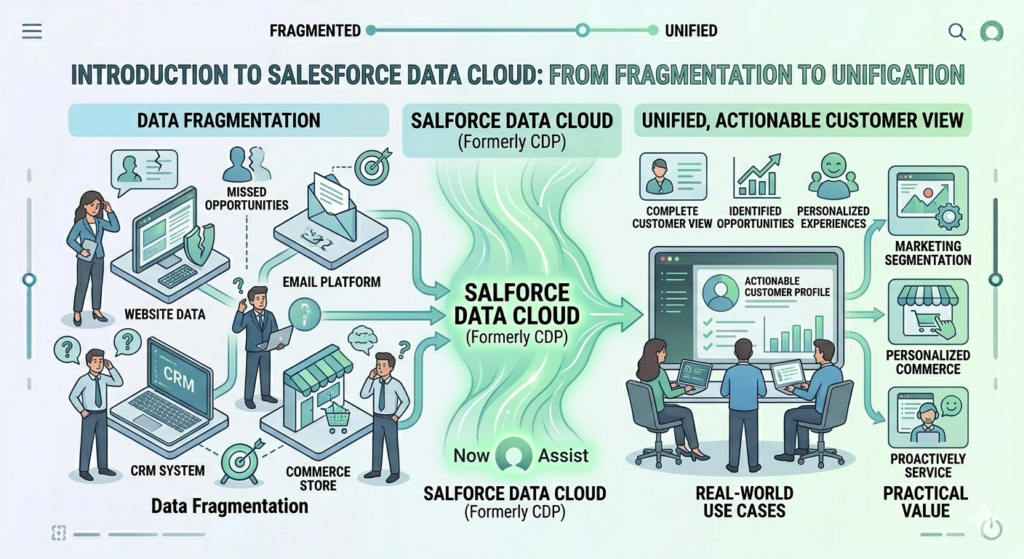
Enter Salesforce Data Cloud, formerly known as Customer Data Platform (CDP). This technology promises to unify all your customer data into a single, actionable view. But what does that actually mean? And why should you care?
In this comprehensive guide, we’ll break down everything you need to know about Salesforce Data Cloud. Whether you’re a marketing manager, IT professional, or business owner, you’ll learn what this platform does, how it works, and whether it’s the right solution for your organization.
By the end of this post, you’ll understand the Salesforce CDP inside and out, including real-world data cloud use cases that demonstrate its practical value.
What Is Salesforce Data Cloud?
The Basic Definition
Salesforce Data Cloud is a real-time customer data platform that collects, unifies, and activates customer data from multiple sources. Think of it as a central hub that pulls information from every touchpoint where your customers interact with your business—websites, mobile apps, email campaigns, customer service interactions, point-of-sale systems, and more.
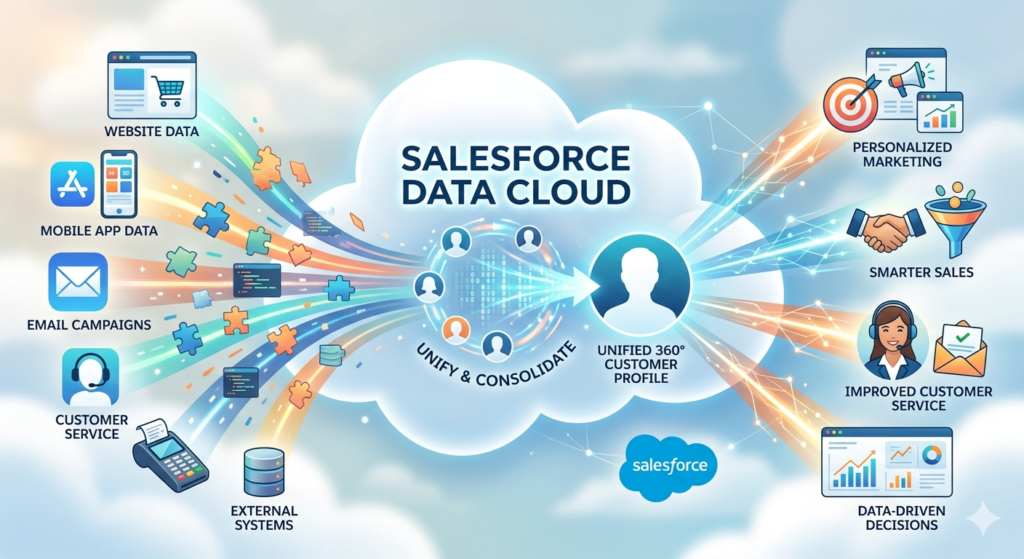
The platform creates unified customer profiles by connecting data that would otherwise remain siloed in separate systems. This means you can see a complete picture of each customer: their purchase history, browsing behavior, support tickets, email engagement, and any other interaction they’ve had with your brand.
Breaking Down “Salesforce Data Cloud Explained”
When we say “Salesforce Data Cloud explained” in simple terms, here’s what you need to know:
Data Collection: The platform automatically ingests data from various sources—both Salesforce products and external systems.
Data Unification: It matches and merges customer records from different sources into single, comprehensive profiles using identity resolution.
Real-Time Processing: Unlike traditional data warehouses that update nightly or weekly, Data Cloud processes information in real-time, giving you up-to-the-minute customer insights.
Data Activation: You can immediately use these unified profiles to personalize marketing campaigns, improve customer service, and drive business decisions across all Salesforce applications and external platforms.
The Evolution: From Salesforce CDP to Data Cloud
Originally launched as “Salesforce CDP,” the platform was rebranded to “Data Cloud” in 2022. This name change reflected an expansion beyond traditional CDP capabilities. While a customer data platform Salesforce built focused primarily on marketing use cases, Data Cloud serves broader business needs across sales, service, commerce, and analytics.
The rebranding also emphasized the platform’s ability to handle more than just customer data—it can manage product data, operational data, and virtually any business information you need to unify.
Why Is a Customer Data Platform Needed?
The Data Fragmentation Problem
Modern businesses operate in a complex digital ecosystem. A typical company might use:
- A CRM system (like Salesforce Sales Cloud)
- Marketing automation tools (like Marketing Cloud or Pardot)
- E-commerce platforms (Shopify, Magento, Commerce Cloud)
- Customer service systems (Service Cloud, Zendesk)
- Web analytics (Google Analytics)
- Mobile apps with their own databases
- Loyalty programs
- Point-of-sale systems for retail
- Third-party data providers
Each system maintains its own database with customer information. The problem? These systems don’t naturally talk to each other.
Real-World Example of Data Fragmentation
Let’s say Sarah visits your website, browses several products, and abandons her cart. Later that week, she calls customer service with a question. The next day, she receives a marketing email and makes a purchase in your physical store.
Without a CDP, here’s what happens:
- Your website analytics shows an anonymous visitor who abandoned a cart
- Your customer service system records a phone call but has no visibility into her browsing history
- Your marketing platform knows she opened an email but doesn’t connect it to the phone call
- Your point-of-sale system logs a transaction under a different customer ID
Your marketing team sees Sarah as four different people. They have no idea she called customer service before purchasing, so they can’t identify which touchpoints actually influenced her decision. They might even send her cart abandonment emails after she’s already bought the product in-store.
The Cost of Disconnected Data
This fragmentation creates several business problems:
Wasted Marketing Spend: You might advertise products to customers who already purchased them or send redundant messages across channels.
Poor Customer Experience: Customers get frustrated when they have to repeat information. If Sarah told customer service which product she was interested in, why is she receiving generic promotional emails?
Incomplete Analytics: You can’t accurately measure customer lifetime value, true conversion rates, or cross-channel attribution when data is scattered.
Slow Decision-Making: Creating reports requires manually extracting data from multiple systems, combining spreadsheets, and reconciling discrepancies—a process that takes days or weeks.
Missed Personalization Opportunities: Without a complete view, you can’t deliver the personalized experiences customers expect.
Why Traditional Solutions Fall Short
Some organizations try to solve this problem with:
Data Warehouses: These collect data from various sources but typically don’t update in real-time. By the time data reaches the warehouse, processes through ETL pipelines, and appears in reports, it’s hours or days old—too slow for real-time personalization.
Manual Integration: IT teams build custom integrations between systems. This approach is expensive, time-consuming, and breaks whenever any system updates its API.
CRM Alone: While Salesforce CRM is powerful, it wasn’t designed to ingest streaming data from websites, mobile apps, and IoT devices, or to handle the massive data volumes that modern businesses generate.
This is exactly why a customer data platform Salesforce developed became necessary—to solve problems that traditional technology couldn’t address.
How Salesforce Data Cloud Works: A Step-by-Step Breakdown
Understanding how Data Cloud operates helps clarify its value. Let’s walk through the process from data collection to activation.
Step 1: Data Ingestion
Data Cloud connects to your various data sources through multiple methods:
Native Salesforce Connections: If you use Sales Cloud, Service Cloud, Marketing Cloud, or Commerce Cloud, Data Cloud integrates automatically without custom development.
Pre-Built Connectors: The platform offers ready-made connectors for popular systems like Google Analytics, Amazon S3, Azure, Snowflake, and many marketing automation platforms.
API Integration: For custom applications or less common systems, you can push data via APIs.
File Uploads: For historical data or systems without APIs, you can upload CSV or JSON files.
The platform supports both batch data (uploaded in chunks, like nightly feeds) and streaming data (flowing continuously in real-time, like website clickstreams).
Step 2: Data Modeling
Once data enters the platform, it needs structure. Data Cloud uses a standardized data model based on common business objects:
- Individual: A person (prospect, customer, contact)
- Engagement: An interaction (email open, website visit, purchase)
- Product: Items or services you offer
- Order: Transaction details
You map your incoming data to these standard objects. For example, when importing data from your e-commerce platform, you’d map “CustomerID” to the “Individual” object and “PurchaseDate” to the “Order” object.
This standardization is crucial. It allows the system to understand that “email_address” in your marketing platform and “EmailAddr” in your CRM refer to the same thing.
Step 3: Identity Resolution
Here’s where the magic happens. Data Cloud identifies which records across different systems refer to the same person, then unifies them into a single customer profile.
How It Works:
The platform uses matching rules you configure. Common identifiers include:
- Email addresses
- Phone numbers
- Customer IDs
- Loyalty program numbers
- Cookie IDs and device identifiers
- Postal addresses
Let’s return to Sarah’s example. Data Cloud might find:
- Website session with email sarah.jones@email.com
- CRM contact record with phone number (555) 123-4567
- Service Cloud case with both the same email and phone number
- E-commerce transaction with email sarah.jones@email.com
- Point-of-sale transaction with loyalty card #12345
The platform recognizes these all represent the same person (because the email and phone number match) and creates a unified profile for Sarah that includes information from all five sources.
Fuzzy Matching: Data Cloud can also identify matches even with slight variations—”Sarah Jones” and “S. Jones” or “sarah.jones@email.com” and “sarahjones@email.com“—using sophisticated matching algorithms.
Step 4: Profile Unification and Enrichment
After identity resolution, Data Cloud creates what’s called a “Unified Individual” profile. This profile contains:
- Demographic information (name, location, age)
- Contact details (email, phone, addresses)
- Behavioral data (website visits, product views, content downloads)
- Transactional data (purchases, returns, order values)
- Service interactions (support tickets, chat transcripts)
- Engagement metrics (email opens, ad clicks)
The platform also calculates metrics like:
- Customer lifetime value
- Average order value
- Days since last purchase
- Engagement score
- Predicted churn risk
Sarah’s unified profile might show she’s a high-value customer (purchased $3,000 in the last year), prefers shopping in-store but researches online first, responds well to email promotions, and is interested in sustainable products.
Step 5: Segmentation
With unified profiles created, you can now segment customers based on virtually any criteria:
- Demographic segments: “Women ages 25-34 in California”
- Behavioral segments: “Visited website 3+ times in the last week but didn’t purchase”
- Transactional segments: “Customers who spent over $500 in the last quarter”
- Predictive segments: “High likelihood to churn in the next 30 days”
- Combined segments: “VIP customers interested in Product Category X who haven’t received an email in 2 weeks”
These segments update in real-time as customer behavior changes. If Sarah makes a purchase that moves her into the “VIP” tier, she instantly joins that segment.
Step 6: Data Activation
This is where Data Cloud delivers ROI. You can activate your unified data across multiple channels:
Marketing Campaigns: Push segments to Marketing Cloud, Google Ads, Facebook, or other platforms for personalized campaigns.
Sales Outreach: Enrich Sales Cloud with behavioral data so sales reps see which products prospects viewed before calling.
Customer Service: When Sarah calls support, the agent sees her complete history—recent purchases, open orders, previous issues—enabling faster, more personalized service.
Website Personalization: Display product recommendations based on Sarah’s purchase history and browsing behavior.
Analytics and BI Tools: Export data to Tableau, Einstein Analytics, or other platforms for deeper analysis.
Step 7: Continuous Learning
As new data flows in, Data Cloud continuously updates profiles, recalculates segments, and refines its matching algorithms. This creates a feedback loop where the system becomes more accurate over time.
Key Features of Salesforce Data Cloud
Real-Time Data Processing
Unlike batch-processing systems that update overnight, Data Cloud streams and processes data in milliseconds. When a customer completes an action—clicks an email, makes a purchase, abandons a cart—that information becomes available immediately for personalization and decisioning.
Practical Impact: If someone abandons a cart at 2 PM, you can trigger a personalized SMS or push notification within minutes, while their interest is still high.
Data Harmonization
The platform doesn’t just collect data; it standardizes it. Whether a date comes in as “MM/DD/YYYY” from one system and “DD-MM-YYYY” from another, Data Cloud normalizes it into a consistent format.
This extends to more complex harmonization:
- Converting currencies for global businesses
- Standardizing product SKUs across systems
- Reconciling different naming conventions (Customer vs. Contact vs. Individual)
Identity Resolution with Privacy Controls
Modern identity resolution respects privacy regulations like GDPR and CCPA. Data Cloud includes:
- Consent management tracking
- Right-to-be-forgotten compliance tools
- Data retention policies
- Role-based access controls
You can configure the system to only match customers who’ve provided consent for data linking, ensuring compliance while still benefiting from unification.
Calculated Insights
Beyond storing data, Data Cloud calculates valuable metrics:
- Customer Lifetime Value: Predicted total value of each customer
- Engagement Scores: How actively customers interact with your brand
- Propensity Models: Likelihood to purchase, churn, or upgrade
- RFM Scores: Recency, Frequency, and Monetary value for segmentation
These calculated insights appear in unified profiles alongside raw data.
Einstein AI Integration
Since Data Cloud sits within the Salesforce ecosystem, it leverages Einstein AI for:
- Predictive analytics (which customers are likely to churn?)
- Recommendation engines (which products should we show Sarah?)
- Next-best-action suggestions (what’s the optimal time to reach out?)
- Automated segmentation (identify emerging customer patterns)
Flexible Activation Options
You can activate data in numerous ways:
- Push to Marketing Cloud: Create personalized email, SMS, and mobile app campaigns
- Sync to Sales Cloud: Enrich account and contact records with behavioral data
- Export to Advertising Platforms: Build lookalike audiences on Facebook, Google, LinkedIn
- API Access: Feed data to custom applications or external systems
- Tableau Integration: Build sophisticated analytics dashboards
Data Security and Governance
Enterprise-grade features include:
- Field-level encryption
- Audit trails showing who accessed what data when
- Data masking for sensitive information
- Compliance certifications (SOC 2, ISO 27001, HIPAA when configured properly)
Data Cloud Use Cases: Real-World Applications
Let’s explore specific data cloud use cases that demonstrate practical business value.
Use Case 1: Omnichannel Retail Personalization
The Scenario: A fashion retailer operates both e-commerce and physical stores. They want to create seamless experiences across channels.
The Implementation:
Data Cloud unifies:
- Website browsing behavior
- Mobile app interactions
- Email engagement
- Purchase history (online and in-store)
- Loyalty program data
- Customer service interactions
The Outcome:
When Jennifer browses winter coats on the website but doesn’t purchase, then visits a physical store, the sales associate’s tablet shows her browsing history. They can say, “I see you were looking at winter coats online—let me show you those styles.”
If Jennifer makes a purchase in-store, she doesn’t receive cart abandonment emails for the coat she already bought. Instead, she receives a personalized email suggesting scarves and boots that complement her purchase.
Business Impact: 35% increase in cross-sell revenue, 28% improvement in customer satisfaction scores.
Use Case 2: Banking Customer Retention
The Scenario: A bank notices customers closing accounts after major life events. They want to predict and prevent churn.
The Implementation:
Data Cloud consolidates:
- Transaction history from core banking systems
- ATM and branch visit data
- Mobile app usage patterns
- Customer service call transcripts
- Life event indicators (address changes, large deposits/withdrawals)
- External credit data
The Outcome:
When Data Cloud detects patterns indicating potential churn—decreased transaction frequency, competitor bank searches on the website, increased customer service calls—it triggers:
- An alert to the relationship manager
- A personalized offer (better interest rate, fee waiver, or new service)
- Proactive outreach via the customer’s preferred channel
Business Impact: 22% reduction in churn among targeted customers, $4.2M in preserved customer lifetime value.
Use Case 3: Healthcare Patient Engagement
The Scenario: A healthcare system wants to improve patient adherence to treatment plans and preventive care.
The Implementation:
Data Cloud integrates:
- Electronic health records (EHR)
- Patient portal activity
- Appointment scheduling system
- Prescription pickup data from pharmacy partners
- Wearable device data (with consent)
- Patient communication preferences
The Outcome:
When a diabetes patient misses a prescription refill, Data Cloud identifies the gap and triggers:
- An automated text reminder (if that’s their preferred communication method)
- A portal message with easy refill options
- A flag for their care team if the gap extends beyond 7 days
For preventive care, patients receive personalized reminders for mammograms, colonoscopies, or vaccinations based on their medical history and risk factors.
Business Impact: 40% improvement in medication adherence, 31% increase in preventive screening completion.
Use Case 4: Media and Entertainment Content Personalization
The Scenario: A streaming service wants to reduce churn and increase viewing time through better content recommendations.
The Implementation:
Data Cloud combines:
- Viewing history across devices
- Search queries
- Watchlist additions
- Completion rates (did they finish the show?)
- Pause/rewind behavior
- Social media engagement with content
- Subscription tier and payment history
The Outcome:
Instead of generic recommendations, each subscriber sees highly personalized content based on:
- Genres they consistently finish (vs. start but abandon)
- Viewing times and patterns (weekend binge-watcher vs. weeknight casual viewer)
- Similar viewers’ preferences (collaborative filtering enhanced with unified data)
When subscription renewal approaches, at-risk customers (those showing decreased viewing) receive personalized emails highlighting new releases in their favorite genres.
Business Impact: 18% decrease in churn, 25% increase in average daily viewing time.
Use Case 5: B2B Account-Based Marketing
The Scenario: A software company wants to identify high-value accounts and coordinate sales and marketing efforts.
The Implementation:
Data Cloud unifies:
- Website visitor tracking at the company level
- Content download and webinar attendance
- Sales interaction history
- Product usage data (for existing customers)
- Third-party firmographic and intent data
- Trade show and event participation
The Outcome:
Data Cloud identifies when multiple people from Target Company X are:
- Visiting pricing pages
- Downloading whitepapers about a specific product
- Attending webinars
- Researching competitor solutions
This signals high buying intent. The platform automatically:
- Assigns a lead score to the account
- Notifies the account executive
- Triggers a coordinated campaign across email, LinkedIn ads, and direct mail
- Enriches the sales record with behavioral insights
When the account executive calls, they know exactly which products the company is researching and which content resonated.
Business Impact: 44% increase in qualified pipeline, 3.2X ROI on marketing spend.
Use Case 6: Travel and Hospitality Loyalty Optimization
The Scenario: A hotel chain wants to maximize loyalty program effectiveness and drive repeat bookings.
The Implementation:
Data Cloud integrates:
- Booking history across all properties
- Website browsing and search behavior
- Email and SMS engagement
- On-property spending (restaurants, spa, room service)
- Guest satisfaction surveys
- Customer service interactions
- Partner data (rental cars, flights, experiences)
The Outcome:
When a guest books a trip to Miami, Data Cloud:
- Recognizes this is their third visit to Florida properties
- Identifies they typically book spa services during beach vacations
- Knows they’ve recently browsed fine dining options
- Sees they’re a high-value loyalty member
Before arrival, the guest receives personalized offers:
- 20% off spa services (based on past behavior)
- Restaurant recommendations matching their preferences
- An upgrade offer to an ocean-view room
After checkout, instead of a generic survey, they receive questions about specific services they used, showing the brand pays attention.
Business Impact: 56% increase in ancillary revenue, 33% boost in loyalty program engagement.
Benefits of Implementing Salesforce Data Cloud
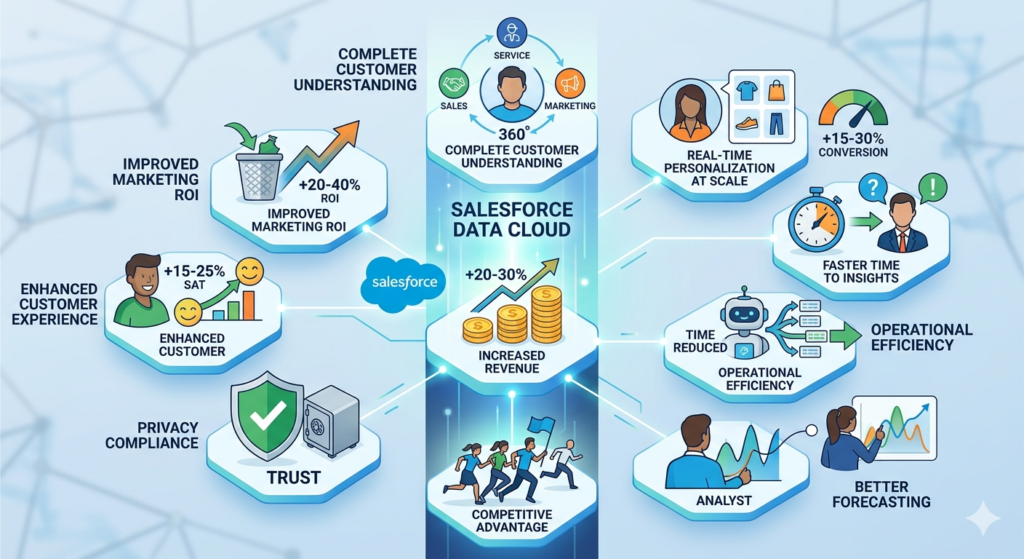
1. Complete Customer Understanding
The most fundamental benefit is seeing the full picture of each customer. Instead of fragmentary views across different departments, everyone in your organization accesses the same comprehensive profile.
Tangible Value: Marketing knows what sales promised. Service knows what customers purchased. Sales knows which marketing content influenced the deal.
2. Real-Time Personalization at Scale
Data Cloud enables personalization that feels human, even with millions of customers. Every interaction can reflect the customer’s unique history and preferences.
Tangible Value: E-commerce sites report 15-30% increases in conversion rates when implementing real-time personalization based on unified customer data.
3. Improved Marketing ROI
Stop wasting budget on irrelevant messages. Unified data means:
- No more cart abandonment emails to customers who already purchased
- Better audience targeting reduces ad spend waste
- Higher engagement rates when messages are relevant
- Accurate attribution across channels
Tangible Value: Companies typically see 20-40% improvement in marketing ROI within six months of implementation.
4. Faster Time to Insights
What previously took weeks of data extraction, combination, and analysis now happens in hours or minutes. Business users can create segments and analyze trends without waiting for IT or data science teams.
Tangible Value: Reduced time from “question asked” to “decision made” accelerates competitive response and opportunity capture.
5. Enhanced Customer Experience
When customers don’t have to repeat information or receive irrelevant communications, satisfaction increases. A unified view enables the seamless, effortless experiences customers expect.
Tangible Value: Organizations implementing CDPs report 15-25% improvements in customer satisfaction scores and Net Promoter Scores.
6. Increased Revenue
Better personalization, improved customer experiences, and coordinated sales and marketing efforts directly impact revenue:
- Higher conversion rates
- Increased average order values through better recommendations
- More cross-sell and upsell opportunities
- Reduced churn through proactive retention
Tangible Value: Forrester research shows companies implementing CDPs see average revenue increases of 20-30% attributed to improved personalization and customer engagement.
7. Operational Efficiency
Unified data reduces manual work:
- No more exporting data from multiple systems and combining spreadsheets
- Automated segment updates replace manual list management
- Pre-built integrations eliminate custom development
- Self-service capabilities reduce dependence on IT
Tangible Value: Marketing teams report 30-50% reduction in time spent on campaign setup and data management.
8. Privacy Compliance
Managing consent, honoring opt-outs, and implementing right-to-be-forgotten requests is easier with centralized customer data and built-in compliance tools.
Tangible Value: Reduced compliance risk and faster response to data subject access requests (from days to hours).
9. Better Forecasting and Planning
Unified historical data plus predictive analytics enable more accurate:
- Demand forecasting
- Inventory planning
- Revenue projections
- Churn predictions
Tangible Value: Improved forecast accuracy reduces both stockouts and excess inventory, optimizing working capital.
10. Competitive Advantage
Companies that leverage unified customer data can move faster, personalize better, and deliver superior experiences compared to competitors still working with fragmented data.
Tangible Value: First-mover advantage in your industry, increased market share, and stronger customer loyalty.
Challenges and Considerations
While Salesforce Data Cloud offers significant benefits, implementation isn’t without challenges. Understanding these upfront helps set realistic expectations and proper planning.
1. Implementation Complexity
The Challenge: Connecting multiple data sources, configuring identity resolution rules, and mapping data to the unified schema requires technical expertise and careful planning.
Reality Check: Initial implementation typically takes 3-6 months for mid-sized organizations, longer for enterprises with complex ecosystems.
Mitigation Strategy:
- Start with a focused use case rather than trying to unify everything at once
- Work with experienced Salesforce partners or consultants
- Invest in proper training for your team
- Document data flows and mapping decisions
2. Data Quality Issues
The Challenge: Data Cloud will unify your data—but if that data is inaccurate, incomplete, or inconsistent, you’ll have unified bad data.
Reality Check: “Garbage in, garbage out” applies. If your CRM has duplicate records, misspelled names, and outdated email addresses, those problems will carry over.
Mitigation Strategy:
- Audit data quality in source systems before implementation
- Implement data validation rules at entry points
- Establish data governance processes
- Use data quality tools to cleanse and enrich data
3. Identity Resolution Complexity
The Challenge: Matching customer records across systems is more art than science. Too loose, and you incorrectly merge different people. Too strict, and the same person appears as multiple profiles.
Reality Check: Perfect identity resolution is nearly impossible. You’ll need to balance accuracy with completeness and regularly review match rates.
Mitigation Strategy:
- Start with conservative matching rules, then gradually expand
- Monitor match rates and false positive/negative rates
- Use multiple identifiers (email + phone + address is better than email alone)
- Implement ongoing quality monitoring
4. Privacy and Compliance Concerns
The Challenge: Unifying customer data across systems raises privacy questions. Different systems may have different consent levels, and regulations like GDPR impose strict requirements.
Reality Check: You need legal review and clear policies about what data you collect, how you use it, and how you honor customer choices.
Mitigation Strategy:
- Involve legal/privacy teams from the start
- Implement consent management tracking
- Configure data retention policies
- Document your lawful basis for processing
- Build processes for data subject requests
5. Cost Considerations
The Challenge: Salesforce Data Cloud requires licensing fees, implementation costs, and ongoing maintenance resources.
Reality Check: For small businesses, the ROI calculation may be challenging. This platform makes most sense for organizations with:
- Significant customer data volume
- Multiple customer touchpoints
- Revenue dependent on personalization and retention
Typical Costs:
- Licensing: Contact units (typically bundled in quantities)
- Implementation: $50,000-$500,000+ depending on complexity
- Ongoing maintenance: Internal resources or retainer with partners
Mitigation Strategy:
- Build a clear business case with projected ROI
- Start with a pilot to prove value before full-scale rollout
- Factor in both hard costs (software, services) and soft costs (internal time)
6. Organizational Change Management
The Challenge: Unified data changes how teams work. Marketing, sales, and service need to adapt processes and collaborate differently.
Reality Check: Technology is often easier than people. Teams may resist changes to established workflows or fear losing control of “their” data.
Mitigation Strategy:
- Involve stakeholders from all departments early
- Communicate benefits clearly to each team
- Provide comprehensive training
- Identify champions within each department
- Celebrate early wins to build momentum
7. Integration Limitations
The Challenge: While Data Cloud offers many pre-built connectors, connecting to legacy systems, custom applications, or niche platforms may require custom development.
Reality Check: Not everything integrates easily. Some systems lack APIs, others have restrictive data access, and some may require middleware.
Mitigation Strategy:
- Audit your technology stack early to identify integration challenges
- Prioritize high-value data sources
- Budget for custom integration work where needed
- Consider whether some systems should be replaced rather than integrated
8. Performance and Scalability
The Challenge: Processing billions of events in real-time requires significant infrastructure. As data volume grows, performance can suffer without proper architecture.
Reality Check: Salesforce manages infrastructure, but you need to design efficient data flows and avoid unnecessary data duplication.
Mitigation Strategy:
- Work with Salesforce architects to design scalable data models
- Implement data retention policies to avoid storing unnecessary historical data
- Monitor performance metrics and optimize as needed
- Use calculated insights rather than reprocessing raw data repeatedly
9. Measuring Success
The Challenge: Proving ROI from unified customer data can be difficult because it impacts multiple departments and metrics.
Reality Check: The benefits are real but not always directly attributable. Did revenue increase because of Data Cloud or because you hired better salespeople?
Mitigation Strategy:
- Establish baseline metrics before implementation
- Define specific KPIs aligned to business objectives
- Conduct A/B tests where possible (personalized vs. non-personalized campaigns)
- Track leading indicators (data quality, segment accuracy) and lagging indicators (revenue, retention)
10. Keeping Pace with Platform Evolution
The Challenge: Salesforce rapidly releases new features and updates. Staying current requires ongoing learning and adaptation.
Reality Check: What you implement today will have new capabilities in six months. You need resources to stay informed and evolve your use of the platform.
Mitigation Strategy:
- Assign someone to monitor Salesforce releases and updates
- Participate in the Salesforce community and user groups
- Attend Dreamforce or watch release readiness sessions
- Schedule regular platform reviews to assess new features
The Future Relevance of Salesforce Data Cloud
The Cookieless Future
Third-party cookies—long the foundation of digital advertising—are being phased out. Safari and Firefox already block them; Chrome will follow. This makes first-party data (data you collect directly from customers) more valuable than ever.
Data Cloud’s Role: By unifying your first-party data across all touchpoints, Data Cloud helps you build rich customer profiles without relying on third-party cookies. You can still personalize experiences and measure marketing effectiveness using your own data.
Future Impact: Companies with robust first-party data strategies will have significant competitive advantages. Those still dependent on third-party data will struggle.
AI and Machine Learning Advancement
As AI capabilities expand, the quality of training data becomes critical. AI models are only as good as the data they learn from.
Data Cloud’s Role: Unified, clean customer data provides the foundation for effective AI:
- More accurate predictive models
- Better personalization engines
- More sophisticated next-best-action recommendations
- Advanced churn prediction and lifetime value calculations
Future Impact: The gap between companies with unified data (feeding sophisticated AI) and those with fragmented data (limited AI effectiveness) will widen significantly.
Composable Customer Data Platforms
The future of enterprise technology is “composable”—assembling best-of-breed components rather than relying on monolithic suites.
Data Cloud’s Role: Salesforce is positioning Data Cloud as the data foundation that can activate across any channel or platform, whether Salesforce-owned or third-party. This flexibility matters as businesses adopt diverse technology stacks.
Future Impact: Data Cloud becomes the “system of truth” for customer data, even in heterogeneous technology environments.
Real-Time Everything
Customer expectations continue shifting toward immediate, contextual experiences. Batch processing and overnight data updates can’t meet these expectations.
Data Cloud’s Role: Real-time data processing enables instant personalization, immediate response to customer actions, and up-to-the-second decision-making.
Future Impact: Companies that can act on customer signals in milliseconds will outperform those working with stale data.
Privacy-First Business Models
Regulations like GDPR, CCPA, and emerging global privacy laws require transparent, consent-based data practices.
Data Cloud’s Role: Built-in consent management, privacy controls, and compliance features make it easier to respect customer preferences while still delivering personalized experiences.
Future Impact: Brands that build trust through transparent data practices will earn customer loyalty. Those that mishandle data will face regulatory penalties and customer defection.
Customer Experience as Competitive Differentiator
As products and prices commoditize, customer experience increasingly determines competitive success.
Data Cloud’s Role: Seamless, personalized experiences across every touchpoint require unified customer data. You can’t deliver exceptional experiences with fragmented information.
Future Impact: In every industry, customer experience leaders will be data unification leaders.
Industry-Specific Applications
Expect to see more industry-tailored versions of Data Cloud with pre-built data models, use cases, and integrations for:
- Healthcare (patient engagement, care coordination)
- Financial services (wealth management, fraud detection)
- Retail (inventory optimization, store operations)
- Manufacturing (service excellence, predictive maintenance)
Future Impact: Faster time-to-value for industry-specific implementations with specialized capabilities.
Best Practices for Success
Based on successful implementations, here are key practices to follow:
Start with Clear Business Objectives
Don’t implement Data Cloud because it’s trendy. Define specific business problems you’re solving:
- Reduce cart abandonment by X%
- Increase customer retention by Y%
- Improve marketing ROI by Z%
Begin with a Pilot
Choose one high-value use case:
- A specific customer segment
- A particular campaign type
- One journey or workflow
Prove value, learn lessons, then expand.
Invest in Data Governance
Establish clear policies for:
- Who owns what data
- How data quality is maintained
- Privacy and consent management
- Access controls and security
Prioritize Data Sources
Not all data is equally valuable. Connect your most important sources first:
- Core transactional systems
- Primary customer touchpoints
- High-engagement channels
You can add less critical sources later.
Train Your Teams
Technology alone doesn’t deliver results. Ensure teams understand:
- How to access and interpret unified data
- How to create and manage segments
- How to activate data for their use cases
- Privacy and compliance requirements
Monitor and Optimize
Implementation isn’t a one-time project. Continuously:
- Review data quality metrics
- Assess identity resolution accuracy
- Measure business outcomes against objectives
- Refine segmentation and activation strategies
Celebrate Wins
Share success stories across the organization to build momentum and justify continued investment.
Conclusion
Salesforce Data Cloud represents a fundamental shift in how organizations manage and activate customer information. By unifying fragmented data from multiple systems into real-time, actionable customer profiles, it solves one of the most persistent challenges in modern business.
When we fully unpack “Salesforce Data Cloud explained,” we’re talking about more than just technology—we’re discussing a strategic approach to customer data that enables personalization at scale, improves operational efficiency, and creates competitive advantage.
The Salesforce CDP, now rebranded as Data Cloud, has evolved beyond traditional marketing use cases to serve sales, service, commerce, and analytics needs across your entire organization. It’s become the customer data platform Salesforce customers—and increasingly, organizations across all industries—rely on to deliver exceptional customer experiences.
The data cloud use cases we’ve explored demonstrate tangible business value across industries: retailers increasing cross-sell revenue, banks reducing churn, healthcare systems improving patient outcomes, and B2B companies accelerating pipeline growth. These aren’t theoretical benefits—they’re measurable results from organizations that have successfully implemented unified customer data strategies.
Of course, implementation comes with challenges: complexity, data quality issues, privacy concerns, and organizational change management. But these challenges are surmountable with proper planning, the right expertise, and realistic expectations.
Looking forward, the importance of unified customer data will only grow. The cookieless future, advancing AI capabilities, heightened privacy regulations, and rising customer experience expectations all point toward first-party data as a critical business asset. Companies that invest in unifying and activating their customer data now will be positioned for success in an increasingly data-driven business landscape.
Is Salesforce Data Cloud right for your organization? If you:
- Operate multiple customer touchpoints across digital and physical channels
- Struggle with fragmented customer data across disconnected systems
- Depend on personalization and customer experience for competitive differentiation
- Have sufficient data volume to justify the investment
- Are committed to first-party data strategies
Then Data Cloud deserves serious consideration.
The question isn’t whether unified customer data matters—it clearly does. The question is whether you’ll take the steps to unify your data before your competitors do.
Start by identifying your highest-value use case, building a business case with clear ROI projections, and assembling the right team. Whether you begin with a small pilot or a comprehensive implementation, the journey toward unified customer data starts with a single step.
The future belongs to organizations that truly know their customers—and that knowledge comes from unified, real-time, actionable data.
About RizeX Labs
At RizeX Labs, we specialize in delivering advanced Salesforce solutions, including Salesforce Data Cloud (formerly CDP), to help organizations unify, manage, and activate their data at scale.
Our expertise combines deep technical knowledge, real-world implementation experience, and industry best practices to help businesses break down data silos, build a 360-degree customer view, and drive smarter decision-making.
We empower organizations to move from disconnected data systems to a fully unified, real-time data ecosystem that fuels personalization, automation, and business growth.
Internal Links:
- Salesforce Admin course page
Salesforce Flows vs Apex: When Should You Use Code vs No-Code Automation? - Salesforce Nonprofit Cloud: Features, Use Cases, and Career Opportunities (2026 Guide)
- Salesforce Net Zero Cloud: What It Is and Why It’s the Next Green Career Niche (2026 Guide)
- Salesforce Slack Integration: How It Works and What Developers Need to Know
- Salesforce Named Credentials: What They Are and How to Use Them Safely
- Prompt Engineering for Salesforce Agentforce — Beginner’s Guide
External Links:
McKinsey Sales Growth Reports
Gartner Sales Automation Insights
