
Introduction: The Age of “Made for Me” Marketing
SFMC personalization Einstein is redefining how modern brands connect with their customers — and the difference is impossible to ignore.
Think about the last time a brand truly surprised you — not with a flashy ad, but with a message that felt like it was written just for you. Maybe it was a product recommendation that matched exactly what you’d been searching for, or an email that arrived at precisely the right moment with precisely the right offer. That feeling — the sense that a brand genuinely gets you — is no accident. It’s the result of intelligent personalization at scale.
In today’s hyper-competitive digital landscape, generic marketing messages are not just ineffective — they’re actively harmful to your brand. According to McKinsey, 71% of consumers expect companies to deliver personalized interactions, and 76% get frustrated when this doesn’t happen. Meanwhile, brands that excel at personalization generate 40% more revenue than their average competitors. The math is simple: personalize or lose.
But delivering true personalization across thousands — or millions — of customer touchpoints is a monumental challenge. That’s where SFMC personalization with Einstein becomes a game-changer. Paired with the power of Einstein AI, Salesforce Marketing Cloud transforms personalization from a manual, time-consuming guessing game into an intelligent, data-driven engine that works around the clock.
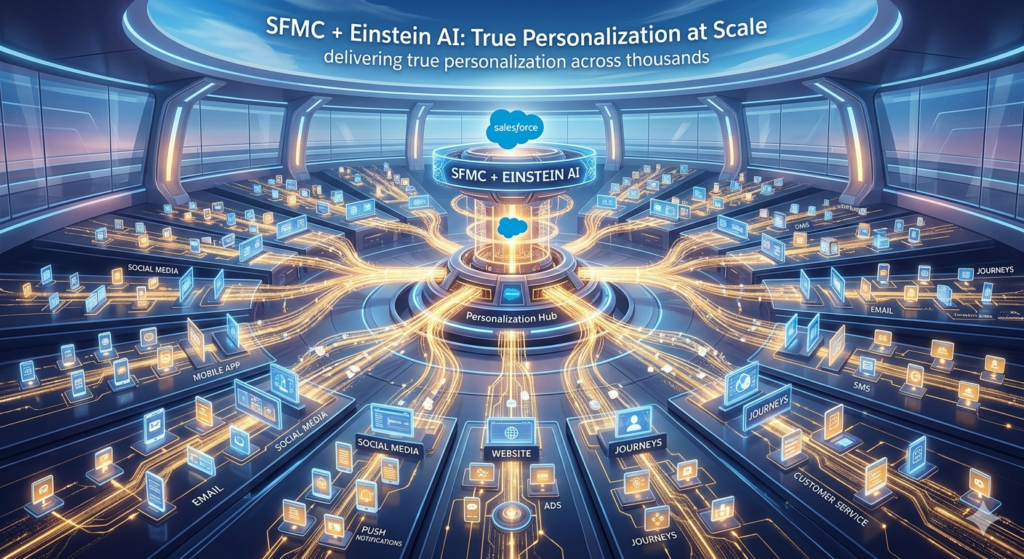
In this guide, RizeX Labs breaks down everything you need to know about SFMC personalization with Einstein — how it works, what it can do, and how your business can harness it to deliver experiences that convert, retain, and delight.
What Is SFMC Personalization with Einstein?
The Foundation: Salesforce Marketing Cloud
Salesforce Marketing Cloud is an enterprise-grade digital marketing platform that brings together email, mobile, social, web, advertising, and data management in a single ecosystem. It’s built for organizations that want to orchestrate complex, multi-channel customer journeys with precision and consistency.
But technology alone doesn’t create personalization. Data does. And the ability to act on that data intelligently is where Einstein enters the picture.
Einstein AI: The Brain Behind the Magic
Einstein is Salesforce’s suite of artificial intelligence capabilities embedded natively across the platform. In the context of Marketing Cloud, Einstein doesn’t just analyze data — it predicts, recommends, and optimizes in ways that would be impossible for human marketers working alone.
Here’s what makes SFMC Einstein personalization fundamentally different from traditional rule-based segmentation:
- Predictive Analytics: Einstein analyzes historical behavior, purchase patterns, and engagement data to predict future actions — like which customers are likely to churn, which products they’ll buy next, or which channel they prefer.
- Machine Learning at Scale: Instead of manually creating dozens of segments, Einstein continuously learns from millions of data points and improves its predictions over time without manual retraining.
- Behavioral Targeting: Einstein tracks what customers do in real time — emails opened, products browsed, links clicked — and uses those signals to trigger personalized responses automatically.
- Intelligent Recommendations: Based on collaborative filtering and behavioral data, Einstein suggests the most relevant products, content, or offers for each individual customer.
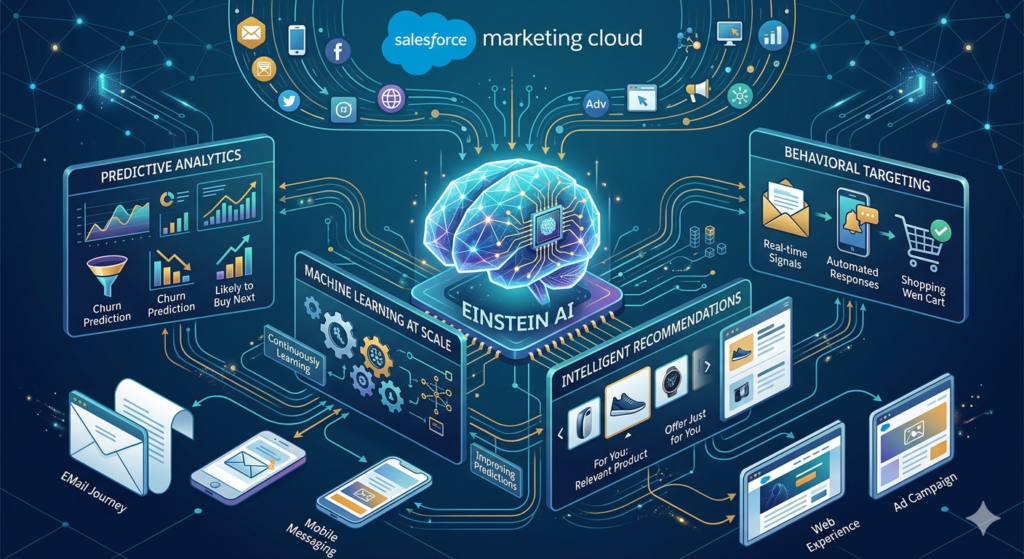
Think of Einstein as a hyper-intelligent marketing analyst who never sleeps, processes data instantly, and personalizes every single customer interaction without burning out. When you integrate Einstein with Marketing Cloud’s content capabilities, you unlock something genuinely powerful.
Understanding Marketing Cloud Dynamic Content
What Is Dynamic Content in SFMC?
Marketing Cloud dynamic content refers to the ability to serve different content blocks to different recipients within a single email, landing page, or message — all based on predefined rules or live data attributes.
Instead of building ten separate email campaigns for ten different audience segments, dynamic content allows you to build one campaign with intelligent content slots that automatically populate with the right message, image, offer, or call-to-action based on who’s receiving it.
How Dynamic Content Adapts to Your Audience
Dynamic content in SFMC adapts based on a wide range of data dimensions:
Demographic Data:
- Age, gender, location, language
- Job title, industry, company size (especially powerful in B2B contexts)
Behavioral Data:
- Purchase history and frequency
- Email open and click history
- Website browsing behavior
- App usage patterns
Preference Data:
- Product category interests
- Communication channel preferences
- Content format preferences (video vs. text, long-form vs. short)
Lifecycle Stage:
- New subscriber vs. loyal customer vs. at-risk churner
- First-time buyer vs. repeat purchaser
Contextual Data:
- Device type (mobile vs. desktop)
- Time of day or day of week
- Weather or local events (yes, this is possible!)
Dynamic Content in Action: A Simple Example
Imagine a fashion retailer sending a seasonal campaign. Without dynamic content, they send one generic email to their entire list. With SFMC dynamic content, the same email template might show:
- Women in New York aged 25–35: A hero image featuring winter coats, with a local store pickup option
- Men in Miami aged 40–55: A banner highlighting lightweight blazers, with a free shipping offer
- Loyal VIP customers (regardless of location): An exclusive early-access offer with a personalized greeting using their first name
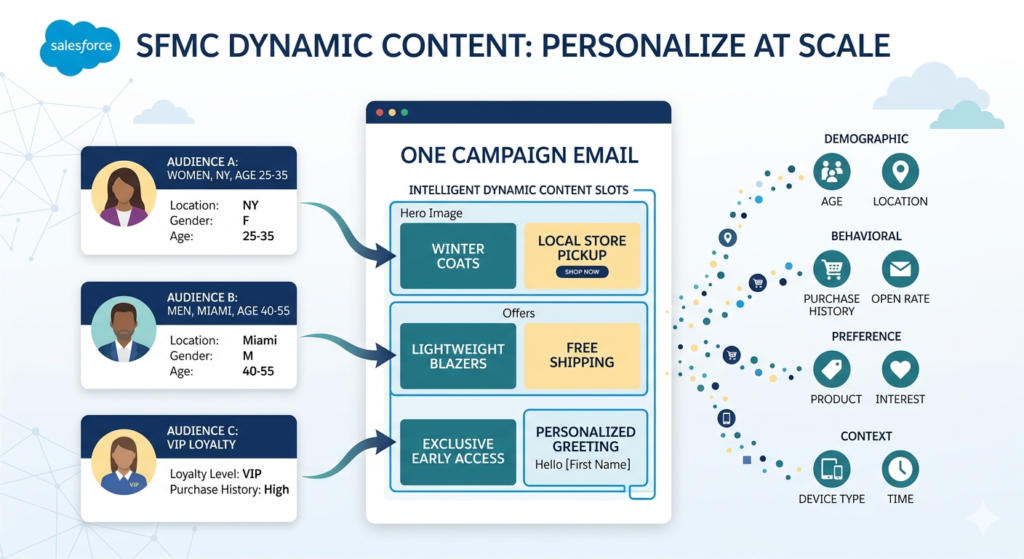
Same email. Three completely different experiences. That’s the power of dynamic content — and it gets even more powerful when Einstein is driving the decisions.
How Einstein + Dynamic Content Work Together
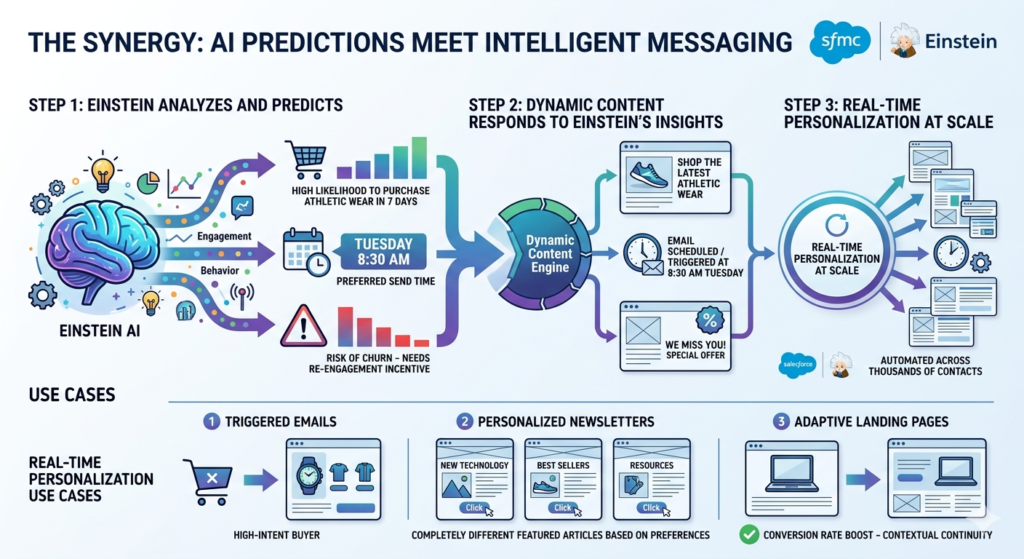
The Synergy: AI Predictions Meet Intelligent Messaging
If dynamic content is the vehicle and data is the fuel, then Einstein is the GPS — constantly calculating the best route for each individual customer based on real-time conditions.
Here’s how the combination works in practice:
Step 1: Einstein Analyzes and Predicts
Einstein processes behavioral signals, engagement history, and predictive scores for each contact in your database. It determines things like:
- This customer has a high likelihood of purchasing athletic wear in the next 7 days
- This customer’s preferred send time is Tuesday at 8:30 AM
- This customer is at risk of churn and needs a re-engagement incentive
Step 2: Dynamic Content Responds to Einstein’s Insights
Using those predictions as rules or data extensions, dynamic content blocks in your email or web page automatically populate with:
- The athletic wear product recommendations Einstein identified as most relevant
- The email is scheduled or triggered at 8:30 AM on Tuesday for that specific contact
- A special “We miss you” offer with a personalized discount appears for at-risk customers
Step 3: Real-Time Personalization at Scale
Because both systems operate within the Marketing Cloud ecosystem and share the same data layer, this entire process happens automatically — across thousands or millions of contacts simultaneously.
Real-Time Personalization Use Cases
The combination of Einstein AI and dynamic content enables several real-time personalization scenarios:
- Triggered Emails: A customer browses a product but doesn’t purchase. Einstein scores them as a high-intent buyer. An automated email triggers within an hour, featuring dynamic content showing the exact product they viewed, along with Einstein-recommended similar items.
- Personalized Newsletters: Monthly newsletters that look the same on the surface but contain completely different featured articles, product highlights, and CTAs based on each recipient’s behavior and preferences.
- Adaptive Landing Pages: When a customer clicks through from an email, the landing page they arrive on dynamically mirrors the products and messaging shown in the email — maintaining contextual continuity and boosting conversion rates.
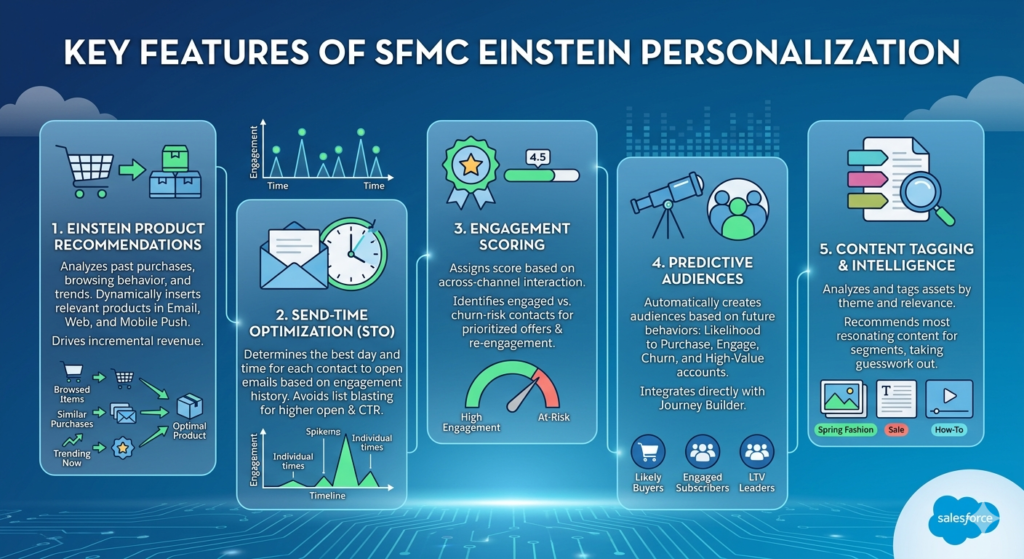
Key Features of SFMC Einstein Personalization
Let’s get specific. Here are the core Einstein capabilities that power SFMC Einstein personalization:
1. Einstein Product Recommendations
Einstein’s recommendation engine analyzes:
- Items a customer has previously purchased or browsed
- Purchase patterns of customers with similar profiles
- Trending products in specific categories
It then surfaces the most relevant product recommendations for each individual — which can be dynamically inserted into emails, web pages, or mobile push notifications. For eCommerce brands, this feature alone can drive significant incremental revenue.
2. Send-Time Optimization (STO)
One of Einstein’s most immediately actionable features, Send-Time Optimization analyzes each contact’s historical email engagement patterns to determine the specific day and time they are most likely to open and engage with a message.
Instead of blasting your entire list at 9 AM on a Tuesday (because that worked once six months ago), STO ensures each person receives your email at their personal optimal time — automatically. The result: higher open rates, better click-through rates, and more conversions.
3. Engagement Scoring
Einstein assigns each contact an engagement score based on how actively they interact with your brand across channels. This score can be used to:
- Identify your most engaged customers for priority messaging or exclusive offers
- Flag disengaged contacts before they fully churn
- Tailor messaging tone and frequency — highly engaged customers get more frequent, content-rich emails; at-risk customers receive targeted re-engagement campaigns
4. Predictive Audiences
Predictive Audiences is one of the most strategic features in the Einstein toolkit. Instead of manually defining audience segments, Einstein automatically creates audiences based on predicted behaviors, including:
- Likelihood to Engage: Who’s most likely to open, click, or convert from your next campaign
- Likelihood to Purchase: Which contacts are primed to buy in the near term
- Likelihood to Churn: Which customers are showing declining engagement signals
- High-Value Customer Prediction: Which new or mid-tier customers are likely to become high-LTV accounts
These predictive audiences integrate directly with Journey Builder and email campaigns, allowing you to route different customers through different journeys automatically — without building complex manual logic trees.
5. Content Tagging and Intelligence
Einstein can analyze your content library, tag assets by theme and relevance, and recommend which content pieces are most likely to resonate with specific audience segments — taking the guesswork out of content curation.
Real-World Use Cases and Examples
Use Case 1: Email Personalization for a Retail Brand
Scenario: A mid-sized retail brand with 500,000 email subscribers wants to increase its email revenue without doubling its team.
The Approach:
- Einstein Engagement Scoring segments the list into highly engaged, moderately engaged, and at-risk cohorts
- Einstein Product Recommendations populate dynamic content blocks in a weekly promotional email with individualized product suggestions
- Send-Time Optimization delivers each email at each subscriber’s peak engagement window
The Result: The brand sees a 28% lift in email click-through rates and a 19% increase in revenue attributed to email — all from the same number of sends, with no additional creative resources.
Use Case 2: Website Personalization for a SaaS Company
Scenario: A B2B SaaS company wants to improve homepage conversion rates for visitors at different stages of the buying journey.
The Approach:
- SFMC integrates with the company’s website to track visitor behavior and match it to known CRM contacts
- For first-time visitors, dynamic content shows a high-level value proposition with a free trial CTA
- For return visitors who’ve attended a webinar (tracked via Marketing Cloud), the page dynamically surfaces a case study relevant to their industry and a demo booking CTA
- For existing customers, the homepage shows product update announcements and upsell opportunities
The Result: Tailored web experiences reduce bounce rates and increase demo bookings by 35%.
Use Case 3: Journey Builder Integration for Customer Onboarding
Scenario: A financial services company wants to improve new customer onboarding completion rates.
The Approach:
- New customers enter an onboarding Journey in Marketing Cloud
- Einstein Engagement Scoring monitors how each customer engages with each step
- Customers who engage quickly receive advanced content and product education
- Customers showing low engagement are automatically branched to a simplified onboarding path with more supportive, human-touch messaging
- Dynamic content in each email adapts to the specific product the customer signed up for
The Result: Onboarding completion rates improve by 42%, and 90-day retention increases significantly.
Use Case 4: eCommerce Cart Abandonment with Einstein Intelligence
Scenario: An online retailer wants to recover abandoned carts more effectively.
The Approach:
- A customer adds items to their cart but doesn’t complete checkout
- Einstein scores them based on historical behavior — are they a frequent abandoner who converts with a small discount, or a first-time abandoner who just needs a gentle reminder?
- The triggered abandoned cart email uses dynamic content to show:
- The exact items left in the cart
- Einstein-powered complementary product recommendations
- A discount code only for those Einstein identifies as needing price incentive
- Send time optimized to each customer’s peak engagement window
The Result: Cart recovery rates increase while discount code redemption is limited to customers who genuinely need it — protecting margin.
Benefits for Businesses
When implemented effectively, SFMC personalization with Einstein delivers measurable impact across every key business metric:
Improved Customer Engagement
Relevant content gets opened, clicked, and acted upon. Einstein-powered personalization ensures every communication earns its place in the customer’s inbox or feed — reducing the “white noise” effect of generic mass marketing.
Higher Conversion Rates
When customers see products, offers, and messages that align with their actual needs and behaviors, the natural result is more conversions. Both dynamic content and Einstein recommendations directly contribute to this.
Enhanced Customer Experience
Personalization at this level signals to customers that your brand understands and values them as individuals — not just transaction sources. This builds the emotional loyalty that drives long-term retention and advocacy.
Data-Driven Decision Making
Einstein’s predictive analytics give marketing teams genuine intelligence — not just vanity metrics. Understanding which segments are likely to churn, which content drives purchases, and which send times maximize engagement transforms how teams allocate budget and plan campaigns.
Operational Efficiency
Paradoxically, delivering highly personalized experiences at scale reduces the manual workload on marketing teams. Once Einstein-powered journeys and dynamic content templates are configured, they run automatically — freeing your team to focus on strategy, creativity, and optimization.
Best Practices for SFMC Einstein Personalization
Getting the technology right is only half the battle. Here are the best practices that separate successful implementations from expensive experiments:
1. Prioritize Data Quality
Einstein is only as smart as the data you feed it. Garbage in, garbage out — this principle has never been more relevant. Before launching personalization initiatives:
- Audit your data: Identify gaps, inconsistencies, and outdated information in your contact records
- Standardize your data model: Ensure attributes are named and formatted consistently across systems
- Implement data governance: Establish clear rules for how data is collected, maintained, and retired
- Connect your data sources: Einstein works best when it has access to CRM data, web behavioral data, transactional data, and customer service interactions — not just email engagement data
2. Test and Optimize Continuously
Einstein improves over time, but your content strategy needs to keep pace. Build a structured testing framework:
- A/B test dynamic content variations to validate which content rules drive better outcomes
- Monitor Einstein recommendations regularly and compare them against your business logic and brand guidelines
- Set clear KPIs for each personalization initiative before launch, so you can objectively measure success
- Iterate quickly — personalization is a practice, not a project
3. Avoid Over-Personalization
There’s a fine line between “this brand gets me” and “this brand is watching me.” Crossing that line creates discomfort and damages trust.
Best practices to avoid the “creepy” factor:
- Don’t explicitly call out personal data in your messaging (“We noticed you were browsing hiking boots at 11 PM last Tuesday…”)
- Use behavioral data to inform relevance, not to demonstrate surveillance
- Give customers control over their preferences and communication frequency
- Be transparent about how you use data in your privacy communications
4. Align Content Strategy with AI Insights
Einstein can tell you who to target and when to reach them — but the quality of the content still matters enormously. Work to:
- Create a rich, varied content library that gives Einstein real options to recommend
- Ensure your content covers all stages of the customer lifecycle
- Brief your creative team on Einstein’s audience insights so content is developed with personalization in mind from the start
- Regularly refresh product and content recommendations to avoid stagnation
5. Start Simple, Scale Intelligently
Many organizations make the mistake of trying to implement full-scale personalization across every channel simultaneously. Instead:
- Start with one channel (email is typically the most immediate ROI driver)
- Implement one Einstein feature at a time (Send-Time Optimization is often the quickest win)
- Prove value to stakeholders with clear metrics before expanding scope
- Build internal capability and expertise progressively
Challenges and Considerations
Honesty matters — and RizeX Labs believes in giving you the full picture. Here are the real challenges you’ll face when implementing SFMC Einstein personalization:
Data Privacy and Compliance
With great personalization capability comes great responsibility. GDPR in Europe, CCPA in California, and similar regulations globally mean you must:
- Have clear consent for data collection and usage
- Provide opt-out mechanisms that are easy to find and use
- Know where your data is stored and how it’s processed
- Conduct regular privacy impact assessments for your personalization use cases
Einstein’s capabilities must always operate within the boundaries of your legal and ethical obligations. Work closely with your legal and compliance teams before implementation.
Implementation Complexity
SFMC is a powerful platform, but it’s not a plug-and-play solution. Implementing Einstein personalization effectively requires:
- Technical expertise in Marketing Cloud configuration and data architecture
- Integration work to connect Marketing Cloud with CRM, eCommerce, and analytics systems
- Clear cross-functional alignment between marketing, IT, and data teams
- Realistic timelines — sophisticated personalization doesn’t happen overnight
This is where working with an experienced SFMC implementation partner (like RizeX Labs) can dramatically reduce risk and accelerate time-to-value.
Learning Curve and Organizational Change
Einstein’s machine learning models need time and data volume to reach their full predictive accuracy. Organizations often underestimate:
- The time required to train models on sufficient behavioral data
- The cultural shift required for marketing teams to trust AI-driven recommendations over gut instinct
- The ongoing education needed to keep teams current as Einstein capabilities evolve with Salesforce releases
Building internal champions — marketers who understand Einstein’s logic and can translate it for leadership — is critical for long-term success.
Conclusion: The Future of Marketing Is Personal — And It’s Already Here
SFMC personalization with Einstein isn’t a distant vision of what marketing could become. It’s available today, and the brands investing in it now are building competitive advantages that will be increasingly difficult for laggards to close.
The combination of Einstein AI and Marketing Cloud dynamic content represents the most sophisticated personalization stack available to enterprise marketers — capable of delivering the right message, to the right person, through the right channel, at the right time, at a scale no human team could achieve manually.
But technology is never the whole answer. The brands that win with Einstein personalization are the ones that combine intelligent AI capabilities with clean data, strong content strategy, thoughtful testing, and a genuine commitment to serving their customers’ needs — not just optimizing their own metrics.
Whether you’re just beginning to explore personalization or looking to push your existing SFMC implementation to the next level, the path forward starts with understanding your data, defining your goals, and choosing the right partner to help you navigate the complexity.
At RizeX Labs, we specialize in helping businesses unlock the full potential of Salesforce Marketing Cloud — from initial implementation to advanced Einstein activation and beyond. Our team of certified SFMC architects and marketing strategists has helped organizations across retail, financial services, technology, and healthcare build personalization engines that deliver real, measurable results.
About RizeX Labs
We’re Pune’s leading IT training institute specializing in emerging technologies like Salesforce and data analytics. At RizeX Labs, we help professionals master tools like Salesforce Marketing Cloud through hands-on training, real-world projects, and expert mentorship. Our programs are designed to transform learners into job-ready Salesforce professionals with strong technical and strategic marketing skills.
Internal Links:
- Salesforce Admin & Development Training
- Email Studio Essentials: Building Your First Campaign
- Salesforce Marketing Cloud: Journey Builder vs. Automation Studio
