
Introduction: The CRM Revolution Is Already Here
Salesforce Einstein GPT 2026 is redefining the way businesses manage customer relationships. Generative AI is no longer a future concept or a pilot program — it is the backbone of modern CRM strategy. Companies that once relied on manual data entry, static dashboards, and reactive customer service are now operating AI-driven workflows that think, adapt, and personalize in real time.
At the center of this transformation sits Salesforce Einstein GPT — the world’s first generative AI platform built natively for CRM at enterprise scale. In 2026, this technology has matured from an experimental feature into a mission-critical business tool that top-performing organizations depend on every day.
Whether you are a Salesforce admin optimizing workflows, a CRM consultant advising enterprise clients, or a decision-maker evaluating your AI investment, understanding Salesforce Einstein GPT 2026 is no longer optional. It is the competitive edge your organization needs to stay relevant, grow faster, and serve customers better.
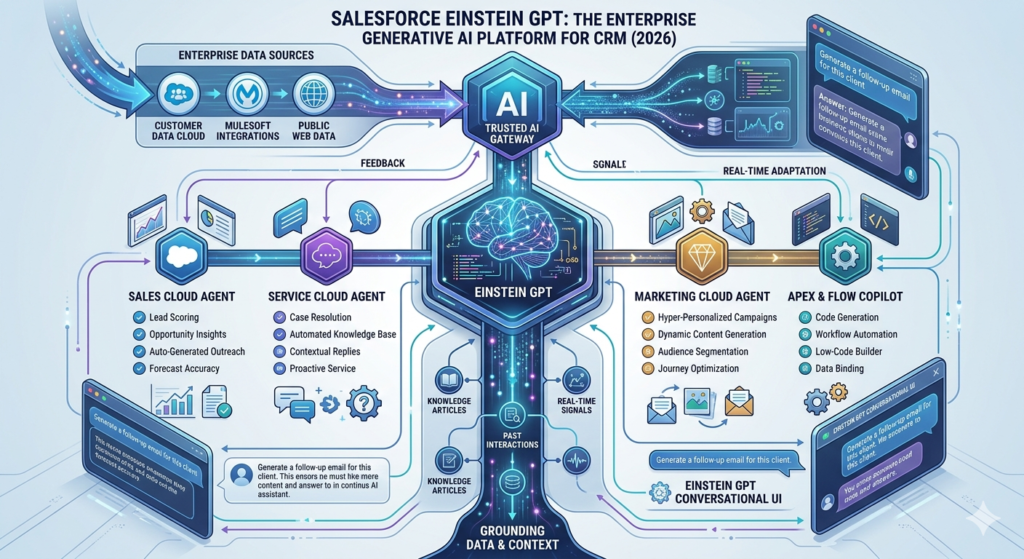
In this guide, RizeX Labs breaks down everything you need to know about Salesforce Einstein GPT in 2026 — what it is, how it works, real-world use cases, implementation strategies, and what comes next. Let’s get into it.
Section 1: What Is Salesforce Einstein GPT?
Definition
Salesforce Einstein GPT is Salesforce’s integrated generative AI layer, embedded across the entire Salesforce platform — including Sales Cloud, Service Cloud, Marketing Cloud, Commerce Cloud, and Tableau. It combines the power of large language models (LLMs) with Salesforce’s proprietary CRM data to generate intelligent, context-aware content, predictions, and automations in real time.
Unlike standalone AI tools, Einstein GPT is built directly into your CRM workflows. It does not require switching between applications. It meets your teams where they already work.
From Einstein AI to Einstein Generative AI: The Evolution
To understand where Einstein GPT stands in 2026, it helps to trace its evolution:
| Phase | Year | Capability |
|---|---|---|
| Salesforce Einstein (v1) | 2016 | Predictive AI — lead scoring, opportunity insights |
| Einstein Next Best Action | 2019 | Rule-based recommendations |
| Einstein Automate | 2021 | Workflow automation with AI triggers |
| Einstein GPT (Launch) | 2023 | Generative AI for CRM — content, code, responses |
| Einstein Copilot (GA) | 2024 | Conversational AI assistant inside Salesforce |
| Einstein GPT + Agentforce | 2025–2026 | Autonomous AI agents, multi-model orchestration |
What started as a predictive analytics engine has evolved into a full generative AI ecosystem that can write, reason, automate, and act — autonomously.
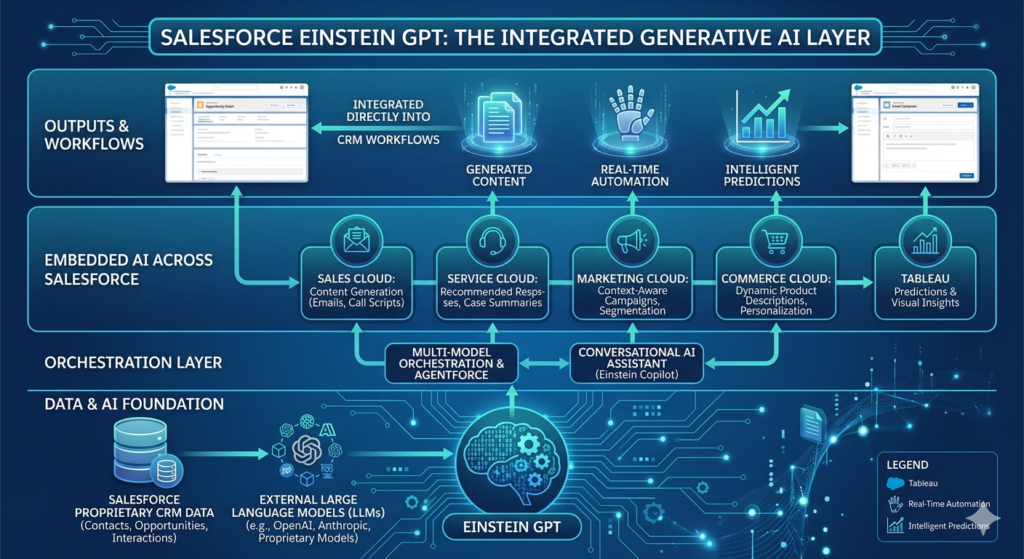
How Einstein Generative AI Works
At its core, Einstein GPT works by combining three critical elements:
- Your Salesforce CRM data — contacts, accounts, opportunities, service cases, marketing engagement history
- Large Language Models (LLMs) — both Salesforce’s proprietary models and integrated third-party models (OpenAI, Anthropic, Google Vertex AI, and others via AI Cloud)
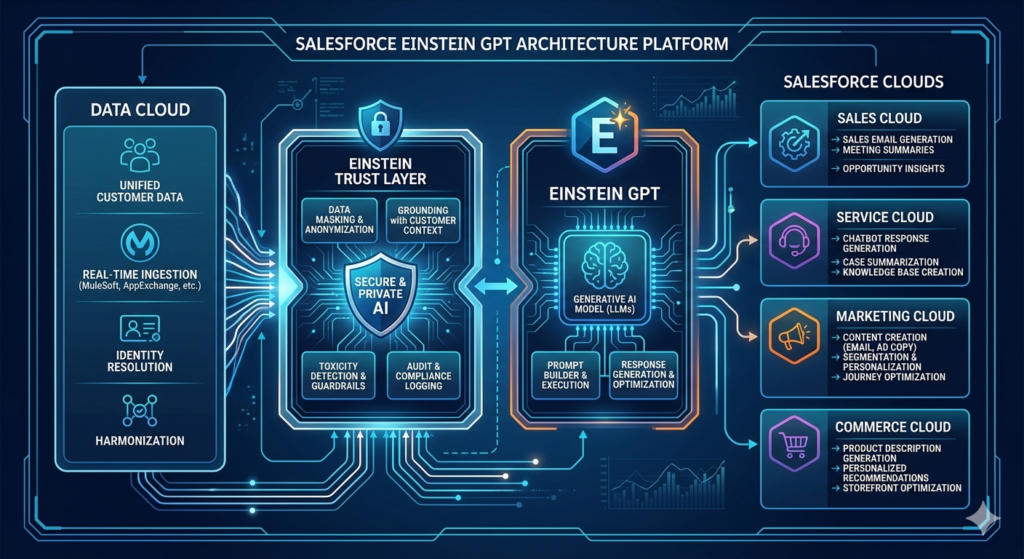
- The Einstein Trust Layer — a proprietary security and governance framework that ensures data privacy, prevents sensitive data from leaving Salesforce, and governs AI outputs
This architecture means the AI is not operating on generic knowledge. It is generating outputs based on your actual customer data, in real time, within a secure and governed environment.
Relationship with Salesforce Data Cloud and AI Cloud
Two infrastructure components make Einstein GPT enterprise-grade:
- Salesforce Data Cloud unifies all customer data — behavioral, transactional, and operational — into a single real-time profile. This is the fuel for Einstein’s AI engine.
- Salesforce AI Cloud is the enterprise-grade AI infrastructure layer that orchestrates LLM calls, manages model selection, enforces the Trust Layer, and ensures compliance at scale.
Together, these components give Einstein GPT something most generative AI tools lack: real-time, contextual, trusted data grounding.
Section 2: Key Salesforce GPT Features in 2026
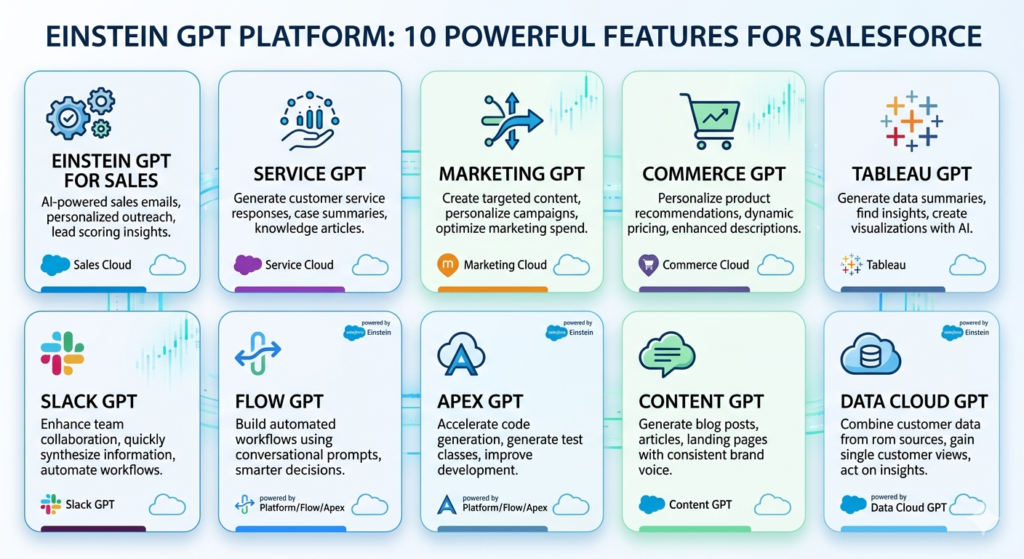
Salesforce has aggressively expanded its Einstein GPT feature set. Here is a comprehensive overview of the capabilities available in 2026 that are reshaping how teams work.
1. AI-Generated Emails and Communications
Sales reps and service agents can generate personalized, contextually relevant emails with a single click. Einstein drafts communications based on CRM data — account history, last interaction, deal stage, sentiment, and more.
Example: A sales rep working a renewal opportunity sees Einstein draft a personalized email referencing the client’s last support ticket, upcoming contract expiry, and a relevant product upgrade — all without opening a separate tool.
2. AI-Powered Sales Forecasting
Einstein’s generative and predictive AI now works together to deliver narrative-driven sales forecasts. Instead of just showing a number, Einstein explains why the forecast looks the way it does, highlights at-risk opportunities, and suggests actions.
3. Automated Customer Service Replies
In Service Cloud, Einstein GPT generates suggested replies for service agents based on the case history, customer sentiment, product data, and knowledge articles. Agents review, edit if needed, and send — dramatically reducing handle time.
4. AI-Generated Reports and Dashboards
Using natural language, users can ask Einstein to generate reports and dashboards. “Show me Q2 pipeline by region with churn risk flagged” — Einstein builds it, no clicks required.
5. Einstein Copilot
Einstein Copilot is Salesforce’s conversational AI assistant embedded across every Salesforce application. In 2026, it has evolved into a multi-step reasoning agent capable of:
- Answering questions about CRM data
- Taking actions inside Salesforce (updating records, sending emails, creating tasks)
- Reasoning across multiple data sources
- Escalating complex decisions to human agents
6. Workflow Automation with Generative AI
Einstein GPT can now generate automation flows based on natural language descriptions. An admin describes what they want to automate, and Einstein builds the Flow logic — dramatically reducing development time.
7. Natural Language CRM Queries
Users across all skill levels can query their CRM data conversationally. “Which accounts in the Northeast haven’t been contacted in 60 days?” — no SOQL, no report builder, just an answer.
8. Personalized Customer Engagement
Marketing Cloud’s Einstein GPT features generate personalized subject lines, email content, SMS copy, and journey recommendations — individualized at scale using real-time Data Cloud profiles.
9. Predictive Analytics + Generative AI Convergence
In 2026, the distinction between predictive and generative AI within Salesforce has blurred. Einstein simultaneously predicts what will happen and generates the content or action needed to respond — closing the loop between insight and execution.
10. Multimodal AI Capabilities
Einstein GPT now supports multimodal inputs — meaning it can process text, structured data, images, and voice inputs to generate CRM-relevant outputs. This is particularly powerful in field service, e-commerce, and healthcare scenarios.
Section 3: How Salesforce Einstein GPT Works
A Step-by-Step Workflow
Understanding the under-the-hood mechanics helps teams implement and govern Einstein GPT effectively.
Step 1: Data Collection and Unification
All relevant CRM data — customer profiles, interaction history, deal data, service records — is unified in Salesforce Data Cloud into a real-time customer graph.
Step 2: User Intent and Prompt Generation
When a user triggers an Einstein GPT feature (clicking “Generate Email,” asking Copilot a question, or activating an AI workflow), Salesforce generates a structured prompt. This prompt includes relevant CRM context pulled from Data Cloud.
Step 3: Einstein Trust Layer Enforcement
Before any data leaves Salesforce, the Trust Layer performs several critical functions:
- Data masking — sensitive PII is removed or anonymized
- Zero data retention enforcement — data sent to external LLMs is not stored or used for training
- Toxicity and compliance filtering — outputs are reviewed against configured rules
- Audit logging — every AI interaction is logged for governance
Step 4: LLM Processing
The sanitized, structured prompt is sent to the appropriate LLM — either Salesforce’s internal model or a configured external model (OpenAI, Anthropic, Google). The model generates a response.
Step 5: Output Grounding and Contextualization
The AI response is grounded back in Salesforce data — references are verified, factual claims are cross-checked against CRM records, and the output is formatted for the specific Salesforce UI context.
Step 6: Human Review and Action
The generated output is presented to the user for review. In most workflows, humans remain in the loop — approving, editing, or rejecting AI outputs. In autonomous agent workflows (Agentforce), certain low-risk actions can execute without human review based on configured trust parameters.
Step 7: Feedback and Continuous Improvement
User edits, acceptances, and rejections feed back into Einstein’s learning systems, progressively improving output quality over time.
AI Governance Inside Einstein GPT
In 2026, AI governance is not optional — it is built in. Einstein GPT includes:
- Role-based access controls for AI features
- Configurable content filters and guardrails
- Model selection controls (use only approved LLMs)
- Audit trails for every AI-generated output
- Bias detection and monitoring dashboards
📌 Image Suggestion: A flowchart diagram illustrating the 7-step Einstein GPT workflow from data input to AI output with Trust Layer highlighted
Section 4: Top Use Cases of Einstein Generative AI
Sales Teams
Challenge: Sales reps spend an average of 65% of their time on non-selling activities — logging calls, writing emails, updating records.
Einstein GPT Solution:
- Auto-generate call summaries and next-step recommendations after every call (integrated with voice/video platforms)
- Draft personalized outreach emails based on prospect behavior and ICP fit
- Generate deal health narratives explaining why an opportunity is at risk
- Suggest talk tracks and objection responses during live calls via Copilot
Mini Case Study: A SaaS company using Einstein GPT for email generation reduced the average time to send a follow-up from 25 minutes to under 3 minutes, increasing daily outreach volume by 340%.
Customer Support Teams
Challenge: High case volumes, inconsistent response quality, long resolution times.
Einstein GPT Solution:
- Auto-generate case summaries for agents taking over mid-conversation
- Suggest knowledge article responses grounded in the customer’s specific product configuration
- Automatically classify and route cases using natural language understanding
- Generate proactive outreach for customers at risk of churn based on support patterns
Mini Case Study: A financial services firm reduced average handle time by 42% after deploying Einstein GPT reply suggestions in Service Cloud — with customer satisfaction scores improving by 18 points.
Marketing Automation
Challenge: Creating personalized content at scale is resource-intensive and slow.
Einstein GPT Solution:
- Generate personalized email subject lines and body copy for each segment
- Create dynamic landing page copy based on visitor Data Cloud profiles
- Generate A/B testing variants automatically
- Write social ad copy tailored to audience personas
E-Commerce
Challenge: Product discovery and personalization gaps lead to abandoned carts and low conversion.
Einstein GPT Solution:
- Generate personalized product descriptions based on shopper behavior
- Write dynamic promotional messages for individual customers
- Auto-generate abandoned cart emails with contextually relevant content
- Create AI-powered chatbot conversations that guide shoppers to purchase
Financial Services
Challenge: Compliance requirements slow down client communication and advice delivery.
Einstein GPT Solution:
- Generate compliant advisor communications pre-screened through configurable filters
- Summarize complex client portfolios in plain language for client-facing reports
- Auto-draft relationship review summaries
- Predict client churn risk with generative explanations for relationship managers
Healthcare
Challenge: Administrative burden reduces time providers spend with patients.
Einstein GPT Solution:
- Generate patient outreach for appointment reminders, follow-ups, and care plan adherence
- Summarize patient interaction history for care coordinators
- Auto-classify and route patient inquiries to appropriate clinical resources
- Generate documentation summaries within HIPAA-compliant guardrails
SaaS Companies
Challenge: Long sales cycles, complex onboarding, high churn.
Einstein GPT Solution:
- Generate personalized onboarding email sequences based on product usage signals from Data Cloud
- Identify expansion opportunities with AI-generated account growth plans
- Create churn risk narratives with recommended retention actions
- Generate renewal proposals customized to each account’s usage profile
📌 Image Suggestion: Industry icons grid (Sales, Service, Marketing, E-commerce, Finance, Healthcare, SaaS) with a brief AI use case bubble for each
Section 5: Benefits of Salesforce Einstein GPT in 2026
The business case for Einstein GPT has matured significantly. Here is what organizations are seeing in 2026:
Productivity Improvements
Sales reps using Einstein GPT report spending 40–60% less time on administrative tasks. Service agents handle more cases per shift. Marketing teams produce content 5x faster.
Faster Response Times
AI-generated replies and case handling reduce customer response times dramatically. Sub-minute first responses are now achievable in service environments using Einstein GPT with autonomous agent configurations.
Better Customer Experiences
Personalization at scale — content that feels individually crafted because it is individually generated — drives measurable improvements in customer satisfaction, NPS, and lifetime value.
AI-Driven Personalization
Every customer interaction — email, chat, proposal, support response — is uniquely personalized based on real-time Data Cloud profiles. This is personalization that legacy CRM automation simply cannot deliver.
Reduced Operational Costs
Organizations report 15–30% reductions in customer service operational costs following full Einstein GPT deployment — driven by faster resolution times, lower handle times, and reduced need for manual content creation resources.
Better Forecasting Accuracy
Einstein’s combined predictive and generative AI delivers forecasts that are not only more accurate but explainable — managers understand why the numbers look the way they do and can act accordingly.
Increased ROI
Salesforce’s own research in 2025 indicated that organizations fully utilizing Einstein AI capabilities see an average ROI of 3.5x–6x within 18 months of implementation — with early adopters of generative AI features seeing results at the higher end.
📌 Image Suggestion: An infographic bar chart or icon grid showing key benefit statistics with percentage improvements
Section 6: Challenges and Limitations
Honest consulting requires acknowledging the real challenges. Here is what you need to prepare for.
Data Privacy Concerns
Einstein GPT processes sensitive CRM data. While the Trust Layer provides strong protections, organizations in regulated industries (healthcare, financial services, government) must conduct thorough data residency and compliance reviews before enabling specific features.
AI Hallucinations
Like all LLM-based systems, Einstein GPT can generate plausible-sounding but incorrect information. Human review workflows are essential — particularly for customer-facing communications and compliance-sensitive content. Prompt engineering and output grounding significantly mitigate this risk, but do not eliminate it entirely.
CRM Data Quality Issues
Garbage in, garbage out. Einstein GPT is only as good as the data in your Salesforce org. Organizations with incomplete contact records, inconsistent opportunity stages, or siloed data will see degraded AI output quality. A data quality audit is a prerequisite for any Einstein GPT implementation.
Cost Considerations
Einstein GPT features are available through specific licensing tiers and AI credit consumption models. Costs can escalate significantly at high usage volumes. Organizations must model their AI consumption carefully and build cost governance into their implementation plan.
Adoption Barriers
Sales reps who view AI as a threat rather than an assistant will resist adoption. Marketing teams may distrust AI-generated content. Customer service supervisors may worry about quality control. Change management is not a nice-to-have — it is a critical success factor.
Governance Challenges
As Einstein evolves toward autonomous agentic AI, the governance questions become more complex. Who is accountable when an AI agent takes an incorrect action? How are hallucinated outputs tracked and corrected? Organizations need clear AI governance policies before enabling autonomous workflows.
📌 Image Suggestion: A risk radar chart or warning-icon list for each challenge with mitigation strategies noted
Section 7: How to Implement Salesforce Einstein GPT
The RizeX Labs 7-Step Implementation Roadmap
Step 1: Define Business Goals
Before touching technology, answer these questions:
- What specific business problems are you solving?
- Which teams will benefit most from Einstein GPT?
- What does success look like in 90 days, 6 months, and 12 months?
- What KPIs will you track?
Pro Tip: Start with one use case — such as AI email generation for sales — before expanding. Focused pilots build confidence and generate measurable ROI fast.
Step 2: Audit Your CRM Data
Einstein GPT performs best on clean, complete, well-structured data. Conduct a data audit that covers:
- Contact and account completeness rates
- Opportunity stage accuracy and hygiene
- Data duplicates and merge status
- Integration gaps between Salesforce and other systems (ERP, support platforms, marketing tools)
- Data Cloud readiness
Step 3: Set Up AI Cloud and Data Cloud
Work with your Salesforce partner (hi, that’s us 👋) to:
- Provision Salesforce AI Cloud
- Configure Data Cloud data streams and identity resolution
- Establish the Einstein Trust Layer settings appropriate for your regulatory environment
- Select and configure approved LLM models
Step 4: Configure Einstein GPT
This is where feature enablement begins:
- Enable Einstein GPT features by Cloud (Sales, Service, Marketing)
- Configure prompt templates for your specific use cases
- Set up Einstein Copilot with relevant actions and data sources
- Define approval workflows and human-in-the-loop controls
- Configure content filters and compliance guardrails
Step 5: Train Your Teams
Technology alone does not drive adoption. Build a training program that covers:
- What Einstein GPT does and does not do (set realistic expectations)
- How to review and edit AI-generated content effectively
- Prompt crafting for Copilot interactions
- How to flag poor AI outputs (feedback loops)
- Governance policies and responsible AI use
Step 6: Monitor AI Outputs
Establish ongoing quality monitoring:
- Review random samples of AI-generated content weekly
- Track acceptance vs. rejection rates for AI suggestions
- Monitor AI consumption and cost against budget
- Track downstream KPIs (email reply rates, case resolution times, opportunity conversion)
Step 7: Optimize Prompts and Workflows
Einstein GPT improves with iteration. Continuously:
- Refine prompt templates based on output quality
- Expand AI coverage to additional use cases as confidence grows
- Review and update governance policies as Salesforce releases new capabilities
- Stay current on Einstein GPT updates (Salesforce releases three major updates per year)
Common Mistakes to Avoid
- Skipping the data audit — the single most common reason Einstein GPT underperforms
- Enabling too many features at once — overwhelming users kills adoption
- Ignoring governance — especially critical as you move toward autonomous agent workflows
- Not measuring ROI — without KPI tracking, you cannot justify expansion or defend the investment
- Treating Einstein GPT as a finished product — it requires ongoing optimization and governance
📌 Image Suggestion: A horizontal roadmap timeline graphic showing the 7 implementation steps with milestone markers
Section 8: Salesforce Einstein GPT vs Traditional CRM Automation
One of the most common questions we get at RizeX Labs: “We already have automation in Salesforce — why do we need Einstein GPT?”
The answer is in this comparison:
| Capability | Traditional CRM Automation | Salesforce Einstein GPT |
|---|---|---|
| Automation Type | Rule-based, deterministic | AI-driven, adaptive, generative |
| Intelligence Level | Static logic — follows pre-set rules | Dynamic reasoning — learns from data patterns and context |
| Personalization | Segment-level (1-to-many templates) | Individual-level (1-to-1 unique generation) |
| Content Generation | Template fill-in with merge fields | Fully generated, contextually aware content |
| Natural Language Interaction | Not available | Native — ask questions, get answers, take actions |
| Learning Capability | Does not learn — rules must be manually updated | Continuously improves from CRM data and feedback |
| Speed to Deploy New Automation | Requires developer/admin configuration | Can generate automation flows from natural language descriptions |
| Forecasting | Formula-based or static ML models | Predictive + generative — explains and narrates forecasts |
| User Experience | Technical, admin-dependent | Conversational, accessible to all user levels |
| Cost | Lower (included in standard licensing) | Additional licensing/AI credits required |
| Governance | Manual policy enforcement | Built-in Trust Layer with automated guardrails |
The bottom line: Traditional automation executes what you tell it. Einstein GPT thinks, generates, and adapts. They are not mutually exclusive — in fact, the most powerful implementations use both in combination.
📌 Image Suggestion: A side-by-side visual comparison card with green checkmarks for Einstein GPT capabilities vs. amber/grey for traditional automation
Section 9: The Future of Salesforce AI in 2026 and Beyond
We are at an inflection point. What is coming next will make today’s Einstein GPT look like a warm-up act.
Agentic AI and Agentforce
Agentforce — Salesforce’s autonomous AI agent platform — is the most significant shift in CRM since the move to the cloud. In 2026, AI agents are handling entire workflows without human intervention: qualifying inbound leads, resolving service cases end-to-end, executing marketing campaigns, and managing renewal touchpoints.
These agents are not chatbots. They are multi-step reasoning engines that can take actions inside and outside Salesforce — and they are getting smarter every month.
Autonomous CRM Workflows
The next frontier is self-managing CRM workflows. Imagine an AI agent that:
- Detects that a high-value account has gone quiet
- Drafts a personalized re-engagement plan
- Schedules outreach across email, LinkedIn, and phone
- Logs outcomes and adjusts strategy based on responses
- Escalates to a human only when it detects complex signals
This is not science fiction. Early configurations of this workflow are live in Agentforce today. By 2027, it will be standard.
Hyper-Personalization
As Data Cloud profiles become richer — incorporating behavioral signals, third-party data, IoT data, and real-time engagement signals — Einstein’s personalization will reach a level of precision that makes today’s “personalization” look like a mail merge.
Every interaction will be uniquely generated for each individual, in real time, across every channel.
Voice AI in CRM
Voice is emerging as a primary interface for CRM interaction. Sales reps will brief Einstein verbally during their commute. Service agents will interact with Copilot through voice commands. Customers will engage with Einstein-powered voice agents for complex service interactions.
Salesforce’s investment in voice AI and its integration with Einstein Copilot signals this is a near-term reality, not a distant possibility.
Predictive + Generative AI Convergence
In 2026, we are already seeing this convergence — but it will deepen. Einstein will not just predict churn risk; it will simultaneously generate the personalized intervention campaign to prevent it. It will not just forecast pipeline; it will generate the specific actions each rep needs to take to close the gap.
AI Governance Evolution
As AI autonomy increases, governance frameworks will become more sophisticated. Expect Salesforce to introduce:
- Granular agent behavior controls
- Real-time AI monitoring dashboards
- Regulatory compliance templates (GDPR, CCPA, HIPAA, EU AI Act)
- Explainability reports for every AI decision
Organizations that build strong AI governance today will be positioned to adopt autonomous capabilities with confidence as they mature.
📌 Image Suggestion: A futuristic roadmap visual showing the evolution from Einstein GPT (2026) → Agentforce Autonomy → Hyper-Personalization → Voice AI → Fully Autonomous CRM
Conclusion: Why 2026 Is the Year to Move on Einstein GPT
We are past the early adopter phase of generative AI in CRM. In 2026, Einstein GPT is a competitive necessity, not a competitive advantage reserved for the largest enterprises. Organizations of every size — from SaaS startups to global financial institutions — are using Einstein generative AI to work faster, serve customers better, and operate more intelligently.
The key takeaways from this guide:
- Einstein GPT is not a standalone AI tool — it is a deeply integrated generative AI layer across the entire Salesforce platform, grounded in your CRM data
- The Trust Layer is what makes it enterprise-safe — privacy, governance, and compliance are built in, not bolted on
- The use cases are broad and proven — from sales email generation to autonomous service resolution, the ROI is measurable and real
- Implementation requires strategy, not just technology — data quality, change management, and governance are as important as the technical configuration
- The future is agentic and autonomous — the organizations building their Einstein GPT foundation now will be best positioned to capture the value of AI agents in 2027 and beyond
The window to gain a meaningful competitive edge is still open — but it is closing. Every quarter you delay is a quarter your competitors are compounding their AI advantage.
About RizeX Labs
We’re Pune’s leading IT training institute specializing in emerging technologies like Salesforce and data analytics. At RizeX Labs, we help professionals master the cutting edge of AI, including Einstein GPT and Agentforce, through hands-on training, real-world projects, and expert mentorship. Our programs are designed to transform learners into job-ready Salesforce AI specialists with the skills to lead the next generation of digital transformation.
Internal Links:
- Salesforce AI Associate Certification: A Comprehensive Prep Guide
- Mastering the Einstein Trust Layer: Securing Your Enterprise Data
- Prompt Engineering for Salesforce Admins: Best Practices for 2026
