
Introduction: Why AI Agents Still Need a Human Safety Net
Artificial intelligence has come a long way. Today’s AI agents can resolve customer queries, process orders, handle FAQs, qualify leads, and even negotiate basic terms — all without a single human interaction. Salesforce Agentforce is at the forefront of this transformation, enabling enterprises to deploy autonomous AI agents that work 24/7 across every customer touchpoint.
But here is the truth that every forward-thinking CX leader and Salesforce admin already knows: AI cannot — and should not — handle everything on its own.
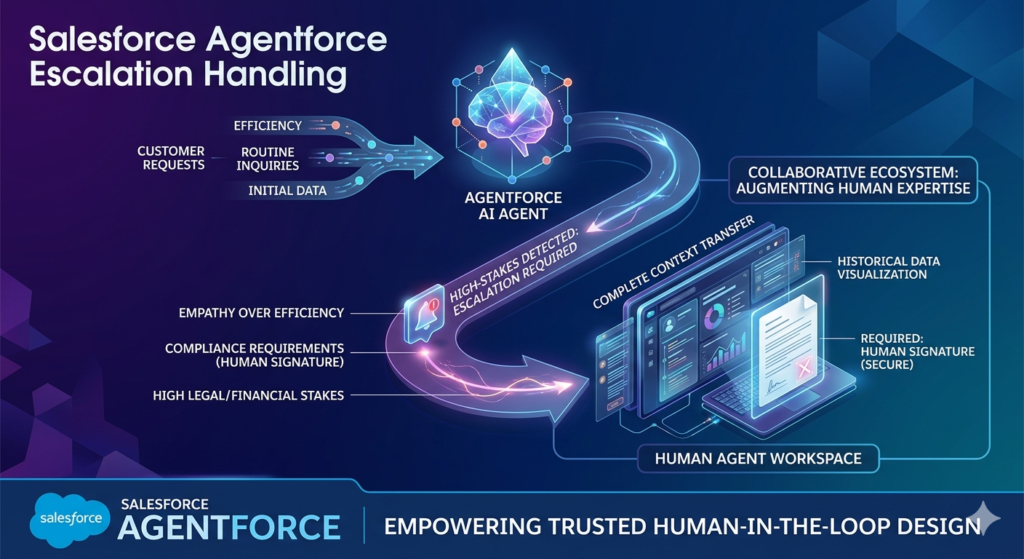
There are moments in every customer journey where empathy matters more than efficiency. Situations where compliance requirements demand a human signature, not an algorithmic guess. Cases where the stakes are too high — legally, financially, or emotionally — to leave in the hands of an AI agent acting alone.
This is precisely where Agentforce escalation handling becomes the defining feature that separates intelligent automation from reckless automation.
The ability to recognize when to step back, involve a human, and transfer context seamlessly is not a limitation of AI — it is a sign of AI maturity. Salesforce Agentforce is designed with this philosophy at its core. Through human-in-the-loop design, Agentforce creates a collaborative ecosystem where AI agents augment human expertise rather than attempting to replace it entirely.
In this blog, we will explore exactly how Agentforce escalation works, why it matters for enterprise operations, and how organizations can design escalation workflows that protect customers, reduce risk, and build lasting trust in AI-powered service delivery.
What Is Agentforce Escalation Handling?
Agentforce escalation handling refers to the structured process through which an AI agent operating within the Salesforce ecosystem recognizes that a conversation, task, or decision requires human involvement and intelligently transfers control — along with all relevant context — to the appropriate human resource.
Unlike traditional chatbots that simply say “Let me transfer you to an agent” after failing to understand a query three times, Agentforce uses a far more sophisticated approach. It does not just escalate when it is stuck. It escalates intelligently, based on a combination of real-time signals, confidence thresholds, policy rules, and contextual awareness.
How Autonomous AI Agents Detect the Need to Escalate
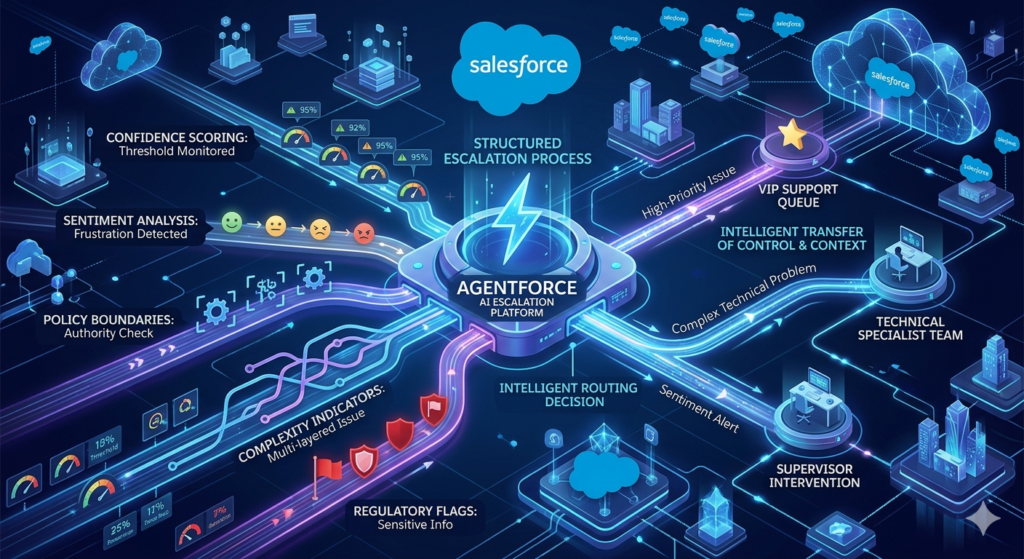
Agentforce agents operate using Salesforce’s underlying data infrastructure, large language model capabilities, and a configurable layer of business rules. They continuously evaluate multiple signals during every interaction to determine whether they should continue handling the case or route it to a human.
These signals include:
- Confidence scoring: How certain is the AI about the accuracy of its response?
- Sentiment analysis: Is the customer becoming frustrated, distressed, or hostile?
- Policy boundaries: Does this request fall outside the AI’s authorized scope of action?
- Complexity indicators: Is the issue multi-layered, requiring judgment beyond structured data?
- Regulatory flags: Does this involve sensitive information requiring human verification?
- Customer tier recognition: Is this a VIP account that deserves premium human attention?
When one or more of these signals crosses a defined threshold, the escalation workflow is triggered. What makes Agentforce genuinely powerful is that this is not a binary on/off switch. It is a nuanced, intelligent routing system that can escalate to different queues, agents, supervisors, or departments depending on the nature of the situation.
Think of it as giving your AI agent the awareness to say, “This is beyond what I should handle alone — and here is everything the next person needs to take it from here.”
Why AI-to-Human Handoff Matters in Salesforce
The concept of AI to human handoff in Salesforce is not just a technical feature. It is a strategic capability that directly impacts customer satisfaction, legal compliance, and operational integrity.
According to a 2023 Salesforce State of Service report, 88% of customers say the experience a company provides is as important as its products or services. A failed escalation — where a customer is transferred without context, left waiting with no acknowledgment, or passed between agents repeatedly — can permanently damage that experience.
The Hidden Risks of Poor Escalation Handling
When escalation workflows are poorly designed or absent altogether, the consequences extend far beyond a bad customer experience. Here is what organizations actually risk:
1. Customer Frustration and Churn
Nothing is more infuriating than explaining your problem three times to three different people. When an AI agent fails to hand off context during escalation, customers start from zero. According to McKinsey, resolving issues on the first contact increases customer satisfaction scores by up to 35%. Broken escalations destroy that opportunity.
2. Compliance and Legal Exposure
In regulated industries — financial services, healthcare, insurance — certain conversations must be handled by licensed humans and documented appropriately. An AI agent that handles a coverage dispute or a loan modification request without escalating exposes the organization to regulatory penalties.
3. Inaccurate or Harmful Responses
AI models can hallucinate. When confidence is low and the AI is operating outside its training domain, incorrect information delivered with confidence is dangerous. Without a proper escalation mechanism, these responses go unchecked.
4. Unresolved Tickets and Escalating Backlogs
Without intelligent escalation, complex issues get stuck in AI loops — repeatedly attempted and repeatedly failed. This creates ticket backlogs, frustrated customers, and overwhelmed support teams who eventually inherit poorly documented messes.
How Seamless Handoff Preserves Customer Context
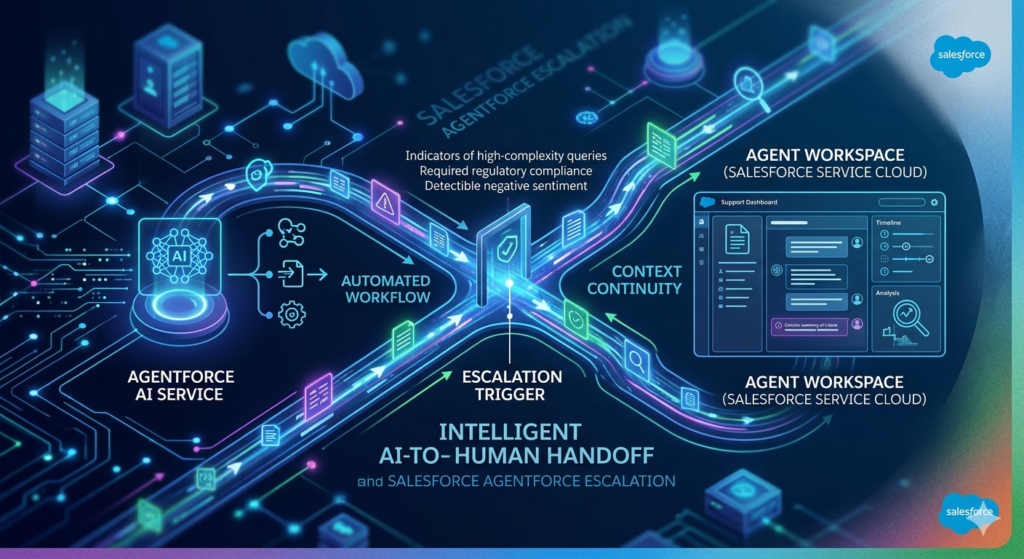
When Agentforce escalates correctly, the receiving human agent does not walk into a blank slate. They inherit a complete interaction summary, the customer’s full Salesforce CRM profile, conversation history, sentiment indicators, and the AI’s assessment of why escalation was triggered.
This context continuity is what transforms a potentially frustrating moment into a demonstration of organizational competence. The customer feels heard. The agent feels equipped. And the resolution is dramatically faster.
[Internal Linking Suggestion: Link to “Getting Started with Agentforce: A Complete Implementation Guide” and “Salesforce AI Features Every Admin Should Know”]
How Agentforce Detects Escalation Scenarios
Detection is the foundation of intelligent escalation. Agentforce monitors a rich set of signals throughout every interaction to identify when human intervention is warranted. Let us examine the most common escalation triggers in detail.
1. Negative Customer Sentiment
Agentforce leverages natural language processing to analyze sentiment in real time. When a customer’s language shifts toward frustration, anger, or emotional distress — phrases like “this is ridiculous,” “I’ve been waiting for weeks,” or “I’m canceling my account” — the system recognizes a sentiment threshold breach and initiates escalation.
This is critical because customers in emotional distress do not want to talk to a bot. They want a human who can genuinely empathize and take ownership.
2. Repeated Failed Responses
When an AI agent attempts to resolve an issue and the customer continues to express dissatisfaction or repeats their query in different ways, Agentforce treats this as a resolution failure pattern. After a configurable number of failed attempts, escalation is automatically triggered rather than continuing the loop.
3. Sensitive Billing or Legal Issues
Requests involving refunds above a certain dollar threshold, disputed charges, contract termination, legal threats, or account fraud immediately trigger a compliance escalation. These conversations require human authorization, proper documentation, and often, licensed personnel.
4. Low Confidence AI Predictions
Every response generated by an Agentforce agent is associated with a confidence score. When the model determines that its response has a confidence level below a defined threshold — say, below 75% — rather than serving a potentially incorrect answer, it flags the case for human review. This is responsible AI in action.
5. VIP Customer Requests
Agentforce integrates directly with Salesforce CRM data, which means it can recognize account tier, relationship value, and contract size in real time. When a customer tagged as a strategic account, an executive contact, or a high-value enterprise client initiates an interaction, the system can automatically route them to dedicated human support — regardless of the nature of the query.
6. Complex Technical Support Cases
When support cases involve multi-system integrations, custom configurations, product bugs requiring engineering input, or escalation paths that require cross-departmental coordination, Agentforce recognizes the complexity ceiling and escalates to a senior technical resource with full case context.
Human-in-the-Loop Design in Agentforce
The phrase human-in-the-loop AI describes a design philosophy where human judgment remains an integral part of the AI workflow — not as a fallback for failure, but as a deliberate, structured component of the system architecture.
Salesforce Agentforce is built on this philosophy from the ground up. The goal is not to maximize the percentage of interactions handled entirely by AI. The goal is to maximize the quality and appropriateness of every interaction — whether handled by AI, by a human, or by a combination of both.
The Architecture of Human Oversight
Agentforce’s human-in-the-loop framework operates across several layers:
Confidence Scoring and Thresholds
Every AI action — every response generated, every decision recommended, every workflow triggered — is scored for confidence. Administrators define the thresholds at which AI acts autonomously versus when it pauses and requests human review. This is configurable at the organization, object, and flow level.
Approval Workflows
For high-stakes actions — processing a refund, modifying a contract, applying a discount — Agentforce can be configured to generate an approval request routed to the appropriate supervisor before the action is executed. The AI prepares all the context. The human makes the final call.
Escalation Queues
Rather than routing escalations randomly, Agentforce feeds into Salesforce’s Omni-Channel routing engine, which assigns cases based on agent skill, availability, workload, and case priority. Escalated cases arrive in the right queue, for the right agent, at the right time.
Supervisor Review and Monitoring
Supervisors have real-time visibility into AI agent performance through Salesforce dashboards. They can monitor conversation sentiment, escalation rates, resolution times, and confidence trends. They can intervene in active conversations, reassign cases, and flag interactions for quality review.
Live Agent Intervention
In Salesforce’s digital engagement environment, a supervisor or senior agent can observe an AI-handled conversation and step in directly — taking over the conversation without the customer experiencing any disruption. The transition is seamless from the customer’s perspective.
Humans and AI as Collaborators, Not Competitors
The most powerful mental model for understanding Agentforce escalation is this: AI handles the volume; humans handle the value. AI agents resolve high-frequency, low-complexity interactions at scale. Human agents focus their expertise on complex cases, emotional conversations, strategic relationships, and decisions that require judgment beyond data.
This is not humans versus AI. It is humans and AI, each operating in their zone of excellence.
[Internal Linking Suggestion: Link to “What Is Agentforce? Understanding Salesforce’s Autonomous AI Platform” and “Human-in-the-Loop AI: Why It Matters for Enterprise Automation”]
Key Features of Agentforce Escalation Workflows
Understanding the philosophy is important. But let us get practical. Here are the core features that make Agentforce escalation workflows function at an enterprise level.
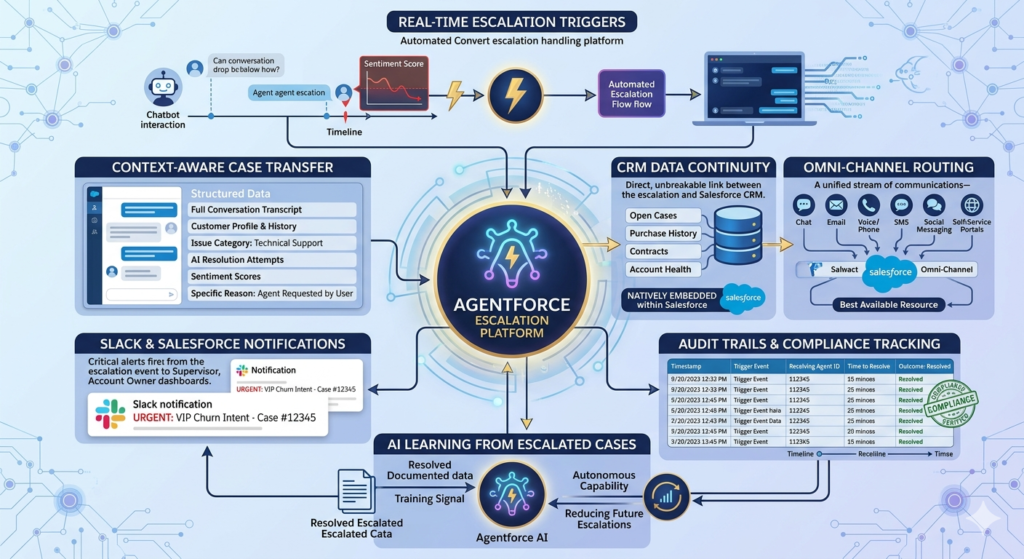
Real-Time Escalation Triggers
Escalation is not reactive — it is proactive. Agentforce evaluates trigger conditions in real time during every conversation. The moment a threshold is crossed, the escalation workflow fires immediately. There is no delay, no waiting for the conversation to “naturally” fail. The system acts at the first signal.
Context-Aware Case Transfer
When escalation occurs, the human agent receives a structured case summary that includes: the full conversation transcript, the customer’s profile and history, the issue category, the AI’s resolution attempts, sentiment scores, and the specific reason escalation was triggered. Nothing is lost in translation.
CRM Data Continuity
Because Agentforce is natively embedded within Salesforce, the escalating agent has instant access to the customer’s complete CRM record — open cases, past interactions, purchase history, entitlements, contracts, and account health. There is no context switching between systems.
Omni-Channel Routing
Escalation works across every channel — chat, email, voice, SMS, social messaging, and self-service portals. Regardless of where the interaction began, Agentforce ensures the escalation routes through Salesforce’s Omni-Channel framework to the best available human resource, maintaining channel continuity wherever possible.
Slack and Salesforce Notifications
When critical escalations occur — a VIP customer expressing churn intent, a legal threat, a high-value opportunity at risk — Agentforce can fire real-time alerts to supervisors and account owners via Slack or Salesforce notifications. This ensures that high-stakes situations receive immediate attention, even from people who are not actively monitoring the queue.
Audit Trails and Compliance Tracking
Every escalation event is logged automatically — including what triggered it, which agent received it, how long it took to resolve, and what the outcome was. This creates a defensible audit trail for compliance purposes and provides the data organizations need to continuously improve their escalation policies.
AI Learning from Escalated Cases
Here is where escalation becomes an investment rather than just a safety net. Escalated cases represent the edge of the AI’s current capability. When they are reviewed, resolved, and documented by human experts, that data becomes training signal for improving the AI’s future performance. Over time, the AI learns from the cases it could not handle — progressively expanding its autonomous capability while narrowing the scope of escalations.
Real-World Use Cases: Agentforce Escalation in Action
Use Case 1: Customer Support Escalation in Retail
A major e-commerce retailer deploys an Agentforce agent to handle post-purchase support — tracking queries, return requests, and refund processing. An AI agent handles thousands of interactions daily without human involvement.
But when a customer contacts support for the fourth time about a damaged product, expresses escalating frustration, and mentions leaving a public review, the sentiment scoring and repeat-contact flags both trigger simultaneously. Agentforce escalates the case to a senior customer experience specialist — complete with the full interaction history, the customer’s lifetime purchase value, and a recommended resolution path.
The specialist greets the customer by name, acknowledges the frustration, and resolves the issue in under five minutes with an expedited replacement and a goodwill credit. A potential churn event becomes a loyalty moment.
Use Case 2: Sales Negotiation Escalation in B2B SaaS
An Agentforce agent is deployed to handle inbound sales inquiries, qualify leads, and guide prospects through product information and standard pricing. During a conversation with a mid-market prospect, the discussion moves into custom contract terms, multi-year pricing, and integration requirements that fall outside the AI’s defined authorization scope.
Agentforce recognizes the complexity threshold, creates a qualified opportunity record pre-populated with all interaction data, and routes the escalation to an account executive with a Slack notification. The AE can pick up the conversation within minutes — already armed with the prospect’s requirements, technical questions, and budget signals captured by the AI agent.
The AI qualified the lead. The human closed the deal.
Use Case 3: Healthcare Compliance Review
A healthcare provider uses Agentforce to support patient services — appointment scheduling, general health information, and administrative queries. A patient contacts the service with questions about a billing dispute that involves insurance claim interpretation and potential HIPAA-sensitive information.
Agentforce immediately detects the regulatory flag — this interaction involves protected health information and requires human authorization before any data is accessed or shared. The case is escalated to a certified patient services representative with the appropriate access permissions. The AI handles nothing beyond the initial acknowledgment.
This is compliance-first escalation design. Not a workaround. An intentional, auditable workflow that protects both the patient and the organization.
Use Case 4: Financial Services Approval Workflow
A financial services firm uses Agentforce to handle customer account inquiries, transaction history requests, and standard account modifications. A high-value client requests a wire transfer above the AI agent’s authorization limit, combined with an unusual destination and an urgent timeline.
Agentforce flags the transaction for fraud risk assessment, routes the case to the compliance team with a high-priority notification, and holds the action pending human approval. The compliance officer reviews the case, contacts the client to verify intent, and approves or declines the transaction with full documentation.
The AI identified the risk. The human applied the judgment. The audit trail is complete.
[Internal Linking Suggestion: Link to “Agentforce for Financial Services: Compliance-First AI Automation” and “How Salesforce Agentforce Transforms Healthcare Customer Engagement”]
Benefits of Agentforce Escalation Handling
When escalation workflows are designed well, the benefits extend across the entire organization — not just the support team.
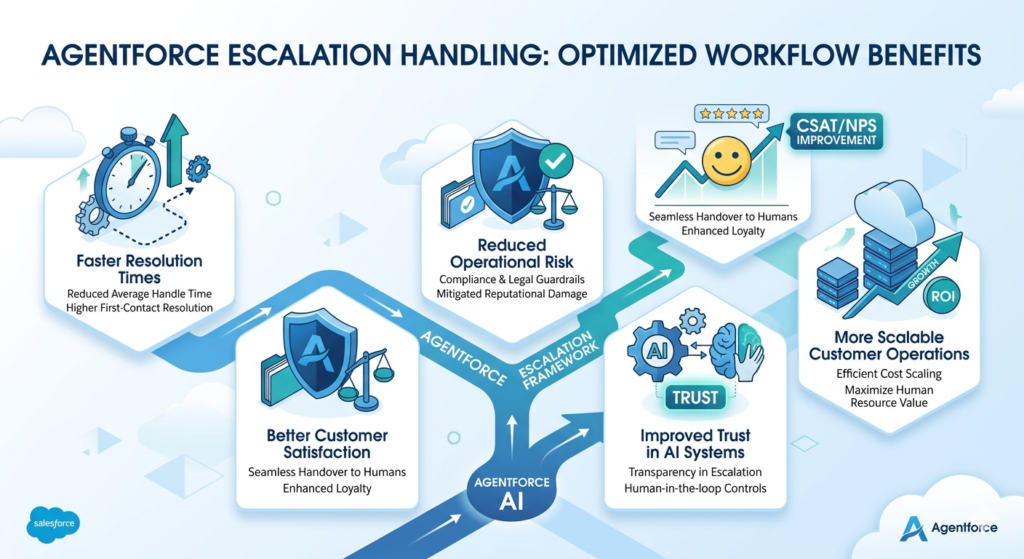
Faster Resolution Times
Counter-intuitively, proper escalation speeds up resolution. When the AI handles routine queries and escalates complex ones efficiently — with full context — human agents spend their time solving problems rather than gathering information. Average handle time drops. First-contact resolution rates climb.
Better Customer Satisfaction
Customers who experience seamless escalation — where the human agent already knows their situation — consistently report higher satisfaction scores. The perception of organizational competence is a powerful loyalty driver. CSAT and NPS scores improve not despite escalation, but because of how it is handled.
Reduced Operational Risk
Intelligent escalation acts as a risk management layer. By routing sensitive, complex, or high-stakes interactions to qualified humans with documented workflows, organizations significantly reduce their exposure to compliance violations, legal liability, and reputational damage.
Improved Trust in AI Systems
One of the biggest barriers to enterprise AI adoption is distrust. Leaders worry about what the AI might do when it gets things wrong. A well-designed escalation framework is the answer to that concern. When stakeholders can see that the AI knows its limits — and that humans remain in control of critical decisions — trust in the overall system increases.
More Scalable Customer Operations
The holy grail of AI-augmented service is the ability to scale customer operations without proportionally scaling headcount. When AI handles 70–80% of routine interactions autonomously and escalates the rest intelligently, organizations can grow their customer base without adding linear support costs. Human capacity is preserved for the interactions that genuinely need it.
Best Practices for Designing AI Escalation Flows
Understanding the theory is one thing. Designing and maintaining escalation workflows that actually perform in production is another. Here are the most important best practices for Salesforce admins, CX architects, and AI implementation leads.
1. Define Escalation Thresholds Precisely
Do not rely on default settings. Work with your customer experience team, compliance officers, and business stakeholders to define exactly when escalation should occur for each use case. Thresholds for sentiment, confidence, transaction value, and interaction count should be deliberate, documented, and reviewed regularly.
2. Monitor AI Confidence Levels Continuously
Set up dashboards in Salesforce to track confidence score distributions across your AI agent interactions. If you see a pattern of low-confidence responses concentrated around a particular topic or query type, that is a signal to improve your AI’s knowledge or adjust your escalation threshold for that domain.
3. Preserve Conversation History at All Times
Never allow context to be lost during escalation. Design your handoff flows to ensure that every data point captured during the AI interaction — including conversation transcript, customer sentiment, resolution attempts, and relevant CRM data — is transferred to the human agent in a structured, readable format.
4. Train Human Agents on AI Collaboration
Your human agents need to understand how the AI works, what triggers escalations, and how to use the context they receive. Agents who understand the AI’s role are better positioned to pick up seamlessly, provide accurate feedback on AI performance, and collaborate effectively in hybrid workflows. AI literacy for human agents is not optional — it is essential.
5. Continuously Optimize Based on Escalation Data
Your escalation data is a goldmine of operational intelligence. Analyze it regularly: Which query types escalate most often? Which agents resolve escalated cases fastest? What are the common failure patterns? Use these insights to retrain your AI, adjust your thresholds, improve your knowledge base, and refine your routing logic. Escalation optimization is an ongoing process, not a one-time configuration.
6. Build Feedback Loops Between Humans and AI
Create a mechanism for human agents to flag AI responses as incorrect, unhelpful, or potentially harmful. This feedback should feed directly into your AI improvement cycle. The humans who work alongside your AI agents every day are your best source of ground-truth data for improving its performance.
[Internal Linking Suggestion: Link to “How to Configure Agentforce for Your Support Team” and “Salesforce Omni-Channel Routing: A Complete Setup Guide”]
The Future of Human-in-the-Loop AI in Salesforce
The human-in-the-loop model is not a temporary bridge to a fully autonomous future. It is becoming the permanent architecture of responsible enterprise AI — and for good reason.
AI Governance Is Becoming Non-Negotiable
Regulatory frameworks around AI are maturing rapidly. The EU AI Act, emerging U.S. AI governance guidelines, and sector-specific regulations in healthcare, financial services, and education are all moving toward requiring human oversight mechanisms for high-stakes AI decisions. Organizations that build human-in-the-loop design into their AI infrastructure today are not just following best practices — they are getting ahead of regulatory requirements.
Agentforce Will Evolve, But Escalation Will Remain
Salesforce is investing heavily in expanding Agentforce’s autonomous capabilities. Future versions of Agentforce will handle increasingly complex tasks, develop deeper contextual memory, and operate across longer time horizons with greater autonomy. But as autonomy expands, so does the importance of escalation design. The higher the stakes of what AI can do, the more critical it is to have intelligent, well-defined boundaries for what it should not do alone.
Collaborative Intelligence as a Competitive Advantage
Forward-thinking organizations are beginning to treat the collaboration between AI agents and human experts as a core competency — not just an IT implementation. The companies that design the best human-AI workflows — where each amplifies the other’s strengths — will outperform competitors who rely on either purely human or purely automated approaches.
Agentforce escalation handling is a foundational piece of that collaborative intelligence architecture.
AI Agents That Learn From Every Escalation
In the near future, we will see Agentforce agents that do not just escalate and hand off — they observe the human resolution, learn from it, and update their own capabilities in near-real-time. Imagine an AI agent that becomes smarter with every case it cannot handle. That is the trajectory Salesforce’s AI investment is pointing toward, and it is both exciting and deeply practical.
The line between AI capability and human oversight will not disappear. It will shift — constantly, intelligently, and always with the goal of better outcomes for customers and organizations alike.
Conclusion: Escalation Is Not a Weakness — It Is a Feature
The most common misconception about AI in enterprise customer service is that escalation represents failure. In reality, intelligent escalation is the hallmark of a mature, trustworthy AI system.
An AI agent that always thinks it can handle everything is an AI agent that will eventually cause serious harm — to customers, to compliance, and to organizational reputation. An AI agent that knows when to step back, hand off with full context, and involve the right human at the right moment is an AI agent that earns trust and delivers consistent value.
Agentforce escalation handling is not a fallback mechanism. It is a core architectural feature that makes Salesforce Agentforce suitable for real enterprise deployment — across industries, use cases, and compliance environments.
By combining autonomous AI capability with thoughtfully designed human-in-the-loop workflows, organizations using Agentforce can achieve something genuinely powerful: the scale and speed of AI automation, governed by the judgment and empathy of human expertise.
At RizeX Labs, we specialize in helping organizations design and implement Agentforce solutions that are not just technically sound but strategically powerful. That means building escalation workflows that protect your customers, empower your teams, and position your organization to lead in the age of AI-augmented service.
If you are ready to explore how Agentforce escalation design can transform your customer operations, let’s start the conversation.
About RizeX Labs
We are Pune’s leading IT training institute specializing in emerging technologies like Salesforce and Data Analytics. At RizeX Labs, we help professionals master cutting-edge platforms like Salesforce Agentforce through hands-on training, real-world automation projects, and expert mentorship. Our programs are designed to transform learners into job-ready AI specialists and Salesforce professionals with strong technical and strategic skills.
Internal Links:
- Getting Started with Agentforce: A Complete Implementation Guide
- Salesforce AI Features Every Admin Should Know
- Human-in-the-Loop AI: Why It Matters for Enterprise Automation
- Salesforce Apex Triggers: Beginner’s Guide with Real-Time Examples
External Links:
- Official Salesforce Agentforce Documentation
- Salesforce State of Service Report (2023)
- McKinsey: Customer Experience Trends and AI
- Trailhead: Agentforce Basics Module
