
Introduction: The Age of Intelligent Email Marketing Has Arrived
Not too long ago, email marketing was a numbers game. Send enough emails to enough people, hope a decent percentage opens them, and measure success by click-through rates that barely scratched double digits. Marketers were essentially casting wide nets into the ocean and celebrating when something — anything — got caught.

Then artificial intelligence walked through the door, and everything changed.
Today's marketing landscape is radically different. Customers expect personalization. They expect relevance. They expect to receive content that speaks to them — not to a demographic segment, not to a buyer persona written on a whiteboard, but to them as individuals. And businesses that fail to meet that expectation are losing ground to competitors who've already embraced AI-powered marketing.
This is where Einstein for SFMC enters the picture.
Salesforce's Einstein AI, integrated deeply into Salesforce Marketing Cloud, represents one of the most powerful leaps forward in email marketing technology. It's not just automation — it's intelligence. It's not just personalization — it's prediction. Einstein for SFMC gives marketers the ability to anticipate what customers want, when they want it, and how to present it in a way that drives real action.
At RizeX Labs, we work with Salesforce Marketing Cloud users every day, helping businesses harness the full power of SFMC Einstein features to transform their email programs from guesswork into precision. In this comprehensive guide, we're going to break down everything you need to know about Einstein for SFMC — from predictive emails to recommended content — and show you exactly how to use it to drive engagement, conversions, and long-term loyalty.
Let's dive in.
What Is Einstein for SFMC? Understanding the Foundation
Before we explore its individual capabilities, it's important to understand what Einstein for SFMC actually is.
Salesforce Einstein is Salesforce's native artificial intelligence layer — a collection of machine learning models, natural language processing capabilities, and predictive analytics tools built directly into the Salesforce platform. When applied specifically to Salesforce Marketing Cloud, Einstein becomes a powerful marketing intelligence engine that learns from your customer data and helps you make smarter marketing decisions at scale.
Einstein for SFMC doesn't require data scientists or complex technical configurations to get value from. It's designed to be accessible to marketers — those who understand their customers but may not have a background in machine learning. The AI works quietly in the background, processing engagement data, behavioral signals, and content performance metrics to surface actionable insights and automated recommendations.
Why Einstein for SFMC Matters More Than Ever
The numbers tell a compelling story:
- 80% of consumers say they are more likely to purchase from a brand that provides personalized experiences (Epsilon)
- 72% of customers will only engage with marketing messages tailored to their interests (SmarterHQ)
- Email campaigns using AI-driven personalization generate 6x higher transaction rates than non-personalized campaigns (Experian)
Yet despite these statistics, the majority of businesses still send generic blast emails based on basic segmentation. The gap between what customers expect and what most marketing teams deliver is enormous — and that gap represents an enormous opportunity for businesses willing to invest in marketing cloud AI.
Einstein for SFMC bridges that gap. It turns raw customer data into predictive intelligence, and predictive intelligence into better marketing outcomes.
Traditional Email Marketing vs. AI-Driven Marketing Cloud AI Strategies
To truly appreciate what Einstein for SFMC brings to the table, it's worth pausing to compare the old approach with the new.
The Old Way: Rule-Based, Reactive Marketing
Traditional email marketing is largely rule-based and reactive. Marketers define segments manually — based on demographics, purchase history, or geographic location. They schedule sends at fixed times, often determined by industry "best practices" (Tuesday at 10 AM, anyone?). They write subject lines based on intuition and test them with A/B splits that take weeks to reach statistical significance.
This approach has several fundamental weaknesses:
- It treats customers as segments, not individuals — a "35-45-year-old female who made a purchase in the last 90 days" is not a person; it's a category
- It looks backward — decisions are made based on past behavior, not predicted future behavior
- It's slow — testing, learning, and iterating takes months
- It scales poorly — the more personalized you try to make it manually, the more resources it requires
The New Way: Predictive, Proactive, AI-Driven Marketing
Marketing cloud AI, powered by Einstein for SFMC, flips this model entirely:
- Customers are treated as individuals — Einstein scores and models each contact uniquely based on their specific behavior patterns
- It looks forward — predictive models anticipate what a customer is likely to do, not just what they've done
- It learns continuously — the AI improves with every email sent, every click recorded, every conversion logged
- It scales effortlessly — Einstein can personalize at 1:1 scale across millions of contacts simultaneously
The contrast is stark. One approach is like a skilled craftsman making furniture by hand — admirable but limited. The other is like having that same craftsman's knowledge applied by an intelligent factory that produces custom pieces for every single customer, simultaneously, around the clock.
Major SFMC Einstein Features: A Deep Dive
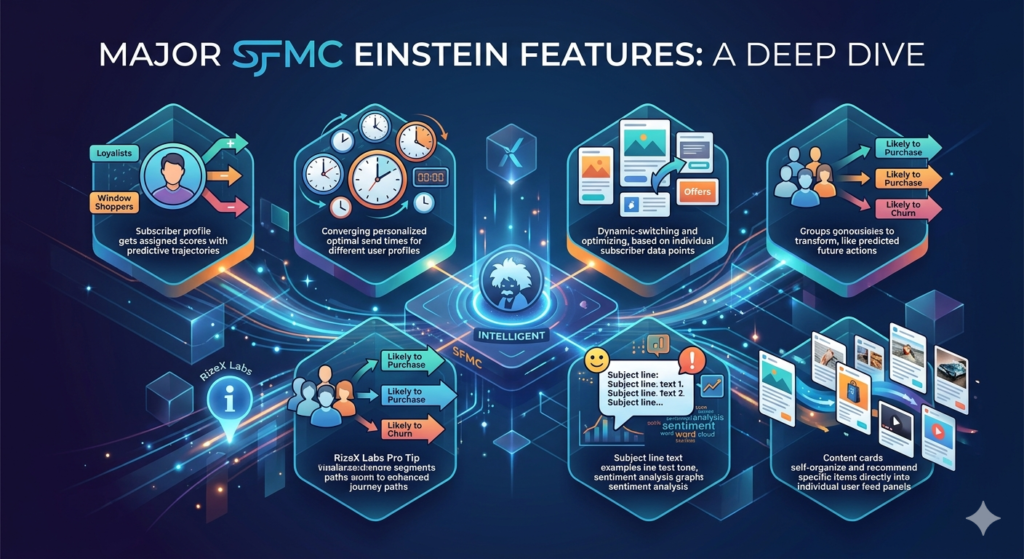
Now let's get into the heart of what Einstein for SFMC offers. Here's a comprehensive look at the core SFMC Einstein features that are transforming email marketing:
1. Einstein Engagement Scoring
What it is: Einstein Engagement Scoring assigns each subscriber in your database a predictive score that indicates how likely they are to engage with your emails. These scores are broken down into four categories: Loyalists, Window Shoppers, Winback Candidates, and Dormant.
How it works: Einstein analyzes each subscriber's historical email engagement data — including open rates, click rates, conversion behavior, and recency of engagement — and builds a predictive model for each individual contact. This isn't just looking at past opens; it's analyzing patterns to predict future behavior.
Why it matters:
- Suppress unlikely engagers from campaigns to protect your sender reputation
- Identify at-risk subscribers before they churn and trigger automated winback flows
- Focus resources on high-value, high-engagement segments
- Improve deliverability by maintaining a healthy, engaged list
Business use case: A retail brand uses Einstein Engagement Scoring to identify "Window Shoppers" — subscribers who occasionally open emails but rarely click. They create a dedicated journey for this segment with simplified emails, stronger CTAs, and a special incentive. Conversions from this segment increase by 23% within 90 days.
Pro tip from RizeX Labs: Don't just use engagement scores for suppression. The most sophisticated marketers use different scoring tiers to trigger completely different journey paths, each optimized for where that subscriber is in their engagement lifecycle.
2. Einstein Send Time Optimization (STO)
What it is: Einstein Send Time Optimization (STO) analyzes each subscriber's historical engagement patterns to determine the exact time of day and day of week when they are most likely to open and engage with an email — and then sends to each person at that optimal time.
How it works: Rather than sending everyone your Tuesday morning email at the same time, Einstein STO staggers your send so that each subscriber receives the email at their personal peak engagement window. If Sarah tends to check her email during her lunch break on Thursdays, and Marcus opens emails on Sunday evenings, each receives the email at their respective optimal time.
Why it matters:
- Average open rate improvements of 15-25% when STO is implemented correctly
- Reduces competition in the inbox at peak send times
- Demonstrates respect for each subscriber's personal communication preferences
- Particularly powerful for global audiences across multiple time zones
Implementation consideration: Einstein STO requires a minimum volume of historical engagement data to generate reliable predictions. Newer contacts with limited send history will receive a default send time until sufficient data is collected — typically after 8-12 email interactions.
Common mistake to avoid: Many marketers set up STO and never revisit it. Einstein's predictions improve over time, but you should regularly review STO performance metrics within SFMC's reporting dashboard to ensure the feature is functioning as expected.
3. Einstein Content Selection
What it is: Einstein Content Selection uses AI to automatically select and serve the most relevant content block, image, or offer to each individual subscriber within a single email send. Think of it as dynamic content taken to its most sophisticated level.
How it works: Marketers create a library of approved content assets — product images, offers, banners, promotional blocks — and define basic parameters. Einstein then analyzes each subscriber's profile, behavioral data, and engagement history to determine which content asset is most likely to resonate with that specific individual, and dynamically inserts it at the moment of open.
This is genuinely powerful for several reasons:
- Content decisions are made at open time, not send time — meaning Einstein can account for real-time context
- It removes the burden of manually creating dozens of audience segments and corresponding email variations
- Marketers can set business rules (such as excluding certain products or promotions) while Einstein handles individual-level optimization within those parameters
Business use case: A financial services company sends a monthly newsletter to 500,000 subscribers. Instead of a single featured product recommendation, they use Einstein Content Selection to serve one of eight different financial product highlights based on each subscriber's account type, recent product interactions, and engagement history. Click-through rates on the featured product block increase by 41%.
4. Predictive Audiences
What it is: Einstein Predictive Audiences allows marketers to build intelligent audience segments based on predicted future behaviors — not just past actions.
How it works: Using machine learning models trained on your engagement and conversion data, Predictive Audiences identifies subscribers who share high propensity scores for specific future actions, such as:
- Likely to purchase in the next 30 days
- Likely to churn without intervention
- Likely to engage with a specific product category
- Unlikely to open your next email
Marketers can then target these predictive segments with tailored campaigns designed specifically for their predicted intent.
Why this is a game-changer:
Traditional segmentation looks backward — it groups customers by what they have done. Predictive Audiences looks forward — it groups customers by what they are likely to do. This shift from reactive to proactive marketing is arguably the single biggest transformation Einstein for SFMC delivers.
Business use case: An e-commerce brand uses Predictive Audiences to identify subscribers with a high churn propensity score two weeks before it would normally become apparent. They trigger an automated "We miss you" journey for this segment, complete with a personalized discount based on browsing history. Churn is reduced by 18% quarter-over-quarter.
5. Einstein Copy Insights
What it is: Einstein Copy Insights is an AI-powered tool within Marketing Cloud that analyzes subject line performance across your historical email sends and provides recommendations for future subject line copy — including insights into tone, length, word choice, and emotional sentiment that drives engagement in your specific audience.
How it works: Einstein Copy Insights doesn't rely on generic "best practices" pulled from industry benchmarks. It analyzes the performance of your subject lines with your audience, identifying patterns that are uniquely effective for your subscribers. It then surfaces these insights in a visual dashboard, helping marketers understand what language, questions, urgency cues, or personalization tokens drive the best results.
Key capabilities include:
- Tone analysis — identifying which emotional tones (playful, urgent, informative, exclusive) resonate best with your audience
- Word cloud insights — highlighting high-performing words and phrases
- Subject line scoring — real-time scores as you write new subject lines, predicting performance before you send
- Competitive intelligence — benchmarks against industry performance where applicable
Why marketers love this feature:
For teams that spend significant time debating subject line copy (and every team does), Einstein Copy Insights acts as an objective, data-driven advisor. Instead of relying on a senior marketer's gut feeling or industry articles, you're making decisions based on actual performance data from your own audience.
6. Einstein Recommended Content
What it is: Einstein Recommended Content takes content personalization to its fullest expression. Using collaborative filtering algorithms (similar to what Netflix uses to recommend shows), Einstein surfaces the most relevant content recommendations for each individual subscriber based on their behavior, preferences, and what similar customers have engaged with.
How it works:
Einstein Recommended Content works in real time and can be deployed across email, web, and mobile channels within SFMC. The AI:
- Analyzes individual subscriber behavior — articles read, products browsed, content clicked
- Identifies patterns across similar customer profiles
- Surfaces content recommendations that align with both individual preferences and collective behavioral patterns of similar high-value customers
Implementation in SFMC:
Within Journey Builder and Email Studio, marketers can add Einstein Recommended Content blocks directly to email templates. These blocks dynamically populate at the time of send (or open, depending on configuration) with personalized content — whether that's blog articles, product recommendations, video content, or promotional offers.
Practical benefits:
- Increases email relevance dramatically without requiring manual content curation for each segment
- Drives deeper engagement with content hubs, media properties, and e-commerce catalogs
- Reduces unsubscribes by ensuring every email feels personally curated
- Improves conversion rates by matching content to buyer journey stage
Business use case: A B2B software company uses Einstein Recommended Content to populate a weekly "Insights Digest" email with individually relevant articles from their resource library. Subscribers in trial stages receive implementation guides. Decision-makers receive ROI case studies. Long-term customers receive advanced feature tutorials. Email click-through rates increase by 34%, and content page engagement metrics improve significantly.
How Predictive Emails Improve Customer Engagement and Conversions
The cumulative effect of these SFMC Einstein features is a fundamentally transformed email program — one where every email feels less like a broadcast and more like a conversation.
Here's how predictive emails, powered by Einstein for SFMC, directly impact key business metrics:
Improved Open Rates Through Smarter Timing and Subject Lines
When Einstein STO ensures your email arrives in each subscriber's inbox at their peak engagement window, and Einstein Copy Insights helps you craft subject lines proven to perform with your specific audience, open rates improve meaningfully. Across RizeX Labs' client portfolio, we've observed average open rate improvements of 18-30% after full Einstein implementation.
Higher Click-Through Rates Through Relevance
Emails populated with Einstein Content Selection and Recommended Content are simply more relevant. Relevant emails get clicked. It's that straightforward. When subscribers see products, articles, or offers that align with their interests and behavior, they engage — and they don't unsubscribe.
Better Conversion Rates Through Predictive Targeting
When Predictive Audiences identifies subscribers who are likely to purchase and those subscribers receive a perfectly timed, personalized email with a relevant offer, the conversion math changes entirely. You're no longer marketing to a broad list hoping someone converts — you're marketing to people who were already moving toward a buying decision.
Reduced Churn and List Fatigue
Email list churn is one of the most underestimated costs in email marketing. Every unsubscribe represents lost marketing reach and, more critically, a customer relationship that deteriorated. By using Engagement Scoring to protect disengaged contacts from over-mailing, and Predictive Audiences to intervene before churn occurs, Einstein for SFMC actively protects and extends the value of your subscriber base.
Implementation Tips for Einstein for SFMC
Ready to get started? Here are practical tips for Salesforce Marketing Cloud users looking to implement Einstein features effectively:
Start With Data Quality
Einstein's predictions are only as good as the data feeding them. Before activating Einstein features, audit your contact data for:
- Completeness — are key profile fields populated?
- Accuracy — are email addresses validated and engagement records clean?
- Volume — Einstein needs sufficient historical data to generate reliable predictions; aim for at least 6 months of engagement history
Activate Features Incrementally
Don't try to turn on every Einstein feature simultaneously. A recommended sequence:
- Start with Einstein Engagement Scoring to clean and segment your list
- Add Einstein STO to your next major campaign
- Implement Copy Insights to refine your subject line strategy
- Introduce Content Selection for a high-volume recurring send
- Layer in Predictive Audiences to fuel targeted journeys
- Deploy Recommended Content within Journey Builder flows
Build Measurement Frameworks Before You Launch
Define success metrics for each Einstein feature before activation. For STO, track opens. For Content Selection, track click-through rates on dynamic blocks. For Predictive Audiences, track conversion rates and churn reduction. Without measurement frameworks established upfront, attributing impact becomes difficult.
Involve Your Data and Technology Teams
While Einstein for SFMC is designed for marketers, optimal implementation often requires collaboration with data engineers (to ensure proper data connections and flow) and SFMC administrators (to configure API connections and data extensions correctly).
Common Challenges and Limitations: An Honest Assessment
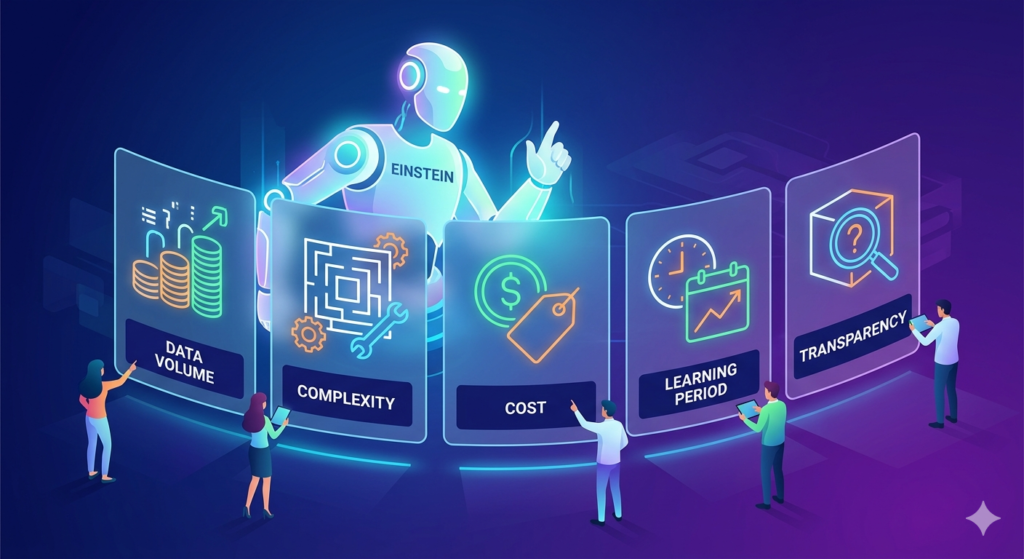
At RizeX Labs, we believe in transparency. Einstein for SFMC is powerful — but it's not magic, and there are real challenges that marketers should be aware of.
Data Volume Requirements
Einstein's machine learning models require significant historical data to generate reliable predictions. If you're a newer brand, have a small list, or have limited engagement history, some Einstein features may produce inconsistent or unreliable outputs in the early stages.
Implementation Complexity
While Einstein is designed to be marketer-friendly, some features — particularly Recommended Content and full Journey Builder integration — require technical configuration that goes beyond typical marketing operations skill sets. Budget for proper implementation support.
Cost Considerations
Several Einstein features are available only at higher SFMC license tiers. It's important to evaluate which features are included in your current contract and what upgrade costs may apply before building your roadmap around specific capabilities.
Learning Period
Einstein gets smarter over time, but there is a meaningful learning period during which predictions may not yet be fully optimized. Marketers need patience and realistic expectations during the initial 60-90 days of deployment.
Transparency of Predictions
Like most AI systems, Einstein's specific model logic is largely opaque to end users. While the outputs are actionable, marketers sometimes want to understand why a specific prediction was made — and that level of transparency isn't always available.
The Future of AI in Salesforce Marketing Cloud
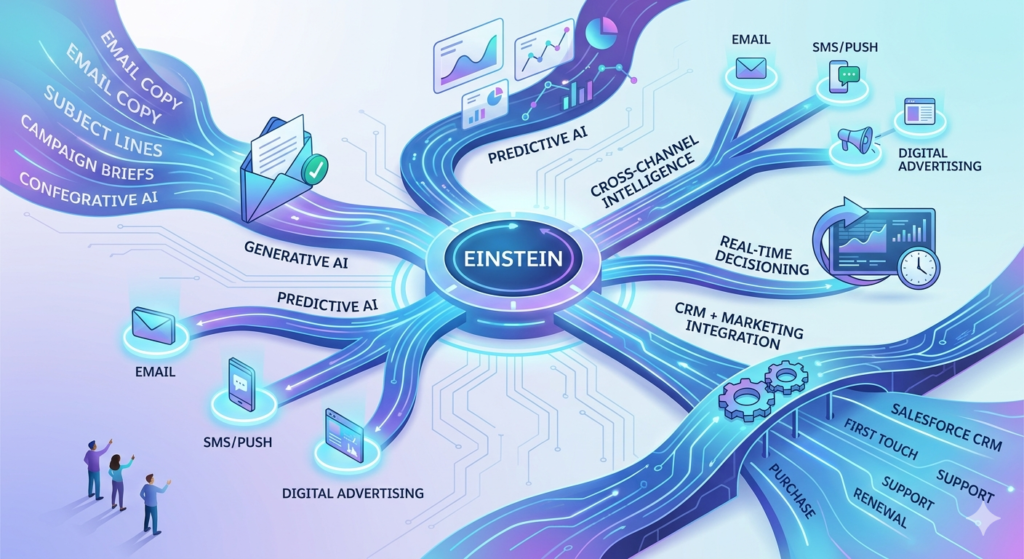
Looking ahead, the trajectory of marketing cloud AI within SFMC points toward even deeper intelligence and broader integration.
Generative AI Integration
Salesforce has already begun integrating generative AI capabilities — powered by Einstein GPT — into Marketing Cloud. This means AI-generated email copy, subject lines, and even full campaign briefs based on natural language prompts. The combination of generative AI for content creation and predictive AI for optimization represents an incredibly powerful one-two punch for marketing teams.
Cross-Channel Intelligence
The future of Einstein for SFMC isn't limited to email. Increasingly, Einstein's intelligence will unify decision-making across email, SMS, push notifications, and digital advertising — ensuring that every touchpoint in the customer journey benefits from the same predictive intelligence.
Real-Time Decisioning at Scale
As processing capabilities improve, real-time decisioning will become increasingly accessible. Imagine an email that doesn't just use real-time data at open — but dynamically adjusts content throughout the subscriber's interaction with the email, responding to scroll behavior, click signals, and real-time inventory data.
Deeper CRM + Marketing AI Integration
The convergence of Salesforce CRM and Marketing Cloud AI will continue to accelerate, creating a unified intelligence layer that spans the entire customer lifecycle — from first marketing touch through purchase, support, and renewal.
Conclusion: Einstein for SFMC Is Not the Future — It's the Present
The brands that are winning in email marketing today aren't the ones sending more emails. They're the ones sending smarter emails. They're using Einstein for SFMC to predict what customers want, deliver it at exactly the right moment, and continuously improve through AI-powered learning.
Whether it's Einstein Engagement Scoring protecting your sender reputation, Send Time Optimization ensuring your emails land at the perfect moment, Einstein Recommended Content delivering a Netflix-style personalized experience, or Predictive Audiences driving proactive retention strategies — these SFMC Einstein features collectively represent a quantum leap forward in what email marketing can achieve.
At RizeX Labs, we've seen firsthand how businesses transform their email programs when they fully embrace marketing cloud AI. The results aren't incremental — they're transformational.
If you're ready to move beyond batch-and-blast and into the era of intelligent, predictive email marketing, Einstein for SFMC is your most powerful ally. And RizeX Labs is here to help you harness it.
Let's build something intelligent together.
About RizeX Labs
At RizeX Labs, we specialize in delivering cutting-edge Salesforce and marketing automation solutions, including AI-powered personalization with Einstein for Salesforce Marketing Cloud (SFMC). Our expertise combines deep technical knowledge, strategic marketing practices, and real-world implementation experience to help businesses improve customer engagement and campaign performance.
We empower organizations to transform traditional email marketing into intelligent, data-driven experiences through predictive emails, AI-powered recommendations, and personalized customer journeys that drive conversions and retention.
Internal Links:
- Salesforce Admin course page
- Salesforce Einstein Analytics for Beginners: Getting Started in 2026
- Agentforce vs ChatGPT for Enterprise: A Salesforce Developer's Perspective
- How to Deploy Agentforce in a Sandbox: Step-by-Step Guide for Salesforce Teams
- SFMC Query Activity SQL: The Complete Guide to Marketing Cloud SQL for Data-Driven Marketers
- SFMC Einstein Send Time Optimization: How It Works
External Links:
McKinsey Sales Growth Reports