
Introduction: AI Is Only as Smart as the Data Behind It
Artificial intelligence promises to transform how businesses engage with customers. But here is the truth that many organizations discover too late: AI is only as powerful as the data it runs on.
A poorly informed AI agent will suggest irrelevant products, misroute service cases, and send tone-deaf marketing messages. On the other hand, an AI agent powered by rich, unified, real-time customer data can anticipate needs, personalize every interaction, and take meaningful action at exactly the right moment.
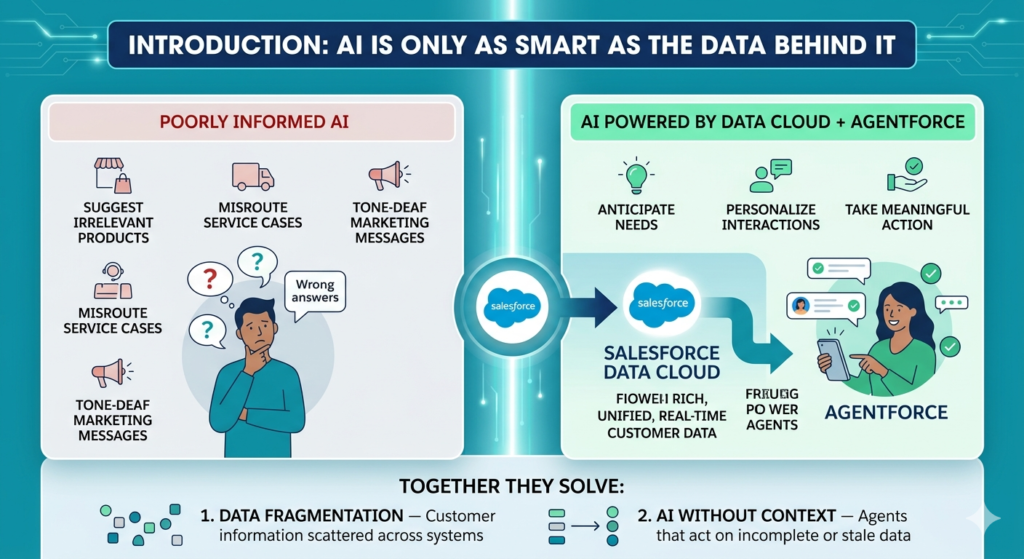
This is precisely why Salesforce Data Cloud + Agentforce has become one of the most discussed combinations in enterprise technology. Together, they solve two fundamental problems:
- Data fragmentation — Customer information scattered across dozens of systems
- AI without context — Agents that act on incomplete or stale data
By unifying your customer data in Data Cloud and exposing it to Agentforce, you create AI agents that are not just automated — they are genuinely intelligent. They understand who your customer is, what they care about, what they have already experienced, and what they are likely to do next.
In this comprehensive guide, we will walk through everything you need to know about salesforce data cloud agentforce — from foundational concepts and architecture to a detailed setup guide and real-world use cases.
1. What Is Salesforce Data Cloud?
Salesforce Data Cloud is a real-time customer data platform (CDP) built natively within the Salesforce ecosystem. Its primary purpose is to break down data silos by ingesting information from every system your business uses and consolidating that information into a single, accurate, and actionable customer profile.
Think of it as the central nervous system of your customer data strategy. Data Cloud does not simply copy records — it understands relationships, resolves identities, and generates intelligence from raw data.
Core Capabilities of Salesforce Data Cloud
Identity Resolution
One of the most powerful features of Data Cloud is its ability to recognize that the same person may appear in multiple systems under different names, email addresses, or identifiers. Identity resolution uses deterministic and probabilistic matching rules to unify these fragmented records into a single Unified Individual profile.
For example, a customer who interacted with your website as an anonymous visitor, signed up for your newsletter with one email address, and placed an order with a different email address will be recognized as one person — not three separate contacts.
Data Harmonization
Data arrives from different systems in different formats and schemas. Data Cloud applies data harmonization to map incoming fields to a standardized data model, ensuring consistency and reliability across all data sources.
Calculated Insights
Beyond storing data, Data Cloud allows you to compute custom metrics and insights directly on top of unified profiles. You can calculate lifetime customer value, engagement scores, churn risk probabilities, purchase frequency, and virtually any other business metric that matters to your organization.
Real-Time Segmentation
Data Cloud enables marketers, sales teams, and AI agents to build dynamic audience segments that update in real time based on customer behaviors and attributes. A customer who crosses a certain spending threshold automatically enters a high-value segment without any manual intervention.
Zero-Copy Integration
Data Cloud supports zero-copy architecture, meaning it can query and analyze data stored in external platforms like Snowflake, Amazon S3, or Google BigQuery without physically moving or duplicating that data. This dramatically reduces data latency and storage costs.
Data Sources Data Cloud Connects To
- Salesforce Sales Cloud, Service Cloud, and Marketing Cloud
- E-commerce platforms
- Mobile applications
- Website analytics systems
- ERP and financial systems
- Third-party data providers
- Streaming event sources
2. What Is Agentforce?
Agentforce is Salesforce’s platform for building and deploying autonomous AI agents across every business function. Unlike traditional chatbots that follow rigid decision trees, Agentforce agents are powered by large language models (LLMs) and can reason, plan, and execute complex multi-step actions based on real-time context.
Agentforce represents a fundamental shift from AI as a recommendation tool to AI as an active participant in business operations.
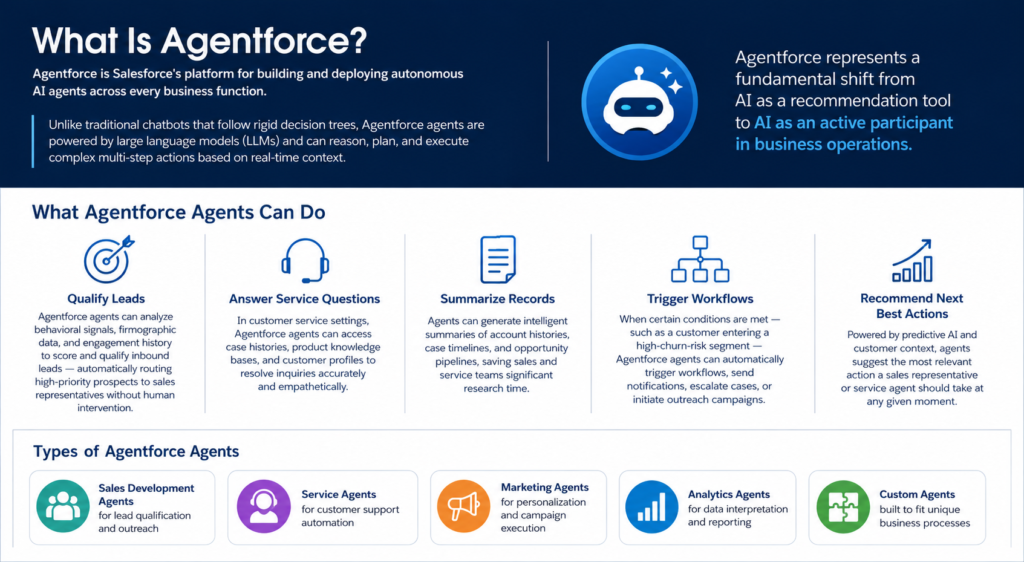
What Agentforce Agents Can Do
Qualify Leads
Agentforce agents can analyze behavioral signals, firmographic data, and engagement history to score and qualify inbound leads — automatically routing high-priority prospects to sales representatives without human intervention.
Answer Service Questions
In customer service settings, Agentforce agents can access case histories, product knowledge bases, and customer profiles to resolve inquiries accurately and empathetically.
Summarize Records
Agents can generate intelligent summaries of account histories, case timelines, and opportunity pipelines, saving sales and service teams significant research time.
Trigger Workflows
When certain conditions are met — such as a customer entering a high-churn-risk segment — Agentforce agents can automatically trigger workflows, send notifications, escalate cases, or initiate outreach campaigns.
Recommend Next Best Actions
Powered by predictive AI and customer context, agents suggest the most relevant action a sales representative or service agent should take at any given moment.
Types of Agentforce Agents
- Sales Development Agents for lead qualification and outreach
- Service Agents for customer support automation
- Marketing Agents for personalization and campaign execution
- Analytics Agents for data interpretation and reporting
- Custom Agents built to fit unique business processes
3. Why Salesforce Data Cloud + Agentforce Is So Powerful
On their own, both platforms are impressive. Together, salesforce data cloud agentforce creates a compounding effect that is significantly greater than the sum of its parts.
Unified Customer Context
Agentforce agents no longer have to operate with a narrow slice of customer information. With Data Cloud behind them, agents have access to the complete 360-degree view — purchase history, service interactions, marketing engagement, behavioral data, and calculated insights — all in one place and in real time.
Real-Time Personalization
Because Data Cloud continuously updates unified profiles as new events occur, Agentforce agents always operate on the freshest possible data. A customer who just visited a pricing page will be treated differently than a customer who last engaged six months ago — and that difference in treatment happens automatically.
Better AI Decisions
Richer, more accurate data leads to better AI reasoning. When an Agentforce agent evaluates whether to escalate a service case or recommend a product upgrade, the quality of that decision is directly tied to the depth and accuracy of the underlying data. Data Cloud ensures that depth is always there.
Reduced AI Hallucinations
One of the most significant risks with AI agents is generating plausible-sounding but factually incorrect responses. When agents are grounded in verified customer data from Data Cloud, the scope for fabrication is dramatically reduced. Agents respond based on real facts about the specific customer, not generic assumptions.
Cross-Cloud Intelligence
Data Cloud pulls together data from Sales Cloud, Service Cloud, Marketing Cloud, Commerce Cloud, and external systems. This means an Agentforce agent serving a service inquiry can also see that the customer is in an active sales cycle — context that transforms how the agent handles the interaction.
4. How Data Cloud AI Integration Works
Understanding the architecture of data cloud AI integration is essential before you begin configuration. Here is how data flows through the system.
The Integration Flow
Step 1 — Data Ingestion
Data Cloud connects to your source systems — CRM, ERP, website analytics, marketing platforms, and third-party providers — using native connectors, APIs, and zero-copy integrations.
Step 2 — Identity Resolution
Incoming records are matched and merged using identity resolution rules. Duplicate records are consolidated into Unified Individual profiles that represent a single, complete view of each customer.
Step 3 — Data Harmonization
Fields from different systems are mapped to a standardized data model, ensuring that “email address” from Salesforce Sales Cloud and “email” from your e-commerce platform are treated as the same attribute.
Step 4 — Calculated Insights and Segmentation
Custom business metrics are computed on top of unified profiles. Segments are built and updated continuously based on behavioral rules and attribute thresholds.
Step 5 — Data Exposure to Agentforce
Unified profiles, calculated insights, and segment membership data are made available to Agentforce through Data Cloud access permissions and grounding configurations.
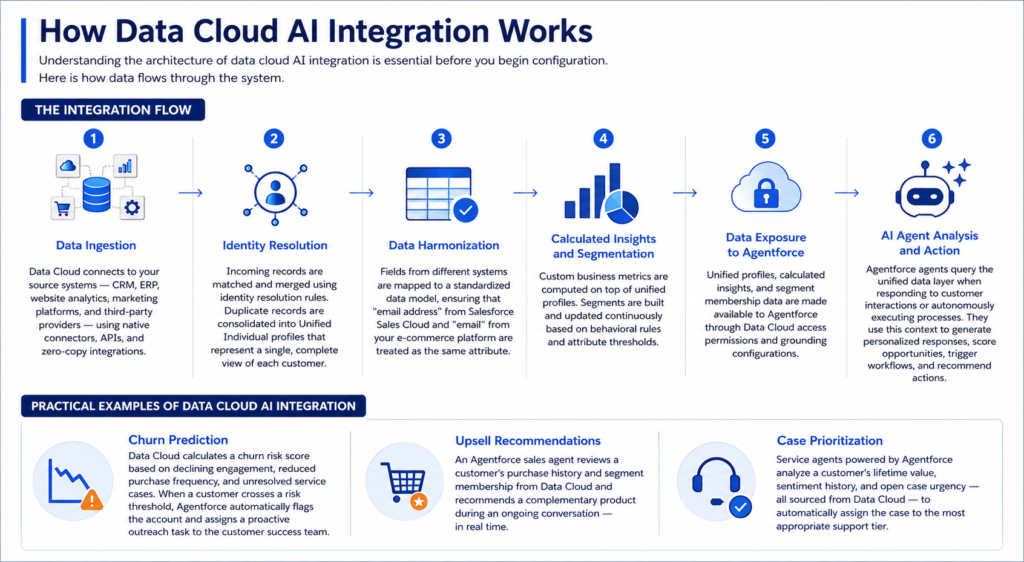
Step 6 — AI Agent Analysis and Action
Agentforce agents query the unified data layer when responding to customer interactions or autonomously executing processes. They use this context to generate personalized responses, score opportunities, trigger workflows, and recommend actions.
Practical Examples of Data Cloud AI Integration
Churn Prediction
Data Cloud calculates a churn risk score based on declining engagement, reduced purchase frequency, and unresolved service cases. When a customer crosses a risk threshold, Agentforce automatically flags the account and assigns a proactive outreach task to the customer success team.
Upsell Recommendations
An Agentforce sales agent reviews a customer’s purchase history and segment membership from Data Cloud and recommends a complementary product during an ongoing conversation — in real time.
Case Prioritization
Service agents powered by Agentforce analyze a customer’s lifetime value, sentiment history, and open case urgency — all sourced from Data Cloud — to automatically assign the case to the most appropriate support tier.
5. Agentforce Data Cloud Setup: Step-by-Step Guide
This section provides a practical agentforce data cloud setup process designed for Salesforce Administrators and Architects.
Step 1: Enable Salesforce Data Cloud
Navigate to Setup > Data Cloud Setup in your Salesforce org. Follow the provisioning wizard to activate Data Cloud. Ensure your edition supports Data Cloud and confirm licensing with your Salesforce account executive.
Step 2: Connect Data Sources
Use the Data Cloud Connectors library to link your source systems. Available connectors include:
- Salesforce CRM (native integration)
- Marketing Cloud Engagement and Account Engagement
- Mulesoft APIs
- Amazon S3
- Google Cloud Storage
- Snowflake (zero-copy)
- Custom connectors via REST API
For each source, configure the data stream, define the ingestion schedule (batch or real-time), and map source fields to Data Cloud’s canonical data model.
Step 3: Configure Identity Resolution
Go to Data Cloud > Identity Resolution and create a new ruleset. Define matching rules using deterministic attributes (email address, phone number, loyalty ID) and probabilistic attributes (name, location, device fingerprint).
Run a test resolution to review match rates and consolidation accuracy. Adjust match thresholds to balance precision and recall based on your data quality.
Step 4: Create Unified Individual Profiles
Once identity resolution rules are active, Data Cloud begins generating Unified Individual records. Review sample profiles to confirm that data from multiple source systems has been correctly consolidated.
Validate that key attributes — contact information, account relationships, purchase history — are populated accurately across the unified profiles.
Step 5: Build Calculated Insights
Navigate to Data Cloud > Calculated Insights and use the SOQL-based formula editor to define custom metrics. Examples include:
- Total Lifetime Value = sum of all completed orders
- Engagement Score = weighted average of email opens, page visits, and event attendance
- Churn Risk Index = formula combining recency, frequency, and service ticket volume
Publish calculated insights to make them available for segmentation and Agentforce grounding.
Step 6: Configure Data Actions
Data Actions allow Data Cloud to trigger responses when segment membership changes or calculated insight thresholds are crossed. Configure Data Actions to:
- Create tasks in Sales Cloud
- Update lead scores
- Trigger Marketing Cloud journeys
- Send Agentforce notifications
Step 7: Enable Agentforce
Go to Setup > Agentforce and enable the Agentforce platform for your org. Review AI model settings and configure the default language model for your agents.
Activate Einstein Trust Layer settings to ensure data used by AI models is governed by your organization’s privacy and security policies.
Step 8: Grant Data Cloud Access to Agents
In Agentforce Agent Builder, configure the data sources available to each agent. Enable Data Cloud grounding by selecting the Unified Individual object and any relevant calculated insights or segment attributes.
Set permission-based access controls to ensure agents can only access data their function requires. For example, a service agent should not have access to sensitive financial attributes beyond what is necessary to resolve a case.
Step 9: Create Agent Instructions and Prompts
Build agent instructions that define how each agent should behave, what data it should reference, and what actions it is authorized to take. Write clear system prompts that include:
- The agent’s role and scope
- Data Cloud attributes it should use
- Boundaries and escalation rules
- Tone and communication guidelines
Test prompts using Agentforce’s built-in testing console to evaluate response quality and data grounding accuracy.
Step 10: Test and Monitor Results
Before going live, run comprehensive tests using real customer profiles from Data Cloud. Evaluate:
- Response accuracy and relevance
- Data grounding correctness
- Workflow trigger accuracy
- Response latency
After deployment, use Agentforce Analytics and Data Cloud dashboards to monitor agent performance, review trust metrics, and continuously refine instructions and data connections.
6. Real-World Use Cases
Sales: Identifying High-Intent Leads
A SaaS company connects its website analytics, CRM, and marketing automation platform to Data Cloud. Behavioral signals — multiple visits to the pricing page, content downloads, and email click-throughs — are unified in a single profile. Agentforce sales agents analyze these signals in real time, score the lead as high-intent, and automatically assign it to the most appropriate sales representative along with a personalized outreach recommendation.
Service: Resolving Cases with Complete Context
A telecommunications provider integrates its billing system, service history database, and CRM into Data Cloud. When a customer contacts support, an Agentforce service agent immediately accesses the unified profile — seeing recent billing disputes, network outage history in their area, and previous case resolutions. The agent provides an informed, empathetic response and proposes a resolution that acknowledges the customer’s full history.
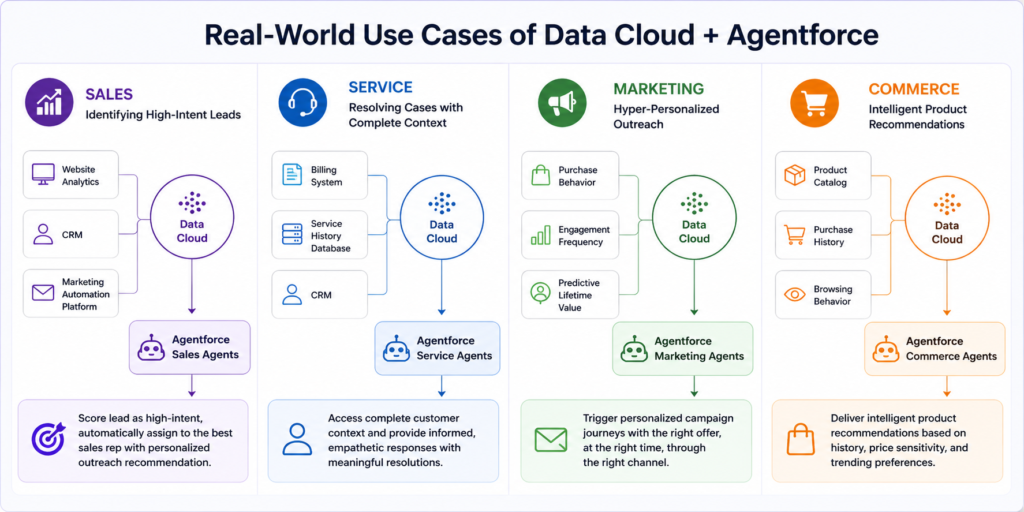
Marketing: Hyper-Personalized Outreach
A retail brand uses Data Cloud to segment customers based on purchase behavior, engagement frequency, and predictive lifetime value. Agentforce marketing agents trigger individualized campaign journeys — sending the right offer, at the right time, through the right channel — based on each customer’s segment membership and real-time engagement signals.
Commerce: Intelligent Product Recommendations
An e-commerce platform connects its product catalog, purchase history, and browsing behavior to Data Cloud. Agentforce commerce agents analyze each customer’s unified profile and deliver product recommendations that account for past purchases, price sensitivity, and trending preferences within similar customer segments.
7. Example Scenario: From Signal to Action
Imagine a prospective enterprise customer named Sarah. Over the course of two weeks, Sarah:
- Visits your product pricing page four times
- Downloads a case study on enterprise ROI
- Opens three emails from your marketing campaign
- Attends a webinar on your platform’s AI capabilities
Each of these signals is captured by a different system — your website analytics platform, your marketing automation tool, your email service provider, and your webinar platform. Without Data Cloud, these signals are scattered across four separate systems and nobody has a complete picture of Sarah’s intent.
With Data Cloud, all four signals are ingested, harmonized, and unified under Sarah’s single profile. A calculated insight computes her Lead Intent Score as 94 out of 100. She automatically enters the High-Intent Enterprise Prospect segment.
Agentforce detects the segment entry, triggers a data action, and automatically:
- Creates a high-priority lead record in Sales Cloud
- Assigns the lead to the most relevant account executive based on industry match
- Generates a personalized outreach email draft referencing the content Sarah engaged with
- Schedules a follow-up reminder for 24 hours later if there is no response
The entire process happens without any human intervention — and the sales representative receives a fully contextualized lead ready for a meaningful first conversation.
8. Benefits of Data Cloud AI Integration
Single Source of Truth
Every AI decision is grounded in one consistent, verified customer profile — eliminating the contradictions and gaps that arise when data lives in separate systems.
Personalized Automation at Scale
AI agents can deliver individualized experiences to thousands of customers simultaneously, something impossible with manual processes.
Real-Time Decision Making
Because Data Cloud profiles update continuously, Agentforce agents always act on the most current available information — responding to customer signals as they happen.
Better Productivity
Sales, service, and marketing teams spend less time researching, summarizing, and manually processing information — freeing capacity for higher-value relationship work.
Scalable AI Architecture
The Data Cloud and Agentforce combination is built to grow with your organization. As data volumes increase and new use cases emerge, the architecture scales without requiring fundamental redesign.
9. Best Practices for Agentforce Data Cloud Setup
Start with High-Value Use Cases
Resist the temptation to connect every data source and build every agent simultaneously. Identify two or three use cases with measurable business impact and build them well before expanding.
Clean and Normalize Source Data
The quality of your unified profiles depends entirely on the quality of your source data. Invest in data cleansing, deduplication, and standardization before ingesting into Data Cloud.
Use Calculated Insights Strategically
Not every metric needs to be a calculated insight. Focus on insights that directly inform AI agent behavior — churn risk, engagement scores, lifetime value — and keep your insight library manageable.
Define Clear Guardrails for AI Agents
Autonomous agents must operate within defined boundaries. Clearly specify what actions an agent can take independently versus what requires human approval. Document escalation paths and audit these regularly.
Monitor Performance and Trust Metrics
Use Salesforce’s Einstein Trust Layer dashboards to track agent accuracy, data grounding quality, and customer satisfaction. Treat AI monitoring as an ongoing practice, not a one-time validation.
10. Common Challenges and Solutions
| Challenge | Solution |
|---|---|
| Duplicate identities in unified profiles | Refine identity resolution matching rules; add more deterministic identifiers |
| Poor data quality from source systems | Implement data validation and standardization at the source before ingestion |
| Agent responses lack sufficient context | Expand Data Cloud attributes exposed to agents; add relevant calculated insights |
| Security and privacy concerns | Use Einstein Trust Layer; configure permission-based access controls per agent role |
| Slow data refresh causing outdated context | Switch from batch ingestion to real-time streaming for high-priority data sources |
| Low adoption among sales and service teams | Demonstrate quick wins; provide training on agent capabilities and time savings |
11. Salesforce Data Cloud + Agentforce vs. Traditional AI
| Dimension | Traditional AI Models | Data Cloud + Agentforce |
|---|---|---|
| Data source | Single or limited systems | Unified multi-source profiles |
| Data freshness | Periodic batch updates | Real-time continuous updates |
| Personalization depth | Segment-level or generic | Individual-level precision |
| Agent autonomy | Recommendation only | Autonomous action and execution |
| Context window | Narrow | Full 360-degree customer view |
| Hallucination risk | Higher due to limited grounding | Lower due to verified data grounding |
| Cross-functional intelligence | Limited | Cross-cloud data visibility |
| Scalability | Model-dependent | Platform-native and inherently scalable |
The contrast illustrates clearly why organizations that invest in the salesforce data cloud agentforce combination outperform those using isolated AI models. The difference is not just technical — it is strategic. Unified data transforms AI from a productivity tool into a genuine business differentiator.
12. The Future of AI on Salesforce
The roadmap for Salesforce AI points toward an increasingly autonomous and predictive CRM experience. Here are the trends shaping the next evolution of salesforce data cloud agentforce.
Predictive and Prescriptive Intelligence
Future Agentforce agents will not just react to current signals — they will predict future customer behavior with greater accuracy and prescribe the optimal business response. Data Cloud’s continuously expanding data layer and increasingly sophisticated calculated insights will power this predictive capability.
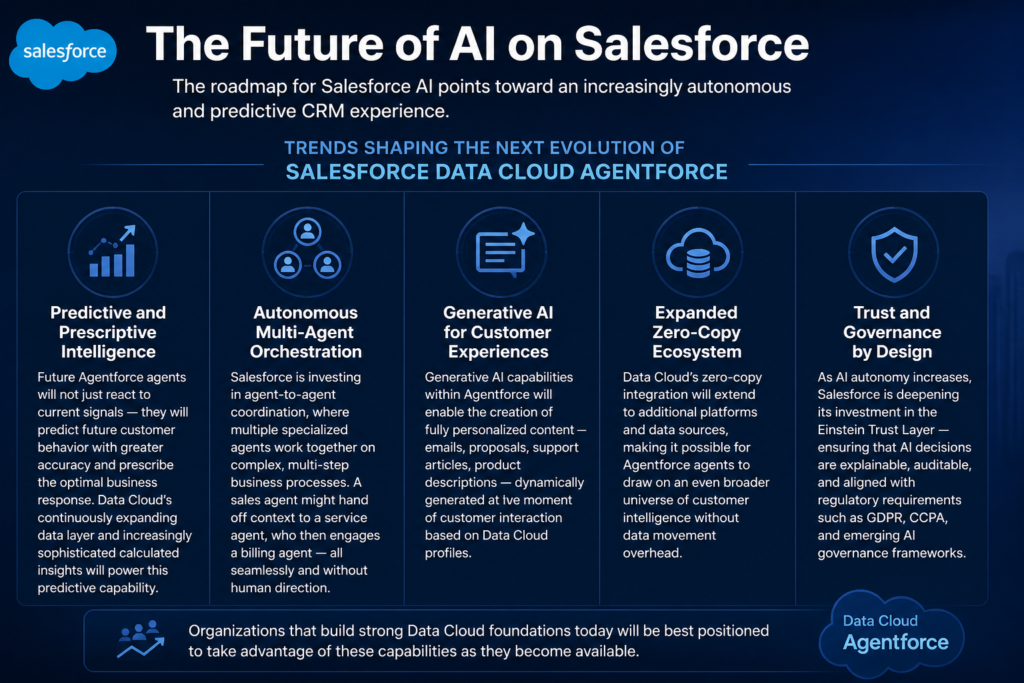
Autonomous Multi-Agent Orchestration
Salesforce is investing in agent-to-agent coordination, where multiple specialized agents work together on complex, multi-step business processes. A sales agent might hand off context to a service agent, who then engages a billing agent — all seamlessly and without human direction.
Generative AI for Customer Experiences
Generative AI capabilities within Agentforce will enable the creation of fully personalized content — emails, proposals, support articles, product descriptions — dynamically generated at the moment of customer interaction based on Data Cloud profiles.
Expanded Zero-Copy Ecosystem
Data Cloud’s zero-copy integration will extend to additional platforms and data sources, making it possible for Agentforce agents to draw on an even broader universe of customer intelligence without data movement overhead.
Trust and Governance by Design
As AI autonomy increases, Salesforce is deepening its investment in the Einstein Trust Layer — ensuring that AI decisions are explainable, auditable, and aligned with regulatory requirements such as GDPR, CCPA, and emerging AI governance frameworks.
Organizations that build strong Data Cloud foundations today will be best positioned to take advantage of these capabilities as they become available.
Conclusion
The combination of Salesforce Data Cloud and Agentforce is not just a technology integration — it is a fundamental rethinking of how AI can serve your customers and your business.
Data Cloud solves the data problem: it unifies fragmented customer information from every source into a trusted, real-time, single profile that is always accurate and always current. Agentforce solves the action problem: it transforms that rich data into intelligent, autonomous agents that can qualify leads, resolve service issues, personalize marketing, and recommend next best actions — all without waiting for human instruction.
Together, salesforce data cloud agentforce creates an AI ecosystem that is more accurate, more personalized, more proactive, and more scalable than anything achievable with traditional approaches.
The agentforce data cloud setup process outlined in this guide gives you a clear, practical path to getting started. Begin with your highest-value use case, invest in data quality, define clear agent boundaries, and monitor continuously. The results — faster sales cycles, stronger customer retention, higher agent productivity, and more meaningful customer experiences — will speak for themselves.
The future of CRM is intelligent, unified, and autonomous. That future is available today with Salesforce Data Cloud and Agentforce — and there has never been a better time to start building it.
About RizeX Labs
At RizeX Labs, we help organizations unlock the full potential of Salesforce AI by implementing Salesforce Data Cloud and Agentforce solutions. Our consultants combine deep technical expertise with real-world experience to design unified data architectures that power intelligent automation across sales, service, and marketing.
We enable businesses to transform fragmented customer data into a single source of truth and use AI agents to deliver personalized insights, automate actions, and improve customer experiences at scale.
Internal Linking Opportunities
- Link to your Salesforce training page
- How to Build a Salesforce Portfolio That Gets You Hired (With Project Ideas)
- Salesforce Admin vs Developer: Which Career Path is Right for You in 2026?
- Wealth Management App in Financial Services Cloud
External Linking Opportunities
- Salesforce official website
- Salesforce Data Cloud
- Salesforce Agentforce
- Salesforce Help Documentation
- Salesforce Trailhead Data Cloud modules
- Salesforce AI resources and blogs
Quick Summary
Salesforce Data Cloud + Agentforce combines unified customer data with autonomous AI agents to create smarter, context-aware automation. Data Cloud consolidates information from CRM, marketing, commerce, and external systems into a real-time customer profile, while Agentforce uses that data to make intelligent decisions and take action.
This powerful combination enables organizations to personalize customer interactions, automate business processes, and improve AI accuracy by grounding responses in trusted data. From lead qualification and service automation to predictive recommendations, this architecture forms the foundation for enterprise AI on Salesforce.
