
Introduction: The Hidden Intelligence in Every Customer Conversation
Every customer who contacts your support team tells a story. Sometimes that story is about a billing error that was never explained clearly. Sometimes it is about a product feature that does not work as advertised. Sometimes it reveals a self-service process so confusing that customers give up and call your agents instead.
The problem is that most organizations never hear those stories — not at scale, anyway. Contact center teams are busy handling the next interaction, not analyzing the last thousand. Managers rely on anecdotal feedback, manual ticket sampling, or lagging metrics like CSAT and average handle time. By the time a trend becomes visible through these traditional methods, the damage is already done.
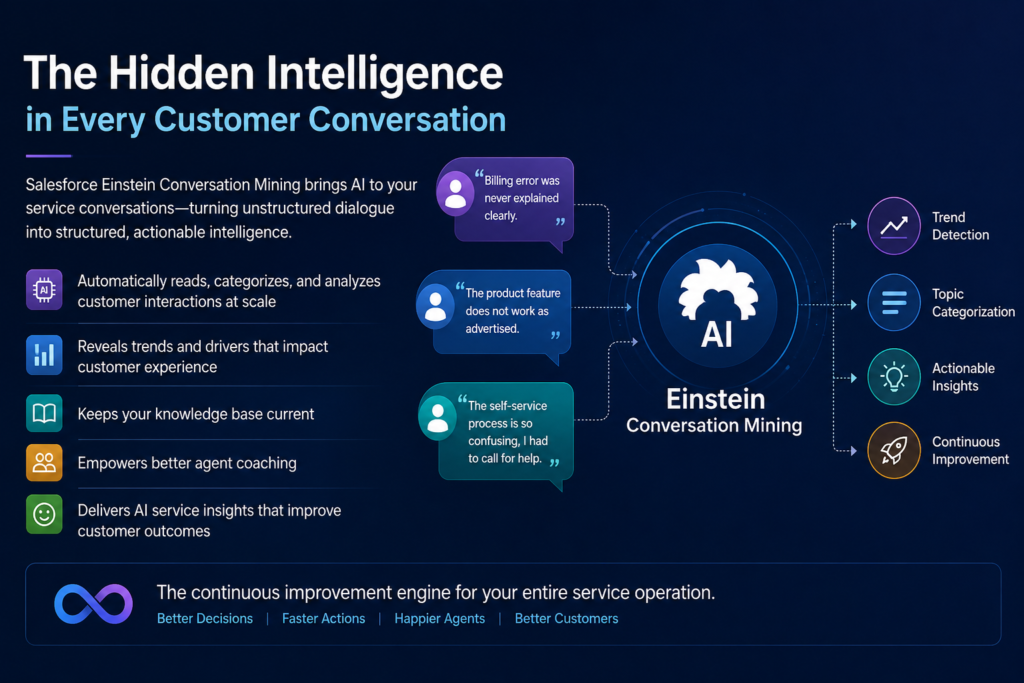
Salesforce Einstein Conversation Mining solves this problem by bringing AI directly to the place where customer intelligence lives — your service conversations. It automatically reads, categorizes, and analyzes customer interactions at scale, turning the raw text of support conversations into structured, actionable intelligence that service leaders can use to make better decisions faster.
This is not just an analytical tool. It is a continuous improvement engine for your entire service operation. When integrated effectively into your conversation analytics Salesforce strategy, Einstein Conversation Mining becomes the feedback loop that keeps your knowledge base current, your agents well-coached, and your customers better served — all powered by AI service insights that previously would have required weeks of manual analysis to produce.
1. What Is Salesforce Einstein Conversation Mining?
Salesforce Einstein Conversation Mining is an AI-powered capability within Salesforce Service Cloud that automatically analyzes customer service conversations to identify topics, detect sentiment, uncover trends, and generate actionable insights about service performance and customer experience.
At its core, Einstein Conversation Mining applies natural language processing (NLP) and unsupervised machine learning to unstructured conversation data — including live chat transcripts, email case threads, messaging interactions, and case notes. It groups similar conversations together into clusters of related topics, identifies patterns across large volumes of interactions, and presents findings in a structured, easily interpretable format.
Think of it as having an infinitely patient analyst who reads every single customer interaction your team handles and then summarizes what customers are really talking about, how they feel about it, and whether certain issues are getting better or worse over time.
Core Capabilities of Einstein Conversation Mining
Topic Discovery
Einstein Conversation Mining uses clustering algorithms to automatically identify the most common subjects appearing across your conversation data. Rather than requiring administrators to predefine categories, the AI discovers topics organically from the actual language customers use — revealing issues that manual category structures might never capture.
Sentiment Analysis
The platform evaluates the emotional tone of conversations, classifying interactions as positive, neutral, or negative and identifying the specific moments within conversations where sentiment shifts. This helps managers understand not just what customers are contacting about, but how they feel about the experience.
Trend Detection
Einstein Conversation Mining monitors topic volumes and sentiment patterns over time, automatically alerting service teams when a particular issue is growing in frequency or when customer satisfaction around a specific topic is declining. This enables proactive responses to emerging problems before they escalate.
Root Cause Identification
By analyzing which topics consistently appear together and which conversation patterns precede negative outcomes, Einstein Conversation Mining helps service leaders identify the underlying causes of service failures — not just the symptoms.
Service Performance Insights
The platform connects conversation intelligence to operational metrics, helping managers understand which topics drive the longest handle times, which issues generate the most repeat contacts, and where self-service deflection opportunities exist.
2. How Conversation Analytics Works in Salesforce
Understanding the underlying process of conversation analytics Salesforce helps administrators and service leaders configure the system effectively and interpret insights with confidence.
The Conversation Analytics Process
Stage 1: Data Collection
Einstein Conversation Mining begins with the aggregation of conversation data from your active service channels. This includes chat transcripts from Live Agent and Messaging, email case communications stored in Service Cloud, case description and comment fields, and integrated voice transcripts where available. The quality and breadth of insights produced depend directly on the volume and diversity of conversation data collected.
Stage 2: Text Processing and Cleaning
Before analysis begins, the platform applies preprocessing steps to standardize conversation text. This includes removing common stop words, normalizing spelling variations, handling industry-specific terminology, and separating agent messages from customer messages to enable more targeted analysis.
Stage 3: AI Topic Clustering
The NLP engine analyzes the semantic content of conversations and groups interactions that share similar meaning and subject matter into topic clusters. This process is unsupervised — the AI identifies natural groupings rather than forcing conversations into predefined boxes. Topics are described using the most representative terms extracted from the conversations within each cluster.
Stage 4: Sentiment Scoring and Emotion Detection
Each conversation and each topic cluster is evaluated for emotional tone. The sentiment model assesses not just the presence of positive or negative language, but the intensity and progression of sentiment throughout an interaction — identifying, for example, whether a conversation that started neutrally deteriorated as it progressed.
Stage 5: Insight Surfacing
Processed data is presented through Einstein Conversation Mining dashboards within Salesforce, showing topic frequency rankings, sentiment distributions, trend lines over selectable time periods, and drill-down views of individual conversation examples within each topic.
Stage 6: Action Enablement
The final and most important stage is converting insights into service improvements. Dashboards connect to Salesforce Knowledge, agent coaching tools, and process management capabilities, creating a direct pathway from insight to action.
3. Why AI Service Insights Matter
AI service insights are not just analytically interesting — they are operationally transformative when acted upon consistently. Here is why they matter profoundly for modern customer service organizations.
Identifying Common Customer Pain Points
Without conversation mining, understanding why customers contact support requires manual sampling, agent surveys, or customer research studies. Each of these approaches is slow, expensive, and subject to bias. Einstein Conversation Mining delivers an objective, comprehensive view of customer pain points derived directly from the conversations themselves — not from what agents remember or what customers say in optional surveys.
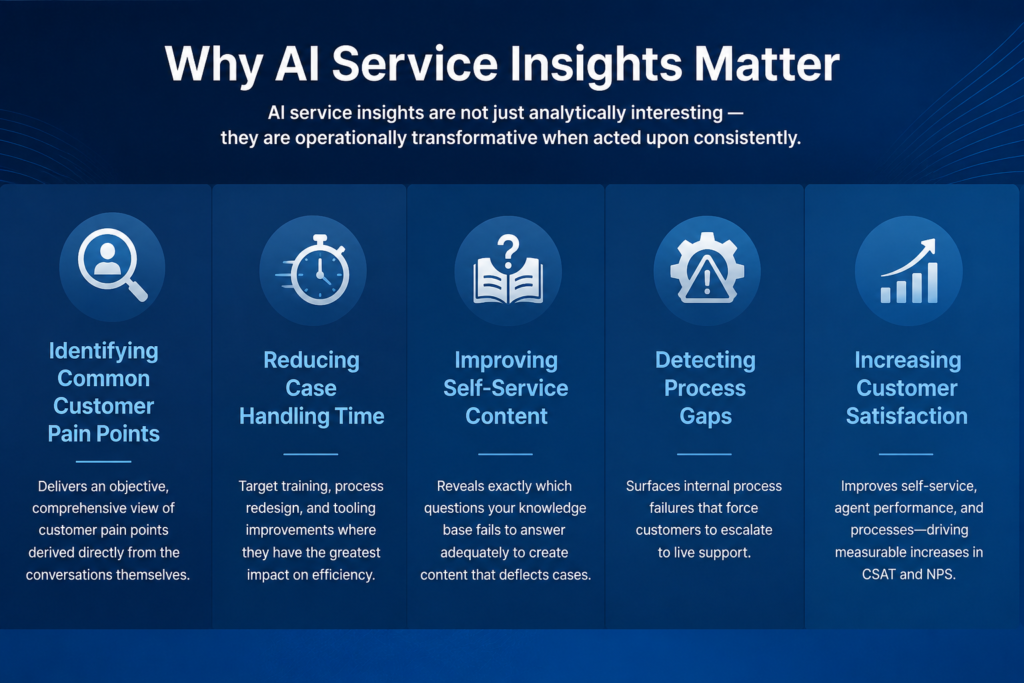
Reducing Case Handling Time
When service leaders understand which topics consume the most agent time and why, they can target training, process redesign, and tooling improvements precisely where they will have the greatest impact on efficiency. Agents become faster and more confident handling common issues when they are equipped with better resources informed by conversation intelligence.
Improving Self-Service Content
Many customers would prefer to resolve issues without contacting support — if they could find clear, accurate answers in your self-service channels. Conversation mining reveals exactly which questions your knowledge base fails to answer adequately, enabling content teams to create targeted articles and guides that genuinely deflect cases.
Detecting Process Gaps
Some of the most valuable insights from conversation analytics relate not to product problems or knowledge gaps, but to internal process failures — confusing invoices, poorly worded notifications, unclear product documentation, or broken automated workflows that force customers to escalate to live support. Conversation mining surfaces these patterns systematically.
Increasing Customer Satisfaction
Organizations that act consistently on conversation insights create a virtuous cycle: better self-service reduces frustration, better-trained agents resolve issues faster, and improved processes eliminate the root causes of common complaints. Each of these improvements contributes directly to measurable increases in CSAT and Net Promoter Score.
4. Key Features of Salesforce Einstein Conversation Mining
Automatic Topic Categorization
Salesforce Einstein Conversation Mining automatically categorizes incoming conversation data into meaningful topic groups without requiring administrators to build manual classification rules. Topics are generated dynamically from actual conversation content, ensuring they reflect the real language and concerns of your customers rather than the assumed categories of internal teams.
Sentiment and Emotion Analysis
The platform goes beyond simple positive/negative classification to evaluate emotional nuance across conversations. Managers can see which topics generate the highest negative sentiment, where customer frustration spikes during interactions, and how sentiment correlates with resolution outcomes.
Trend Monitoring
Trend monitoring capabilities allow service leaders to compare topic volumes and sentiment scores across configurable time periods. Setting up alerts for significant volume increases or sentiment declines ensures that emerging issues receive attention before they reach crisis proportions.
Agent Coaching Opportunities
By analyzing conversation patterns associated with successful resolution versus escalation or repeat contact, Einstein Conversation Mining identifies specific coaching opportunities for individual agents or agent cohorts. Managers receive data-driven guidance on which conversation behaviors to reinforce and which to address.
Knowledge Article Recommendations
One of the most directly actionable outputs of conversation mining is the identification of knowledge article gaps. The platform surfaces topics frequently appearing in conversations but poorly covered by existing Knowledge articles, creating a prioritized content development queue based on actual customer needs.
5. How to Set Up Einstein Conversation Mining: Step-by-Step
This section provides a practical implementation guide for the agentforce data cloud setup of Einstein Conversation Mining within your Salesforce Service Cloud environment.
Step 1: Enable Einstein Features
Navigate to Setup > Einstein > Einstein Conversation Mining in your Salesforce org. Confirm that your Service Cloud edition includes Einstein Conversation Mining as part of your licensing. If not, work with your Salesforce account executive to add the appropriate Einstein for Service license. Enable the feature and accept the Einstein feature settings and data processing agreements.
Verify that Einstein Activity Capture and relevant Einstein AI permissions are enabled in your org to support conversation data access.
Step 2: Connect Service Data Sources
Go to Setup > Data > Data Sources and confirm that your active service channel data is accessible within Salesforce. For native channels such as Salesforce Live Agent, Messaging for In-App and Web, and Email-to-Case, data connections are established automatically through Service Cloud.
For external channels or third-party contact center platforms, configure data integration using Salesforce APIs, MuleSoft connectors, or compatible middleware solutions to pipe conversation transcripts into the Service Cloud data layer.
Step 3: Select Conversation Channels
Within the Einstein Conversation Mining configuration interface, select the specific channels you want to include in your initial analysis. Available channel options typically include:
- Chat — Live Agent and Messaging transcripts
- Email — Email-to-Case thread content
- Case Comments — Text from case activity history
- Voice Transcripts — Where voice AI transcription is configured
For your initial deployment, starting with your highest-volume channel provides the fastest path to statistically significant insights.
Step 4: Train Topic Models
Configure the topic model by defining your data scope — the date range of historical conversations you want to include in the initial analysis. A minimum of 30 days of conversation data is recommended; 90 days or more provides richer trend context.
Set the minimum conversation volume threshold for topic inclusion to filter out extremely rare topics that may represent noise rather than meaningful patterns. Einstein’s AI will process the selected conversation corpus and generate an initial topic model within the configured timeframe.
Step 5: Review and Label Topics
When the initial topic model is generated, review the automatically discovered topics in the Einstein Conversation Mining dashboard. The AI provides suggested topic labels based on the most representative terms within each cluster.
Review a sample of conversations within each topic cluster to validate that the groupings are coherent and meaningful from a business perspective. Relabel topics using clear, business-friendly terminology that will be immediately understandable to service managers and stakeholders.
Merge overlapping topics and split topics that are too broad into more specific sub-categories as needed. This human review step is essential for ensuring the resulting insights are immediately actionable.
Step 6: Build Dashboards
Use the Einstein Conversation Mining dashboard builder and Salesforce CRM Analytics to create visual representations of your conversation intelligence. Essential dashboard components include:
- Topic Volume Ranking — ranked list of the most frequent conversation topics
- Sentiment Distribution by Topic — breakdown of positive, neutral, and negative sentiment within each topic
- Volume Trend Charts — time-series visualization of topic frequency changes
- Topic Heatmap — visualization of which topics occur together frequently
- Agent Performance by Topic — resolution quality metrics broken down by conversation topic
Step 7: Share Insights With Service Teams
Distribute dashboard access to relevant stakeholders using Salesforce sharing settings and permission sets. Create role-specific views so that:
- Contact center managers see strategic trend and volume data
- Team leads see coaching opportunity insights for their specific teams
- Knowledge managers see article gap recommendations
- Product and operations teams see issue trend alerts relevant to their domains
Schedule regular automated report distributions to keep stakeholders informed without requiring active dashboard visits.
6. Real-World Use Cases
Reducing Repetitive Cases
A software company implements Einstein Conversation Mining and discovers that 28% of all support conversations relate to a single issue: customers not understanding how to configure a newly released integration feature. Armed with this data, the service operations team prioritizes the creation of a comprehensive setup guide and an interactive troubleshooting wizard in the self-service portal. Within 60 days, contact volume for this topic drops by 40%.
Improving the Knowledge Base
A financial services company uses AI service insights to identify 15 conversation topics that appear frequently but have no corresponding Knowledge article. The knowledge management team uses this prioritized list to create targeted content, resulting in measurable improvements in self-service deflection rates within the first quarter.
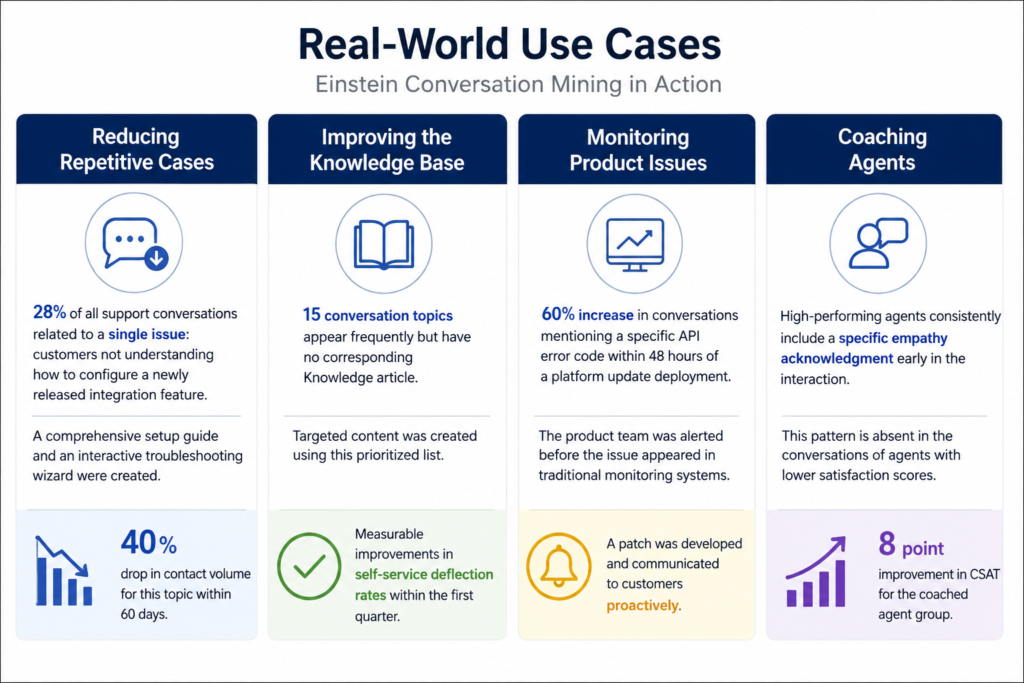
Monitoring Product Issues
An enterprise software provider uses trend monitoring within salesforce einstein conversation mining to detect a sudden 60% increase in conversations mentioning a specific API error code within 48 hours of a platform update deployment. The product team is alerted before the issue appears in traditional monitoring systems, enabling a patch to be developed and communicated to customers proactively.
Coaching Agents
A telecommunications contact center uses conversation pattern analysis to identify that calls handled by high-performing agents consistently include a specific empathy acknowledgment early in the interaction. This pattern is absent in the conversations of agents with lower satisfaction scores. The insight drives a targeted coaching intervention that improves CSAT by 8 points for the coached agent group.
7. Example Scenario: Telecom Billing Confusion Drives Chat Volume
Consider a mid-sized telecommunications provider experiencing an unexpected 35% increase in chat volume over a three-week period. Traditional analysis methods — sampling tickets, reading agent feedback — produce conflicting theories about the cause.
The service operations manager activates Einstein Conversation Mining on the past 30 days of chat transcripts. Within hours, the dashboard reveals a clear pattern: billing-related topics account for 41% of all chat conversations, and sentiment within this topic cluster is strongly negative — significantly worse than the company’s historical billing sentiment baseline.
Drilling into the billing topic cluster, the manager discovers that a high proportion of conversations reference confusion about new line item descriptions on the recently redesigned monthly invoice. Customers cannot interpret the charges, do not trust them, and are contacting support to ask agents to explain what they are being billed for.
Armed with this specific insight, the service team takes three targeted actions:
First, the billing and product teams are alerted immediately and design a plain-language explanatory guide for the new invoice format.
Second, the knowledge management team creates a detailed FAQ article explaining each new line item — and promotes it prominently in the self-service portal and within chat bot pre-conversation messages.
Third, the agent training team develops a specific response template for billing explanation conversations, reducing handle time from an average of 9 minutes to 4 minutes.
Within four weeks, billing-related chat volume drops by 45%, overall chat volume returns to baseline levels, and CSAT for billing interactions improves by 12 points. The entire insight-to-action cycle took less than one week from initial conversation mining analysis to implemented changes.
8. Benefits of Conversation Analytics Salesforce
Faster Root Cause Analysis
What previously required weeks of manual ticket sampling can be accomplished in hours with conversation analytics Salesforce. Service leaders can identify the root causes of volume spikes, satisfaction declines, and process failures with the speed and precision that modern business demands.
Data-Driven Decision Making
Investment decisions about knowledge base content, agent training programs, product improvements, and self-service channel development are grounded in objective, comprehensive conversation data rather than intuition or anecdote.
Lower Support Costs
Every case deflected through improved self-service content, every repeat contact eliminated through better first-contact resolution, and every minute saved through more efficient agent conversations contributes directly to measurable cost reduction in support operations.
Better Customer Experiences
Customers experience the benefits of conversation mining indirectly but tangibly — through clearer self-service resources, faster and more accurate agent responses, and proactive communications about issues before they have to call and ask.
Continuous Service Optimization
Unlike one-time service improvement projects, Einstein Conversation Mining creates a continuous feedback loop. As new issues emerge, they are detected quickly. As improvements are implemented, their impact is measured in subsequent conversation data. Service quality improves iteratively and permanently.
9. Best Practices for AI Service Insights
Use Clean, High-Quality Conversation Data
The quality of insights produced by Einstein Conversation Mining is directly proportional to the quality of conversation data ingested. Invest in standardizing how conversations are captured across channels, ensure transcripts are complete, and address any data gaps before expecting high-quality topic models.
Regularly Review Discovered Topics
Topic models should not be configured once and forgotten. Schedule monthly reviews of your conversation mining dashboard to validate that topic labels remain accurate, merge topics that have become redundant, and identify newly emerging issues that warrant attention.
Combine Sentiment with Operational Metrics
Sentiment data is most powerful when correlated with operational metrics such as average handle time, first contact resolution rate, and customer effort scores. Building integrated dashboards that show both dimensions simultaneously enables richer analysis.
Validate Insights with Business Stakeholders
Before acting on conversation mining insights, validate your interpretations with subject matter experts from product, operations, and customer success teams. Conversation mining tells you what customers are saying — domain experts help you understand why and what to do about it.
Act Quickly on Emerging Trends
The competitive advantage of AI-powered trend detection is only realized if your organization has processes in place to respond rapidly. Establish a clear escalation path for significant trend alerts, with defined owners and response timelines for different types of emerging issues.
10. Common Challenges and Solutions
| Challenge | Solution |
|---|---|
| Inconsistent conversation data quality across channels | Standardize data collection processes and implement conversation logging requirements for all active channels |
| AI generates irrelevant or too-broad topics | Refine topic labeling manually, increase minimum volume thresholds, and adjust conversation date range scope |
| Low dashboard adoption among managers | Conduct targeted training sessions, share insight-to-action success stories, and integrate dashboards into existing team review rituals |
| Difficulty translating insights into concrete actions | For each significant topic, create a structured action plan template that assigns owners, timelines, and success metrics |
| Conversation mining insights contradict team assumptions | Treat the discrepancy as a valuable finding; investigate whether operational assumptions need to be updated based on actual customer data |
| Privacy concerns about analyzing customer conversations | Review Einstein Trust Layer settings, ensure data anonymization where required, and conduct a privacy impact assessment before deployment |
11. Einstein Conversation Mining vs. Manual Analysis
| Dimension | Manual Analysis | Einstein Conversation Mining |
|---|---|---|
| Analysis speed | Days to weeks per cycle | Hours for continuous analysis |
| Coverage | Sample-based (typically 1-5% of conversations) | 100% of conversation data |
| Objectivity | Subject to analyst bias and interpretation | Objective, algorithm-driven clustering |
| Topic discovery | Limited to predefined categories | Discovers unanticipated topics organically |
| Trend detection | Reactive — identified after trends mature | Proactive — alerts to emerging patterns early |
| Sentiment analysis | Manual reading and scoring | Automated scoring across all conversations |
| Scalability | Degrades as volume increases | Scales linearly with conversation volume |
| Cost | High — requires dedicated analyst time | Low marginal cost per additional conversation analyzed |
| Consistency | Variable across analysts and time periods | Consistent methodology applied uniformly |
| Actionability | Dependent on analyst’s business context | Integrated with Knowledge, coaching, and workflow tools |
The contrast is stark and significant. Organizations relying on manual conversation analysis are operating with a fundamental intelligence disadvantage — seeing only a fraction of their conversation data, seeing it slowly, and seeing it through the subjective lens of whoever happens to be doing the analysis at the time. Salesforce Einstein Conversation Mining eliminates all of these limitations simultaneously.
12. The Future of AI Service Insights
The capabilities of Einstein Conversation Mining today represent just the beginning of what AI-powered conversation intelligence will deliver to customer service organizations in the near future.
Generative AI-Powered Insight Narratives
Rather than presenting raw dashboards that require interpretation, future iterations of conversation analytics will use generative AI to produce natural language summaries and recommendations. A contact center manager will be able to ask “What are the most important service issues I need to address this week?” and receive a comprehensive, contextually aware response that synthesizes conversation data, operational metrics, and historical patterns.
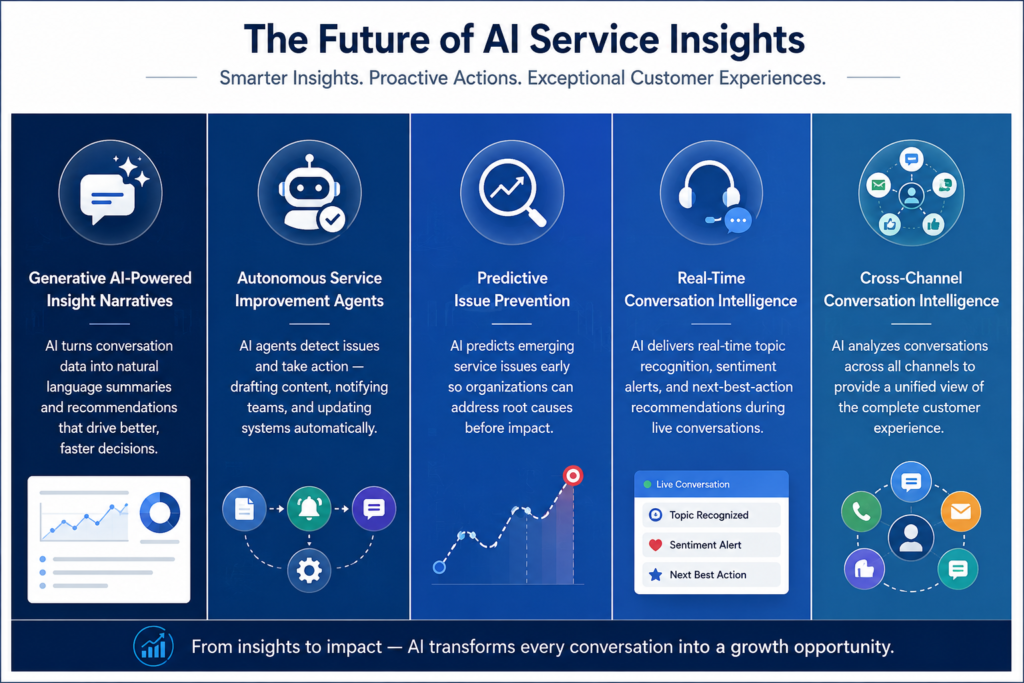
Autonomous Service Improvement Agents
As Agentforce and conversation intelligence become more deeply integrated, AI agents will not just surface insights — they will act on them autonomously. An agent detecting a rising complaint trend might automatically draft a knowledge article for human review, trigger a product team notification, and update the relevant chatbot decision tree — all within minutes of the trend crossing a significance threshold.
Predictive Issue Prevention
Future conversation analytics capabilities will shift from reactive pattern detection to predictive issue identification — forecasting emerging service problems based on early signal patterns before they generate significant contact volume. Organizations will be able to address root causes before most customers experience the issue.
Real-Time Conversation Intelligence
While current Einstein Conversation Mining operates primarily on historical data with some near-real-time capabilities, future development will bring conversation intelligence directly into the live interaction — providing agents with real-time topic recognition, sentiment alerts, and next-best-action recommendations as conversations unfold.
Cross-Channel Conversation Intelligence
As customer journeys span an increasing variety of channels — voice, chat, email, messaging, social, and emerging channels — conversation intelligence platforms will evolve to provide unified analysis across all touchpoints simultaneously, creating a complete picture of the multi-channel customer experience.
Conclusion
Customer conversations are among the richest sources of strategic intelligence available to any service organization. Every chat transcript, every email thread, every case note contains signals about what your customers need, what your processes are failing to deliver, and where your biggest opportunities for improvement lie.
Salesforce Einstein Conversation Mining ensures that none of this intelligence goes to waste. By automatically analyzing conversations at scale, discovering topics organically, tracking sentiment and trends continuously, and surfacing actionable insights through intuitive dashboards, it transforms conversation data from an archive of past interactions into a living engine for ongoing service improvement.
The organizations that invest in conversation analytics Salesforce today will have a structural advantage in understanding and serving their customers tomorrow. They will detect issues faster, respond more effectively, coach agents more precisely, and create self-service experiences that genuinely answer the questions customers are actually asking.
The implementation path is clear, the technology is mature, and the business case is compelling. Whether you are starting with a single channel or building a comprehensive multi-channel conversation intelligence strategy, the first step is the same: turn on Einstein Conversation Mining, let the AI read what your customers are telling you, and then have the discipline to act on what it finds.
Your customers have been telling you exactly how to serve them better — in every conversation, every day. Salesforce Einstein Conversation Mining makes sure you finally hear them.
About RizeX Labs
At RizeX Labs, we help organizations transform customer service operations with advanced Salesforce AI capabilities, including Einstein Conversation Mining and Service Cloud analytics. Our team combines deep Salesforce expertise with practical implementation experience to uncover actionable insights from customer conversations and improve service performance.
We enable businesses to analyze chat, email, messaging, and call transcripts using AI to detect recurring issues, measure sentiment, and identify opportunities to enhance customer satisfaction, agent productivity, and operational efficiency.
Internal Linking Opportunities
External Linking Opportunities
- Salesforce official website
- Salesforce Einstein AI
- Salesforce Service Cloud
- Salesforce Help Documentation
- Salesforce Trailhead
Quick Summary
Einstein Conversation Mining helps organizations turn customer conversations into actionable insights using AI. By applying conversation analytics Salesforce capabilities to chat, email, messaging, and call transcripts, businesses can automatically identify trends, recurring issues, customer sentiment, and escalation risks.
These AI service insights empower service leaders to improve customer satisfaction, coach agents more effectively, reduce repeat issues, and make data-driven decisions that enhance overall service quality and operational performance.
