
Introduction
Choosing between Salesforce Marketing Cloud vs Pardot 2026 remains one of the most critical decisions for businesses investing in marketing automation. With Pardot now officially rebranded as Account Engagement, the confusion has only intensified. While both platforms live under the Salesforce umbrella, they serve fundamentally different purposes and business models.

If you're evaluating SFMC vs Account Engagement for your organization, this isn't about picking the "better" tool—it's about identifying which platform aligns with your business model, customer journey complexity, and marketing maturity. In 2026, this decision carries even more weight as both platforms have evolved with AI capabilities, enhanced integration options, and refined pricing structures.
This comprehensive guide breaks down everything you need to know to make an informed, strategic choice between Marketing Cloud and Pardot (Account Engagement).
Understanding the Core Difference: SFMC vs Account Engagement (Pardot)
Before diving into features and pricing, let's establish the fundamental distinction that determines which platform suits your needs.
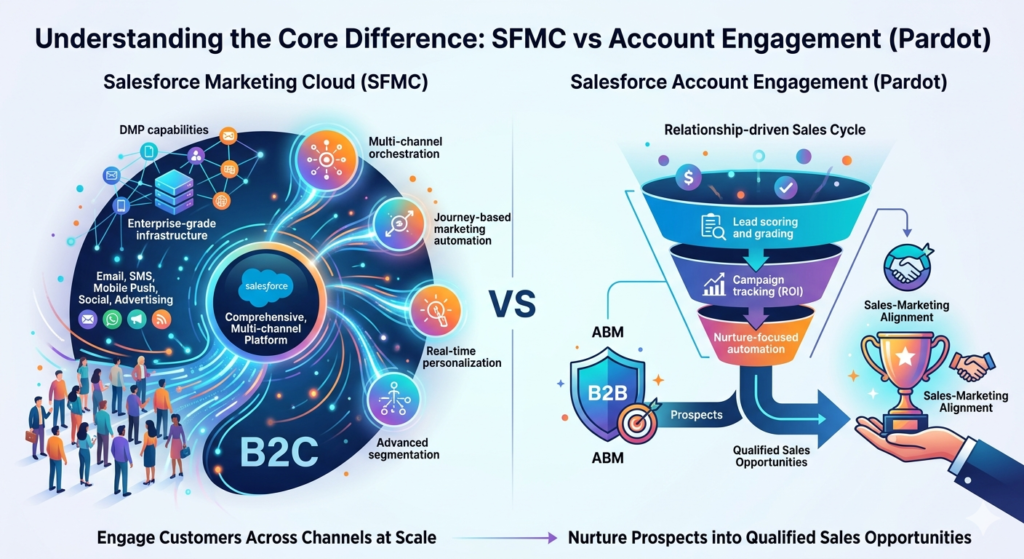
Salesforce Marketing Cloud (SFMC)
Marketing Cloud is a comprehensive, multi-channel marketing platform designed primarily for B2C companies managing large-scale, complex customer journeys across multiple touchpoints. Think airlines, retail brands, financial services, and e-commerce companies engaging millions of consumers.
Key characteristics:
- Multi-channel orchestration (email, SMS, mobile push, social, advertising)
- Journey-based marketing automation
- Real-time personalization at scale
- Data management platform (DMP) capabilities
- Advanced segmentation using behavioral and transactional data
- Enterprise-grade infrastructure
Pardot (Account Engagement)
Account Engagement (formerly Pardot) is a B2B marketing automation platform built specifically for companies with longer, relationship-driven sales cycles. It excels at lead nurturing, account-based marketing (ABM), and tight sales-marketing alignment.
Key characteristics:
- Lead scoring and grading
- Campaign tracking tied to ROI
- Native Salesforce CRM integration
- Account-based marketing features
- Sales enablement tools
- Linear, nurture-focused automation
The Bottom Line: Marketing Cloud helps you engage customers across channels at scale; Account Engagement helps you nurture prospects into qualified sales opportunities.
Detailed Comparison Table: Features, Pricing, and Use Cases
| Criteria | Salesforce Marketing Cloud (SFMC) | Pardot (Account Engagement) |
|---|---|---|
| Primary Audience | B2C, high-volume consumer brands | B2B, lead-generation focused companies |
| Ideal Company Size | Mid-market to Enterprise (500+ employees) | SMB to Enterprise (10-5000+ employees) |
| Core Strength | Multi-channel journey orchestration | Lead nurturing and sales alignment |
| Email Marketing | Advanced personalization, dynamic content, Einstein AI | Template-based, A/B testing, engagement tracking |
| Automation | Journey Builder (visual, behavior-triggered workflows) | Engagement Studio (linear nurture programs) |
| Lead Management | Basic lead capture, requires customization | Advanced lead scoring, grading, and routing |
| CRM Integration | Requires Marketing Cloud Connect | Native Salesforce integration (seamless) |
| Channel Support | Email, SMS, Push, Social, Advertising, Web | Primarily email, forms, landing pages |
| Segmentation | SQL-based queries, AI-powered, data extensions | List-based, dynamic lists, filtering |
| Analytics | Journey analytics, Einstein predictions, attribution | Campaign reporting, ROI tracking, sales insights |
| Learning Curve | Steep (requires dedicated admin/developer) | Moderate (marketers can manage independently) |
| Mobile Capabilities | Mobile Studio (SMS, Push, MMS, in-app messaging) | Limited (mobile-responsive emails only) |
| Social Media | Social Studio for listening, engagement, publishing | Basic social posting |
| AI Features | Einstein Send Time, Engagement Scoring, Content Selection | Einstein Lead Scoring, Campaign Insights, Behavior Scoring |
| Account-Based Marketing | Requires custom implementation | Built-in ABM features |
| Starting Price | ~$1,250/month (Pro Suite) | ~$1,250/month (Growth Edition) |
| Implementation Time | 3-6 months (complex) | 4-8 weeks (moderate) |
| Typical Use Cases | E-commerce journeys, loyalty programs, event marketing | Webinar funnels, content nurturing, sales enablement |
Real-World Use Cases: B2B vs B2C Scenarios
Understanding how each platform performs in actual business scenarios helps clarify the right choice.
B2C Scenarios: When Marketing Cloud Excels
Scenario 1: E-Commerce Retail Brand
A fashion retailer with 2 million customers needs to:
- Send personalized product recommendations based on browsing behavior
- Trigger abandoned cart SMS messages within 2 hours
- Deploy mobile app push notifications for flash sales
- Coordinate email, SMS, and social advertising for new collections
Why Marketing Cloud wins: Journey Builder orchestrates cross-channel touchpoints based on real-time behavior. Integration with Commerce Cloud enables product catalog syncing. Mobile Studio delivers timely SMS and push notifications.
Scenario 2: Travel and Hospitality
An airline managing millions of travelers requires:
- Booking confirmations via email and SMS
- Travel updates and gate changes through mobile push
- Post-trip satisfaction surveys
- Personalized destination marketing based on travel history
Why Marketing Cloud wins: Multi-channel coordination ensures consistent customer experience. Data extensions manage complex customer profiles with booking history, preferences, and loyalty status.
Scenario 3: Financial Services
A bank communicating with 500,000 customers needs:
- Compliance-approved messaging across channels
- Account alerts and fraud notifications
- Personalized product offers based on account activity
- Customer journey mapping from prospect to multi-product holder
Why Marketing Cloud wins: Enterprise security, compliance features, and sophisticated segmentation handle sensitive financial data while delivering personalized experiences.
B2B Scenarios: When Account Engagement (Pardot) Excels
Scenario 1: SaaS Company
A B2B software provider with a 45-day sales cycle needs to:
- Capture leads from gated whitepapers and webinars
- Score leads based on engagement and firmographic data
- Nurture cold leads until they're sales-ready
- Track campaign ROI and attribute revenue to marketing activities
Why Account Engagement wins: Lead scoring automatically prioritizes prospects. Engagement Studio nurtures leads through educational content. Native Salesforce integration ensures sales receives qualified opportunities at the right time.
Scenario 2: Manufacturing Company
An industrial equipment manufacturer with a 6-month sales cycle requires:
- Account-based marketing to target specific enterprises
- Content tailored to different decision-makers (engineers vs. C-suite)
- Sales alerts when key accounts engage with content
- Pipeline reporting showing marketing's influence on deals
Why Account Engagement wins: Account-level tracking groups multiple contacts from the same organization. Lead grading evaluates fit beyond engagement. Sales teams receive real-time notifications when prospects show buying signals.
Scenario 3: Professional Services Firm
A consulting company needs to:
- Nurture relationships with long-term prospects
- Share thought leadership content
- Coordinate with account executives on outreach timing
- Measure which content types drive consultation requests
Why Account Engagement wins: Campaign influence reporting shows which touchpoints contribute to opportunities. Sales-marketing alignment features prevent duplicate outreach. Content performance tracking guides strategy.
Hybrid B2B/B2C Scenarios: The Gray Area
Scenario: Enterprise Software with SMB and Enterprise Segments
A company selling to both small businesses (transactional, short sales cycle) and enterprises (consultative, long sales cycle) faces a dilemma:
- SMB segment: High volume, self-service buyers, quick decisions → Marketing Cloud characteristics
- Enterprise segment: Relationship-driven, multiple stakeholders, 6+ month cycles → Pardot characteristics
Solution options:
- Choose Account Engagement if enterprise segment represents >70% of revenue
- Choose Marketing Cloud if SMB volume demands sophisticated automation and you can build custom lead scoring
- Use both platforms (expensive but sometimes necessary for large organizations)
Comprehensive Pros and Cons Analysis
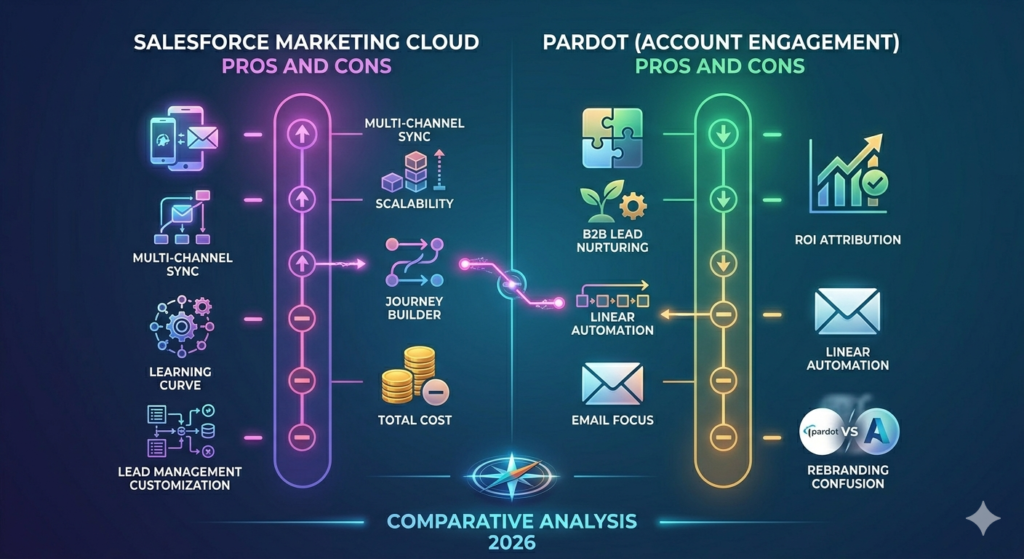
Salesforce Marketing Cloud: Pros
1. Unmatched Multi-Channel Capabilities
No other platform in the Salesforce ecosystem offers native SMS, push notifications, social listening, and advertising management in one place.
2. Scalability for High-Volume Engagement
Handles millions of sends, complex data relationships, and real-time triggers without performance degradation.
3. Advanced Personalization
Einstein AI, AMPscript, and dynamic content capabilities enable truly individualized experiences at scale.
4. Journey-Based Thinking
Journey Builder visualizes and automates complex, non-linear customer paths that mirror real-world behavior.
5. Data Management Platform
Audience Studio (DMP) consolidates first, second, and third-party data for comprehensive customer profiles.
6. Future-Proof Feature Development
Salesforce invests heavily in Marketing Cloud innovations, particularly AI and predictive analytics.
Salesforce Marketing Cloud: Cons
1. Steep Learning Curve
Requires specialized training, certifications, and often dedicated administrators or developers. Not marketer-friendly for beginners.
2. High Total Cost of Ownership
Beyond licensing, expect significant costs for implementation partners, training, and ongoing management.
3. Complex Implementation
Initial setup takes 3-6 months with experienced consultants. Data architecture decisions have long-term implications.
4. Over-Engineering for Simple Needs
Many features go unused by companies with straightforward email marketing needs.
5. Lead Management Not Native Strength
Requires customization and Marketing Cloud Connect to achieve what Pardot does out-of-the-box.
6. Fragmented User Experience
Different "Studios" (Email, Mobile, Social, Advertising) feel like separate products rather than one cohesive platform.
Pardot (Account Engagement): Pros
1. Seamless Salesforce CRM Integration
Native integration means real-time data sync, no middleware, and unified reporting between marketing and sales.
2. Marketer-Friendly Interface
Intuitive UI allows marketers to build campaigns, forms, and automation without technical resources.
3. Purpose-Built for B2B
Lead scoring, grading, account-based features, and sales alignment tools address specific B2B challenges.
4. Faster Time to Value
Typical implementation takes 4-8 weeks; teams can launch campaigns within the first month.
5. Strong ROI Attribution
Campaign influence reporting and multi-touch attribution show marketing's revenue contribution.
6. Excellent for Sales Enablement
Sales alerts, prospect tracking, and engagement history empower account executives with actionable intelligence.
7. Predictable Pricing
Tier-based pricing with clear feature sets makes budgeting straightforward.
Pardot (Account Engagement): Cons
1. Email and Forms Primarily
Limited to email marketing, landing pages, and forms. No native SMS, push notifications, or advanced mobile capabilities.
2. Linear Automation Thinking
Engagement Studio uses sequential nurture tracks, not the flexible, behavior-driven journeys of Marketing Cloud.
3. Scalability Limitations
Performance can degrade with extremely large databases (500K+ records) or complex automation scenarios.
4. Basic Segmentation
List-based segmentation lacks the SQL query power and data relationship complexity of Marketing Cloud.
5. Consumer Marketing Challenges
Not designed for high-frequency, high-volume B2C communications or omnichannel consumer journeys.
6. Customization Constraints
Template-based approach limits design flexibility compared to Marketing Cloud's custom HTML/CSS capabilities.
7. Rebranding Confusion
The Pardot-to-Account Engagement transition has created documentation gaps and community confusion.
Pricing Comparison: What You'll Actually Pay in 2026
Understanding total cost of ownership requires looking beyond sticker prices to implementation, training, and ongoing management.
Marketing Cloud Pricing (2026)
Pricing Tiers:
- Pro Suite: ~$1,250/month (up to 10,000 contacts)
- Email Studio, Mobile Studio (limited), Journey Builder (basic), Audience Builder
- Best for: Small teams testing multi-channel marketing
- Corporate Suite: ~$3,750/month (up to 10,000 contacts)
- Full Journey Builder, advanced segmentation, Einstein features
- Best for: Mid-market companies with dedicated marketing teams
- Enterprise Suite: Custom pricing (typically $20,000-$50,000+/month)
- All Studios, API access, dedicated support, advanced analytics
- Best for: Large enterprises with complex requirements
Additional Costs:
- Implementation: $30,000-$150,000+ (depending on complexity)
- Training/Certifications: $2,000-$5,000 per team member
- Annual Consulting/Support: $20,000-$100,000
- Additional Contacts: Volume-based pricing increases
Hidden Costs:
- Dedicated administrator salary ($70K-$120K annually)
- Developer resources for AMPscript and custom integrations
- Data quality and management tools
- Third-party analytics platforms for advanced attribution
Total First-Year Investment: $100,000-$500,000+ for mid-market to enterprise
Account Engagement (Pardot) Pricing (2026)
Pricing Tiers:
- Growth Edition: ~$1,250/month (up to 10,000 contacts)
- Email marketing, landing pages, forms, basic automation, lead scoring
- Best for: Small B2B companies starting with automation
- Plus Edition: ~$2,500/month (up to 10,000 contacts)
- Advanced dynamic content, A/B testing, custom roles, Salesforce Engage
- Best for: Growing companies needing sales-marketing alignment
- Advanced Edition: ~$4,000/month (up to 10,000 contacts)
- Einstein features, advanced analytics, business units, premium support
- Best for: Enterprises with multiple divisions or brands
- Premium Edition: ~$15,000/month (up to 75,000 contacts)
- Einstein attribution, premium success services, dedicated support
- Best for: Large enterprises requiring sophisticated attribution
Additional Costs:
- Implementation: $10,000-$40,000 (simpler than SFMC)
- Training: $1,000-$3,000 per team member
- Annual Optimization: $10,000-$30,000
- Additional Contacts: Tiered increases at 10K, 25K, 50K, 75K, 100K+
Hidden Costs:
- Salesforce CRM licenses (required; ~$75-$300/user/month)
- Content creation resources
- Additional database storage for large contact lists
Total First-Year Investment: $40,000-$150,000 for small to mid-market B2B
Practical Pricing Insights
Cost-per-Contact Reality:
- Marketing Cloud: Higher initial cost, but more economical at scale (500K+ contacts)
- Account Engagement: Better value for smaller databases (under 100K contacts)
ROI Timeline:
- Marketing Cloud: 12-18 months to positive ROI (longer implementation and learning curve)
- Account Engagement: 6-9 months to positive ROI (faster deployment and adoption)
Budget Allocation Recommendation:
- Allocate 2-3x the annual licensing cost for implementation and first-year support
- Reserve 20% of licensing cost annually for ongoing optimization and training
When to Choose Marketing Cloud vs Pardot: Decision Framework
Use this decision tree to determine the right platform for your business.
Choose Marketing Cloud If:
✅ You're primarily B2C with high-volume customer communications
✅ Multi-channel engagement is critical (email + SMS + push + social + advertising)
✅ Customer journeys are complex with multiple touchpoints and non-linear paths
✅ Your database exceeds 500,000 contacts and will continue growing significantly
✅ Real-time personalization based on behavioral triggers is a competitive advantage
✅ You have technical resources (developers, certified administrators) or budget for them
✅ Your annual marketing budget exceeds $500,000 and you can sustain ongoing investment
✅ E-commerce integration is central to your marketing strategy
✅ You need advanced analytics and predictive capabilities to inform strategy
✅ Mobile engagement (apps, location-based marketing) is part of your plan
Choose Account Engagement (Pardot) If:
✅ You're B2B with a defined sales process and lead qualification criteria
✅ Lead nurturing and scoring are priorities for improving sales efficiency
✅ Your sales cycle is 30+ days requiring ongoing education and relationship-building
✅ Salesforce CRM is (or will be) your system of record for customer data
✅ Marketing and sales alignment is a current pain point you're solving
✅ Email marketing and landing pages cover 80%+ of your marketing needs
✅ Your database is under 100,000 contacts without plans for massive expansion
✅ Marketing team lacks technical resources and needs an intuitive platform
✅ ROI and pipeline attribution reporting are critical for proving marketing value
✅ Account-based marketing (ABM) is part of your go-to-market strategy
Consider Both Platforms If:
⚠️ You're a large enterprise with distinct B2B and B2C business units
⚠️ Revenue exceeds $500M with complex organizational structure
⚠️ Marketing budget exceeds $2M annually with dedicated teams for each audience
⚠️ Technical resources can manage integration between both platforms
Red Flags: When Neither May Be Right
🚫 Your primary need is social media management → Consider Social Studio standalone or Hootsuite
🚫 You want simple email newsletters with minimal automation → Mailchimp, Constant Contact, or HubSpot may be more cost-effective
🚫 Budget is under $25,000 annually → Start with HubSpot, ActiveCampaign, or Salesforce Essentials
🚫 You don't use Salesforce CRM and don't plan to → Non-Salesforce platforms may integrate better with your existing tech stack
Common Mistakes Businesses Make When Choosing
Avoid these frequent pitfalls that lead to expensive platform switches or underutilization.
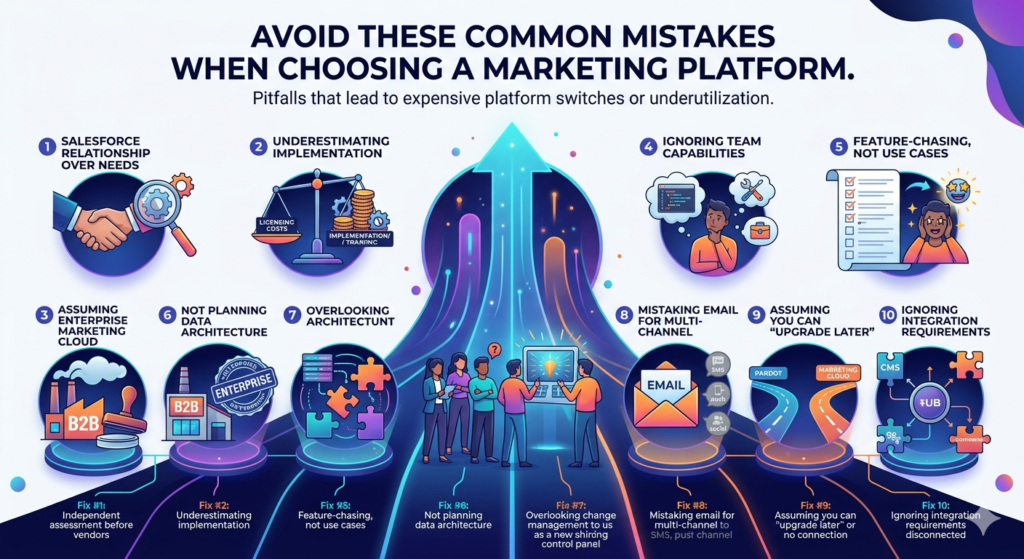
Mistake #1: Choosing Based on Salesforce Relationship, Not Business Needs
The Problem: Your sales rep recommends Marketing Cloud because "it's the flagship product" or because your enterprise agreement gets you a discount.
The Reality: The wrong platform at 30% off is still more expensive than the right platform at full price when you factor in underutilization and missed opportunities.
The Fix: Conduct an independent needs assessment focused on your customer journey, business model, and marketing maturity before discussing with vendors.
Mistake #2: Underestimating Implementation Complexity
The Problem: Budgeting only for licensing costs without accounting for implementation, training, and ongoing management.
The Reality: Marketing Cloud's licensing might be $45,000 annually, but total first-year costs often hit $150,000-$200,000 with implementation and resources.
The Fix: Request total cost of ownership projections including implementation, training, headcount, and annual optimization for Years 1-3.
Mistake #3: Assuming "Enterprise" Means Marketing Cloud
The Problem: Believing that only Marketing Cloud can scale with your enterprise growth.
The Reality: Many enterprise B2B companies with millions in revenue successfully use Account Engagement because their business model aligns with its strengths.
The Fix: Define "enterprise needs" based on your specific use cases, not company size alone. A 2,000-person B2B manufacturing company may be perfectly served by Account Engagement.
Mistake #4: Ignoring Current Team Capabilities
The Problem: Selecting Marketing Cloud when your team has basic marketing automation experience and no developers.
The Reality: The platform sits underutilized for 6-12 months while you hire specialized resources or pay consultants, delaying ROI and frustrating stakeholders.
The Fix: Honestly assess your team's technical capabilities. If you lack SQL knowledge, AMPscript experience, or developer resources, the faster time-to-value of Account Engagement may outweigh Marketing Cloud's theoretical advantages.
Mistake #5: Feature-Chasing Instead of Use Case Mapping
The Problem: Creating a feature comparison spreadsheet and choosing the platform with more checkmarks.
The Reality: Having 50 features you'll never use doesn't create value. Account Engagement's focused feature set often delivers more ROI for B2B companies than Marketing Cloud's expansive but complex toolkit.
The Fix: Map your top 5 marketing priorities and select the platform that executes those specific use cases most effectively, even if it has fewer overall features.
Mistake #6: Not Planning for Data Architecture
The Problem: Rushing into Marketing Cloud without designing your data model, resulting in disconnected data extensions and inefficient queries.
The Reality: Poor data architecture decisions in the first 90 days create technical debt that costs tens of thousands to fix later.
The Fix: Invest in data architecture planning during implementation. For Account Engagement, ensure your Salesforce CRM data structure supports marketing segmentation needs.
Mistake #7: Overlooking Change Management
The Problem: Focusing entirely on technical implementation while ignoring user adoption, training, and process changes.
The Reality: Even perfectly implemented platforms fail when marketing teams don't understand how to use them or sales teams don't trust the data.
The Fix: Allocate 30% of implementation budget to change management, training, and process documentation. Create internal champions who can support ongoing adoption.
Mistake #8: Choosing Pardot for Multi-Channel When You Mean Multi-Email
The Problem: Believing Pardot's email capabilities equal "multi-channel marketing" when you actually need SMS, push, and social coordination.
The Reality: Pardot excels at email-centric B2B marketing but can't orchestrate true multi-channel consumer experiences.
The Fix: Define "multi-channel" specifically. If you mean "email + landing pages," Pardot works. If you mean "email + SMS + push + social," Marketing Cloud is necessary.
Mistake #9: Assuming You Can "Upgrade Later"
The Problem: Starting with Pardot with plans to "upgrade to Marketing Cloud when we grow."
The Reality: These aren't upgrade paths—they're different products requiring separate implementations. Migration is complex, expensive, and disruptive.
The Fix: Choose based on your 3-year roadmap, not just immediate needs. If multi-channel consumer engagement is in your future, start with Marketing Cloud despite the steeper learning curve.
Mistake #10: Ignoring Integration Requirements
The Problem: Selecting a platform without assessing how it connects to your existing tech stack (commerce platform, CMS, event tools, analytics).
The Reality: Integration gaps force expensive custom development or create data silos that undermine marketing effectiveness.
The Fix: Map your critical integrations before selecting a platform. Verify native connectors exist or budget for custom API development.
Making the Final Decision: A Practical Checklist
Before committing to either platform, work through this checklist with your team:
Business Model Assessment
- We have clarity on whether we're primarily B2B, B2C, or hybrid
- We've documented our typical customer journey from awareness to purchase
- We understand our sales cycle length and key conversion points
- We know our customer lifetime value and acceptable acquisition costs
Technical Readiness
- We've audited our current marketing team's technical skills
- We have (or can hire) resources with SQL/coding skills for Marketing Cloud OR
- Our team can manage marketing automation independently for Account Engagement
- We've identified who will serve as platform administrator
- Our Salesforce CRM data structure supports marketing segmentation needs
Budget Validation
- We've secured budget for licensing, implementation, and Year 1 support
- We understand total cost of ownership for Years 1-3
- We have realistic ROI expectations and measurement plans
- Executive stakeholders support the required investment
Use Case Prioritization
- We've identified our top 5 marketing automation use cases
- We've verified the chosen platform excels at these specific scenarios
- We have metrics defined for measuring success
- We've confirmed the platform integrates with our critical systems
Vendor Validation
- We've completed demos with realistic use cases, not generic presentations
- We've spoken with 3+ reference customers in our industry
- We've reviewed implementation partner options and costs
- We understand support options and escalation processes
Risk Mitigation
- We have executive sponsorship for the project
- Change management and training plans are documented
- We've identified potential adoption barriers and mitigation strategies
- Data migration and integration approaches are validated
Conclusion: Making the Right Choice for Your 2026 Marketing Strategy
The Salesforce Marketing Cloud vs Pardot 2026 decision isn't about picking the objectively "better" platform—it's about aligning your marketing technology with your business model, customer journey complexity, and organizational capabilities.
Our Strong Recommendations:
Choose Account Engagement (Pardot) if:
You're a B2B company where email marketing, lead nurturing, and sales-marketing alignment drive revenue. The platform's intuitive interface, native Salesforce integration, and purpose-built B2B features deliver faster time-to-value and clearer ROI attribution. Companies with databases under 100,000 contacts, sales cycles exceeding 30 days, and marketing teams without extensive technical resources will achieve better outcomes with Account Engagement's focused capabilities than Marketing Cloud's complex infrastructure.
Choose Marketing Cloud if:
Your B2C business model requires multi-channel customer engagement at scale. If SMS, mobile push notifications, social media coordination, and complex behavioral triggers are competitive necessities—not nice-to-haves—Marketing Cloud's journey orchestration capabilities justify the higher investment and technical complexity. Companies engaging 500,000+ consumers, operating e-commerce platforms, or executing sophisticated loyalty programs need Marketing Cloud's enterprise-grade infrastructure.
The 80/20 Reality:
Most B2B companies (80%+) will achieve better ROI with Account Engagement due to faster implementation, lower total cost of ownership, and better alignment with relationship-driven sales models. However, high-growth B2C companies and omnichannel retailers will quickly outgrow Account Engagement's limitations, making Marketing Cloud the strategic choice despite the steeper learning curve.
Final Decision Framework:
If you can definitively answer "yes" to this question, choose Account Engagement:
"Is our primary marketing goal to generate qualified leads for a sales team to convert through relationship-building?"
If you answer "yes" to this question, choose Marketing Cloud:
"Do we need to engage customers across email, SMS, mobile apps, and social media with personalized, behavior-triggered experiences at scale?"
The SFMC vs Account Engagement decision shapes your marketing capabilities for 3-5 years. Choose based on your business model fundamentals, not feature checklists or sales pressure. Both platforms are powerful—but only one is right for your specific business context in 2026.
About RizeX Labs
At RizeX Labs, we specialize in delivering advanced Salesforce marketing solutions, including Salesforce Marketing Cloud and Account Engagement (Pardot). Our expertise combines strategic marketing automation, deep Salesforce integration, and real-world implementation experience to help businesses personalize customer journeys and maximize ROI.
We empower organizations to choose the right marketing platform—whether it’s B2B lead nurturing with Pardot or large-scale B2C engagement with Marketing Cloud—ensuring efficient campaigns, better targeting, and measurable growth.
Internal Links:
- Salesforce Admin course page
- Salesforce Flows vs Apex: When Should You Use Code vs No-Code Automation?
- Salesforce Data Import Wizard vs Data Loader: Full Comparison (2024 Guide)
- Salesforce Custom Objects: Complete Build Guide for Beginners
- Salesforce Headless 360: The Complete Guide to Building the Agentic Enterprise
- Salesforce Mobile App: Complete Admin Configuration Guide for Enterprise Deployment
- Salesforce Currency Management: Multi-Currency Setup Guide
External Links:
McKinsey Sales Growth Reports