
Introduction: Your New Career Awaits in the Cloud
Are you feeling stuck in your current non-IT role? Do you find yourself scrolling through job portals, wondering if there's something more fulfilling and financially rewarding out there? If you've got 3–5 years of professional experience under your belt and are contemplating a career switch to Salesforce, you're in the right place—and at the right time.
India's digital transformation is accelerating at an unprecedented pace, and Salesforce has emerged as one of the most sought-after skills in the job market. The best part? You don't need a computer science degree or years of coding experience to break into this field. Whether you're from sales, marketing, finance, HR, or any other non-technical background, Salesforce offers a welcoming gateway into the tech world.
This comprehensive guide will walk you through everything you need to know about making a successful Salesforce career change in India. We'll cover the benefits, the roadmap, suitable roles, challenges you might face, and practical tips that will set you up for success. By the end of this article, you'll have a clear action plan to transform your career trajectory.
Let's dive in!
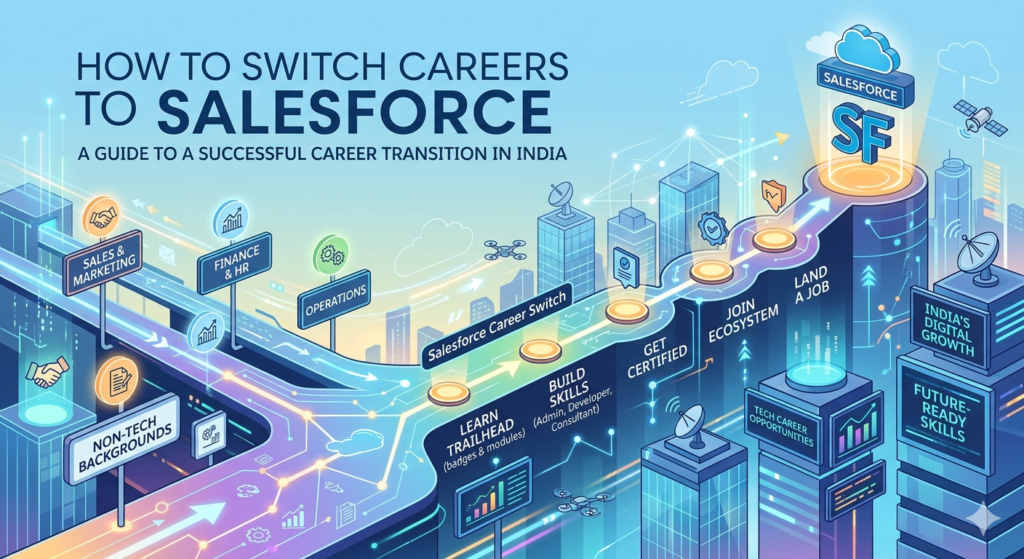
Why Salesforce? Understanding the Opportunity
What is Salesforce?
Before we discuss the career transition, let's understand what Salesforce actually is. Salesforce is the world's #1 Customer Relationship Management (CRM) platform that helps businesses manage their relationships with customers and potential customers. It's a cloud-based software that handles everything from sales and marketing to customer service and analytics.
Think of it as the central nervous system of modern businesses—connecting various departments, automating processes, and providing valuable insights that drive growth.

The Salesforce Boom in India
India has become one of the largest markets for Salesforce professionals globally. Companies across industries—from startups to Fortune 500 giants—are implementing Salesforce to streamline their operations. According to recent industry reports, the demand for Salesforce professionals in India has grown by over 300% in the last five years, with salaries often 40-60% higher than comparable non-IT roles.
Major Indian cities like Bangalore, Hyderabad, Pune, Mumbai, Delhi-NCR, and Chennai have become Salesforce hubs, with thousands of job openings at any given time. Remote work opportunities have further expanded the market, allowing professionals from tier-2 and tier-3 cities to access these lucrative positions.
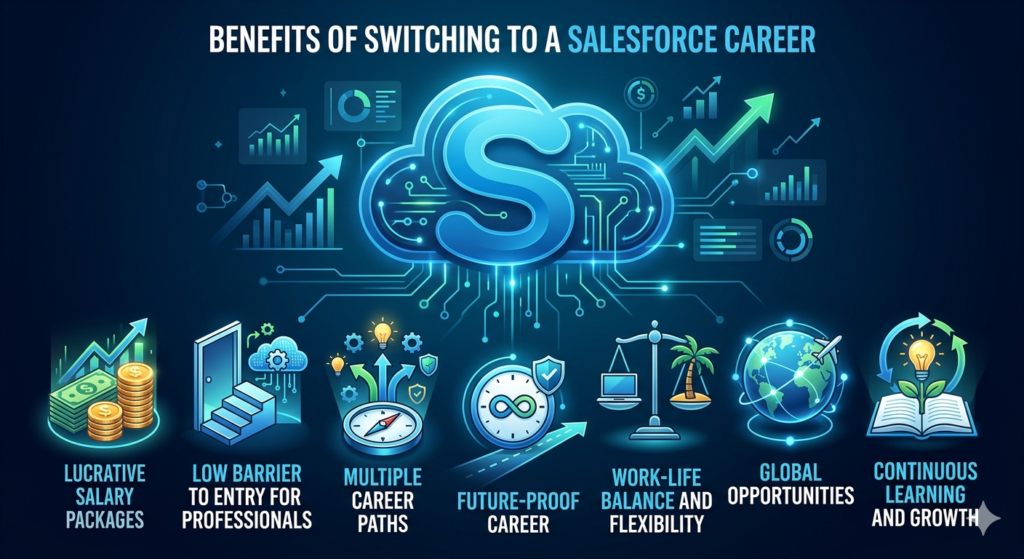
Benefits of Switching to Salesforce from a Non-IT Background
1. Lucrative Salary Packages
One of the most compelling reasons for a career switch to Salesforce is the significant salary upgrade. Entry-level Salesforce administrators in India typically earn between ₹4-7 lakhs per annum, which can quickly scale to ₹10-15 lakhs within 2-3 years with the right certifications and experience. Senior Salesforce professionals and architects command packages upwards of ₹20-40 lakhs annually.
2. Low Barrier to Entry for Non-IT Professionals
Unlike traditional software development roles that require extensive coding knowledge, Salesforce for non-IT professionals is remarkably accessible. The platform uses a "low-code/no-code" approach for many functions, meaning you can configure and customize applications using visual interfaces rather than writing complex code.
3. Multiple Career Paths
Salesforce isn't a one-size-fits-all career. Depending on your interests and background, you can specialize in:
- Administration
- Development
- Business Analysis
- Consulting
- Architecture
- Marketing Automation
- And many more specialized areas
4. Future-Proof Career
Cloud computing and CRM are not passing trends—they're the foundation of modern business. By building expertise in Salesforce, you're investing in a skill set that will remain relevant and valuable for decades to come.
5. Work-Life Balance and Flexibility
Many Salesforce roles offer excellent work-life balance, remote work options, and flexible schedules. The Salesforce ecosystem is known for its supportive community and progressive work culture.
6. Global Opportunities
Salesforce skills are transferable globally. Once you build expertise, you open doors to international opportunities, whether through remote positions with global companies or relocating abroad.
7. Continuous Learning and Growth
Salesforce releases three updates every year, introducing new features and capabilities. This ensures your job never becomes monotonous, and you're always learning and growing professionally.
Suitable Salesforce Roles for Non-IT Professionals
One of the beautiful aspects of the Salesforce career change in India is that your existing non-IT experience can be a significant advantage. Here are roles particularly suited for professionals from different backgrounds:
1. Salesforce Administrator
Best for: Professionals from operations, customer service, or general management backgrounds
What you'll do:
- Manage user accounts and permissions
- Customize Salesforce to meet business requirements
- Create reports and dashboards
- Train end-users
- Maintain data quality
Why it's ideal for non-IT backgrounds: This role requires strong organizational skills, attention to detail, and understanding of business processes—skills you've likely developed in your current role.
2. Salesforce Business Analyst
Best for: Professionals from consulting, project management, or business operations
What you'll do:
- Gather and document business requirements
- Bridge the gap between business stakeholders and technical teams
- Design Salesforce solutions to solve business problems
- Create process flows and documentation
Why it's ideal: Your experience understanding business needs and communicating with diverse stakeholders is directly transferable.
3. Salesforce Marketing Specialist
Best for: Professionals from marketing, advertising, or content creation backgrounds
What you'll do:
- Manage email marketing campaigns using Marketing Cloud
- Create customer journeys and automation
- Analyze campaign performance
- Segment audiences for targeted marketing
Why it's ideal: Your marketing knowledge combined with Salesforce tools creates a powerful skillset that's highly valued.
4. Salesforce Sales Cloud Consultant
Best for: Professionals from sales, business development, or account management
What you'll do:
- Configure Sales Cloud to optimize sales processes
- Create sales forecasting and pipeline reports
- Implement lead management and opportunity tracking
- Train sales teams on best practices
Why it's ideal: Your firsthand understanding of sales challenges makes you exceptionally qualified to design effective solutions.
5. Salesforce Support Specialist
Best for: Professionals from customer service, technical support, or help desk backgrounds
What you'll do:
- Provide technical support to Salesforce users
- Troubleshoot issues and implement fixes
- Document solutions and create knowledge articles
- Work with development teams on complex issues
Why it's ideal: Your customer service experience and problem-solving skills are the foundation of this role.

Step-by-Step Guide: How to Make Your Career Switch to Salesforce
Now comes the most important part—your roadmap to success. Here's a detailed, step-by-step guide to transitioning into a Salesforce career:
Phase 1: Research and Self-Assessment (Week 1-2)
Step 1: Understand Your Motivation
Ask yourself:
- Why do I want to switch to Salesforce specifically?
- What aspects of my current role do I enjoy that align with Salesforce careers?
- Am I prepared for the learning curve?
- What are my long-term career goals?
Being clear about your motivation will keep you focused during challenging times.
Step 2: Research Different Salesforce Roles
Spend time understanding various Salesforce career paths. Watch YouTube videos of professionals sharing their day-to-day experiences, read blogs, and join Salesforce communities on LinkedIn and Facebook.
Step 3: Assess Your Transferable Skills
List all the skills from your current role that apply to Salesforce:
- Communication skills
- Problem-solving abilities
- Project management experience
- Domain knowledge (sales, marketing, finance, etc.)
- Client relationship management
- Analytical thinking
These are your hidden advantages in the transition.
Phase 2: Learning and Certification (Month 1-4)
Step 4: Create a Trailblazer Account
Visit Trailhead—Salesforce's free, gamified learning platform. Create an account and start with the "Salesforce Administrator Beginner" trail. Trailhead is specifically designed for beginners and makes learning fun and interactive.
Step 5: Follow a Structured Learning Path
For Salesforce for non-IT professionals, here's a recommended learning sequence:
Month 1:
- Complete "Salesforce Platform Basics" module
- Understand CRM fundamentals
- Learn about Salesforce products and ecosystem
- Familiarize yourself with the Salesforce interface
- Complete "Data Modeling" modules
Month 2:
- Study Security and Access
- Learn Process Automation (Flows, Process Builder)
- Understand Reports and Dashboards
- Practice on a Developer Org (free practice environment)
Month 3:
- Deep dive into your chosen specialization (Admin, Marketing, etc.)
- Complete advanced Trailhead modules
- Start preparing for certification exam
- Join study groups
Month 4:
- Take practice exams
- Review weak areas
- Schedule and appear for certification exam
Step 6: Get Your First Salesforce Certification
The Salesforce Administrator Certification is the best starting point for most non-IT professionals. This certification validates your ability to configure and manage Salesforce.
Exam Details:
- 65 multiple-choice questions
- 105 minutes duration
- Passing score: 65%
- Cost: $200 (approximately ₹16,000)
- Can be taken online from home
Study Resources:
- Trailhead (free)
- Focus on Force (practice exams - paid)
- Udemy courses (affordable)
- YouTube tutorials (free)
- Salesforce documentation (free)
Pro Tip: Many Indian Salesforce communities organize free study groups and webinars. Connect with them to reduce your preparation costs.
Phase 3: Practical Experience (Month 3-6, parallel with learning)
Step 7: Build Hands-On Experience
Theory alone won't land you a job. You need practical experience:
Get a Developer Org:
- Sign up for a free Salesforce Developer Edition org
- Practice everything you learn immediately
- Build sample applications
- Create custom objects, fields, and automation
Work on Real-World Scenarios:
- Think about problems in your current organization that Salesforce could solve
- Design solutions in your Developer Org
- Document your projects with screenshots
Step 8: Create a Portfolio
Since you're making a career switch to Salesforce without professional experience, your portfolio becomes crucial:
Include:
- 3-5 projects demonstrating different Salesforce features
- Screenshots and process documentation
- Video walkthroughs (upload to YouTube or LinkedIn)
- GitHub repository with any code snippets (if applicable)
- Case studies showing problem-solution-outcome
Example Projects:
- A lead management system for a sales team
- An event management application
- A customer support ticketing system
- A scholarship tracking system for an NGO
Step 9: Contribute to Nonprofit Projects
Salesforce offers free or heavily discounted licenses to nonprofits. Many NGOs need Salesforce help but can't afford consultants:
- Join the Salesforce for Nonprofits community
- Volunteer through platforms like Taproot Plus or Catchafire
- Offer to help local NGOs implement basic Salesforce features
- This gives you real-world experience and references
Phase 4: Building Your Professional Brand (Month 4-6)
Step 10: Optimize Your LinkedIn Profile
Your LinkedIn is your new resume:
Profile Optimization:
- Update headline: "Salesforce Administrator | Certified Professional | Helping Businesses Optimize CRM"
- Write a compelling summary highlighting your unique background
- Add your certification to the Certifications section
- Share Trailhead badges on your profile
- Update your experience section to highlight transferable skills
Content Strategy:
- Share what you're learning
- Write posts about your Salesforce journey
- Engage with Salesforce content
- Join Salesforce groups and participate actively
- Follow Salesforce influencers and MVPs
Step 11: Network Actively
The Salesforce community in India is incredibly supportive:
Networking Opportunities:
- Join local Salesforce User Groups (online and offline)
- Attend Salesforce community events and webinars
- Connect with Salesforce professionals on LinkedIn
- Participate in Twitter conversations using #SalesforceOhana
- Join Indian Salesforce communities on Telegram and WhatsApp
Important: Don't just connect—engage genuinely. Ask questions, share insights, and build real relationships.
Step 12: Start Your Blog or YouTube Channel
Creating content serves multiple purposes:
- Deepens your own understanding
- Builds your personal brand
- Demonstrates communication skills
- Gets you noticed by recruiters
Content Ideas:
- "My Journey from [Your Field] to Salesforce"
- "Top 5 Trailhead Modules for Beginners"
- "How to Prepare for Salesforce Admin Certification"
- Project walkthroughs
- Tips for non-IT professionals
Phase 5: Job Search Strategy (Month 5-8)
Step 13: Prepare Your Resume
Your resume needs to bridge your past experience with your Salesforce future:
Structure:
- Professional Summary: Highlight your years of experience + new Salesforce skills
- Skills Section: List Salesforce-specific skills prominently
- Certifications: Place this near the top
- Professional Experience: Reframe past experiences using Salesforce terminology
- Projects: Dedicated section for your Salesforce portfolio projects
Example of Reframing:
- Instead of: "Managed customer complaints"
- Write: "Managed end-to-end customer issue resolution process, which led me to design a Salesforce Service Cloud solution for streamlined case management"
Step 14: Strategic Job Applications
Where to Look:
- Naukri.com (use keywords: "Salesforce Administrator", "Salesforce Analyst")
- LinkedIn Jobs
- Indeed.in
- Salesforce-specific job boards (SalesforceJobs.com)
- Company career pages directly
- Salesforce consulting partners' websites (Accenture, Deloitte, Capgemini, TCS, etc.)
Application Strategy:
- Start with entry-level positions and internships
- Consider contract or project-based roles initially
- Look for "Junior" or "Associate" positions
- Apply to both product companies and consulting firms
- Don't ignore smaller companies and startups
- Consider remote opportunities from anywhere in India
Customize Each Application:
- Tailor your resume to match job descriptions
- Write personalized cover letters
- Mention specific projects relevant to the role
- Follow up professionally after 5-7 days
Step 15: Ace the Interview
Typical Interview Structure for Entry-Level Roles:
Round 1: HR Screening
- Why Salesforce?
- Why career change?
- Salary expectations
- Notice period
Round 2: Technical Assessment
- Basic Salesforce concepts
- Scenario-based questions
- Certification knowledge verification
- Sometimes practical assignments
Round 3: Hiring Manager
- Cultural fit
- Problem-solving approach
- Communication skills
- Career goals
Preparation Tips:
- Prepare your "career change story" thoroughly
- Practice explaining technical concepts simply
- Prepare scenarios from your projects
- Research the company and their Salesforce usage
- Prepare thoughtful questions for interviewers
- Do mock interviews with friends or mentors
Common Questions for Career Switchers:
- "You don't have IT experience. Why should we hire you?"
- Answer: Highlight your domain expertise, transferable skills, self-learning ability, and fresh perspective
- "How do you stay updated with Salesforce changes?"
- Answer: Mention Trailhead, Release Notes, community participation, blogs you follow
- "Describe a challenging problem you solved."
- Answer: Use STAR method (Situation, Task, Action, Result) from your project portfolio
Phase 6: Landing and Excelling in Your First Role (Month 6 onwards)
Step 16: Consider Alternative Entry Points
If direct Salesforce roles seem challenging initially:
Alternative Pathways:
- Join as a Business Analyst in a company using Salesforce
- Take a general CRM role with Salesforce exposure
- Join Salesforce implementation teams in a support capacity
- Freelance on platforms like Upwork for small Salesforce projects
- Accept a temporary or contract role to gain experience
These stepping stones can lead to full-fledged Salesforce careers within 6-12 months.
Step 17: Continue Learning
Once you land your first role:
- Pursue additional certifications (Platform App Builder, Advanced Administrator)
- Specialize in areas that interest you
- Stay updated with Salesforce releases
- Build expertise in complementary tools (integration, analytics)
- Consider niche specializations based on industry demand
Challenges and Realistic Expectations
Let's address the elephant in the room. While a Salesforce career change in India is absolutely achievable, it's not without challenges. Being prepared helps you overcome them:
Challenge 1: Initial Learning Curve
Reality: Salesforce has its own terminology, concepts, and way of thinking. The first few weeks can feel overwhelming.
Solution:
- Be patient with yourself
- Follow a structured learning path rather than random tutorials
- Join study groups for peer support
- Practice daily, even if just for 30 minutes
- Celebrate small wins
Challenge 2: Competition from CS/IT Graduates
Reality: You'll compete with candidates who have technical degrees.
Solution:
- Your domain expertise is your differentiator
- Emphasize soft skills and business understanding
- Target roles that value business acumen
- Network to get referrals that bypass initial screening
- Consider smaller companies where versatility is valued
Challenge 3: Salary Expectations During Transition
Reality: Your first Salesforce role might not match your current salary immediately, especially if you're well-established in your current field.
Solution:
- View it as a long-term investment
- Calculate your potential earnings in 2-3 years
- Negotiate based on your total experience, not just Salesforce experience
- Consider signing bonuses or performance-based incentives
- Start with contract roles that might pay better initially
Challenge 4: Impostor Syndrome
Reality: You might feel like you don't belong in tech or aren't "technical enough."
Solution:
- Remember that Salesforce was built for business users, not just techies
- Document your progress to see how far you've come
- Connect with others who've made similar transitions
- Focus on continuous improvement, not perfection
- Your unique perspective is valuable
Challenge 5: Time Management
Reality: Learning Salesforce while working full-time is demanding.
Solution:
- Create a realistic study schedule (1-2 hours daily or 10-15 hours weekly)
- Wake up an hour early or utilize commute time
- Use weekends for intensive practice
- Inform family about your commitment
- Take strategic leave days for certification exams
Challenge 6: Self-Doubt and Motivation
Reality: There will be days when you question your decision, especially when concepts don't click or rejections pile up.
Solution:
- Connect with your "why" regularly
- Join support groups with fellow learners
- Track your progress visually
- Celebrate milestones (completing modules, passing practice exams)
- Take breaks to avoid burnout
- Read success stories of others who've made it
Practical Tips to Succeed in Your Salesforce Career Transition
Based on experiences of hundreds of successful career switchers in India, here are insider tips:
1. Start with the End in Mind
Define your specific goal: "I want to become a Salesforce Administrator earning ₹7 lakhs per annum within 12 months." This clarity drives every decision.
2. Quality Over Speed
Don't rush through Trailhead modules just to collect badges. Truly understand each concept and practice it in your Developer Org. Depth of knowledge beats breadth when job hunting.
3. Leverage Your Existing Network
Inform your current colleagues, friends, and professional contacts about your transition. You'd be surprised how many people know someone in the Salesforce ecosystem.
4. Invest Wisely
You don't need expensive bootcamps. The cost-effective path:
- Trailhead: Free
- Developer Org: Free
- Certification: ₹16,000
- Optional Udemy courses during sales: ₹500-1,500
- Total: Under ₹20,000
This is significantly less than traditional tech courses while being equally effective.
5. Document Everything
Keep a learning journal:
- What you learned each week
- Challenges faced and how you overcame them
- Projects completed
- Concepts that clicked
- Questions that arose
This becomes great content for blogs and interview stories.
6. Practice Interview Questions Early
Don't wait until you start applying. From month 2-3, practice explaining Salesforce concepts to non-technical friends or family. This builds confidence and clarity.
7. Understand the Business, Not Just the Tool
Salesforce is a means to solve business problems. Always connect technical features to business outcomes. This mindset makes you invaluable.
8. Embrace the Growth Mindset
You'll make mistakes. Configurations will break. That's how you learn. The most successful Salesforce professionals aren't those who never struggled—they're the ones who persisted through struggles.
9. Build a Routine
Consistency beats intensity. Daily 1-hour practice trumps weekend marathons. Build Salesforce learning into your daily routine like brushing your teeth.
10. Give Back to the Community
Once you know even a little, help others who are just starting. Explaining concepts to beginners solidifies your own understanding and expands your network.
11. Stay Updated with Indian Market Trends
Follow Indian Salesforce thought leaders, join India-specific communities, and understand what skills are most in-demand in the Indian market specifically. Trends differ from global markets.
12. Consider Location Strategically
While remote work has expanded opportunities, being open to relocating to Bangalore, Hyderabad, or Pune significantly increases your job prospects, especially for your first role.
13. Master the Art of Storytelling
Your career change story is compelling—use it. In interviews, content, and networking, share your authentic journey. People connect with stories, not just qualifications.
14. Balance Perfectionism with Progress
Don't wait until you feel "ready" to apply for jobs. You'll learn more in the first month of a job than in six months of study. Apply when you're 70% ready.
15. Develop Adjacent Skills
Complement your Salesforce knowledge with:
- Basic Excel (for data management)
- Presentation skills (for demos)
- Project management basics
- Communication skills
- Industry-specific knowledge
Real Success Stories: Indians Who Made the Switch
Priya's Journey: From HR to Salesforce
Priya worked in HR for 4 years at a manufacturing company in Pune. Frustrated with repetitive work, she discovered Salesforce through a LinkedIn ad. Within 8 months of self-study, she earned her Admin certification and landed a role as Salesforce Business Analyst at a consulting firm, increasing her salary by 45%.
Her Key Success Factor: She leveraged her HR knowledge to specialize in Salesforce HR solutions, making her unique in the market.
Rajesh's Story: From Banking to Salesforce
Rajesh spent 5 years in retail banking operations in Chennai. The long hours and limited growth pushed him to explore alternatives. He dedicated weekends to Salesforce learning and completed his certification in 5 months. He joined a financial services company implementing Salesforce, where his banking domain knowledge became his biggest asset.
His Key Success Factor: He targeted companies in the BFSI sector specifically, where his background gave him a competitive edge.
Anjali's Transition: From Teaching to Tech
Anjali taught mathematics for 6 years before deciding to switch careers for better financial prospects. Her structured thinking and communication skills translated beautifully to Salesforce. She started with volunteer work for an educational NGO, building them a student tracking system. This project became her portfolio centerpiece and landed her first paid role.
Her Key Success Factor: She used her teaching skills to create Salesforce tutorial content, which caught a recruiter's attention.
Industry-Specific Opportunities for Non-IT Professionals
Your existing industry knowledge can be your golden ticket. Here's how different backgrounds align with Salesforce opportunities:
For Sales Professionals:
- Sales Cloud Consultant
- Revenue Operations Analyst
- Sales Enablement Specialist
- CPQ (Configure, Price, Quote) Specialist
For Marketing Professionals:
- Marketing Cloud Specialist
- Marketing Automation Consultant
- Campaign Manager
- Customer Journey Designer
For Finance Professionals:
- Billing Cloud Specialist
- Financial Services Cloud Consultant
- Revenue Cloud Consultant
- Salesforce Billing Analyst
For Healthcare Professionals:
- Health Cloud Specialist
- Patient Management System Administrator
- Healthcare Data Analyst
For Retail Professionals:
- Commerce Cloud Specialist
- Customer Experience Consultant
- Retail Cloud Analyst
For Service Industry Professionals:
- Service Cloud Consultant
- Field Service Lightning Specialist
- Customer Support System Designer
The Salesforce Ecosystem: Understanding the Bigger Picture
When you switch to Salesforce, you're not just learning software—you're joining an ecosystem. Understanding this ecosystem opens multiple opportunities:
Product Companies
- Salesforce itself (highly competitive but possible)
- Companies building on Salesforce platform
- ISV (Independent Software Vendors) partners
Consulting Firms
- Big 4 (Deloitte, PwC, EY, KPMG)
- IT Services (TCS, Infosys, Wipro, HCL)
- Specialized Salesforce partners (Cloud Analogy, Girikon, Algoworks)
- Boutique Salesforce consultancies
End-User Companies
- Enterprises using Salesforce internally
- Positions in their IT or Operations teams
- Often value domain knowledge heavily
Freelancing and Entrepreneurship
- Independent Salesforce consultant
- Building AppExchange products
- Running a Salesforce implementation agency
Each path has different requirements, lifestyle implications, and growth trajectories. Research them to find your fit.
Financial Planning for Your Transition
Let's talk money—a crucial but often ignored aspect of career change:
Investment Required:
- Salesforce Admin Certification: ₹16,000
- Study materials (optional): ₹5,000-10,000
- Internet and learning tools: ₹2,000-5,000
- Total: ₹23,000-31,000
Time Investment:
- 3-6 months of preparation
- 10-15 hours weekly commitment
Expected Returns:
Entry-Level (0-1 year):
- Salary Range: ₹4-7 lakhs per annum
- Type: Administrator, Analyst, Support roles
Mid-Level (2-4 years):
- Salary Range: ₹8-15 lakhs per annum
- Type: Senior Admin, Consultant, Developer
Senior Level (5+ years):
- Salary Range: ₹15-40 lakhs per annum
- Type: Architect, Lead Consultant, Manager
ROI Analysis:
If you invest ₹30,000 and 6 months, and increase your salary by even ₹2 lakhs per year, you've recouped your investment in 2 months. Over a 5-year period, the cumulative benefit could be ₹15-20 lakhs or more.
Your 12-Month Action Plan
Here's a month-by-month blueprint for your career switch to Salesforce:
Month 1:
- ✅ Research Salesforce careers
- ✅ Create Trailblazer account
- ✅ Complete beginner modules
- ✅ Join Salesforce communities
- ✅ Set up Developer Org
Month 2:
- ✅ Complete intermediate Trailhead paths
- ✅ Start certification preparation
- ✅ Begin building portfolio projects
- ✅ Optimize LinkedIn profile
Month 3:
- ✅ Continue certification study
- ✅ Complete 2 portfolio projects
- ✅ Take practice exams
- ✅ Network actively in communities
Month 4:
- ✅ Pass Admin certification
- ✅ Complete 2 more projects
- ✅ Start content creation (blog/videos)
- ✅ Attend virtual Salesforce events
Month 5:
- ✅ Volunteer for nonprofit project
- ✅ Finalize portfolio
- ✅ Prepare resume and cover letter
- ✅ Start informational interviews
Month 6:
- ✅ Begin job applications
- ✅ Practice interview questions
- ✅ Expand network
- ✅ Consider contract opportunities
Month 7-8:
- ✅ Continue applications and interviews
- ✅ Refine your pitch based on feedback
- ✅ Consider additional certifications
- ✅ Expand job search geographically
Month 9-10:
- ✅ Interview actively
- ✅ Negotiate offers
- ✅ Complete any remaining certifications
- ✅ Prepare for transition
Month 11-12:
- ✅ Start new role
- ✅ Absorb and learn actively
- ✅ Build relationships
- ✅ Plan next certification
Remember, this timeline is flexible. Some achieve results faster, others take longer—both are fine!
Conclusion: Your Salesforce Journey Starts Now
Making a career switch to Salesforce from a non-IT background is one of the most rewarding decisions you can make for your professional future. It offers financial growth, job satisfaction, continuous learning, and flexibility—benefits that few career paths provide.
Yes, the journey requires effort, dedication, and stepping out of your comfort zone. You'll face moments of doubt and challenges that test your resolve. But remember: every successful Salesforce professional you admire today was once exactly where you are now—at the starting line, wondering if they could do it.
The difference between those who succeed and those who don't isn't talent or background—it's persistence. It's showing up every day, even when progress feels slow. It's applying for that job even when you feel under-qualified. It's asking questions in communities even when you fear they're "too basic."
The Indian Salesforce ecosystem is welcoming, supportive, and growing. There's room for you here. Your unique background—whether in sales, marketing, finance, education, or any other field—isn't a handicap; it's your superpower. It gives you perspectives that pure-tech professionals lack.
The best time to start was yesterday. The second-best time is today.
So create that Trailblazer account. Complete that first module. Join that community group. Take the first step.
Your future self, working in a rewarding Salesforce career, will thank you for having the courage to begin.
About RizeX Labs
We’re Pune’s leading IT training institute specializing in empowering professionals to pivot into high-growth tech careers. At RizeX Labs, we bridge the gap between non-IT experience and the cloud ecosystem through hands-on, real-world Salesforce training and expert mentorship. Our programs are specifically designed to help mid-career professionals leverage their existing domain expertise to become certified, job-ready Salesforce specialists.
Internal Links:
- Salesforce Career Roadmap: From Non-IT to Tech Professional
- Top 5 Transferable Skills: Why Your Non-IT Background is a Superpower
- Admin Certification Guide: A Step-by-Step Preparation Strategy