
Introduction
Salesforce continues to dominate the CRM market with a 23% share as of 2025, and businesses relying on the platform face a critical decision: continue outsourcing development work or invest in Salesforce developer training for internal teams. As we move into 2026, the business case for upskilling your existing workforce has never been stronger.
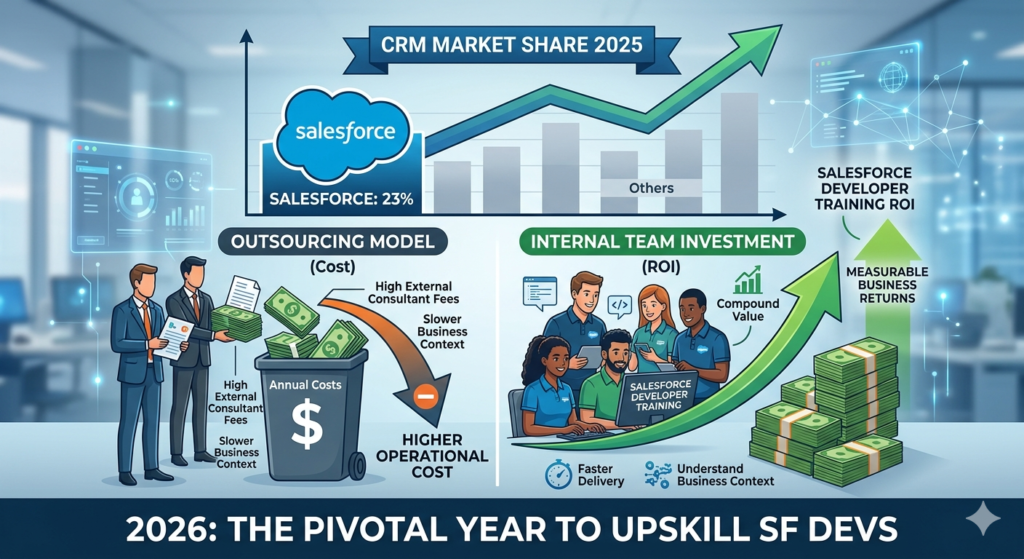
Companies spending six figures annually on Salesforce consultants are discovering that strategic investment in their own teams delivers superior Salesforce developer training ROI. The economics are straightforward—trained internal developers cost less, deliver faster, understand your business context, and compound their value over time.
This isn't about following trends. It's about competitive positioning, cost optimization, and building organizational capabilities that translate directly to your bottom line. Whether you're a CTO evaluating technical strategy, a business owner scrutinizing operational expenses, or an HR leader responsible for workforce development, the data supporting internal Salesforce capability building is compelling.
Let's examine why 2026 is the pivotal year to upskill SF devs within your organization and how this investment creates measurable business returns.
1. The True Cost of Salesforce Consultant Dependency
Most companies don't realize how much consultant dependency actually costs until they calculate the full financial picture.
The visible costs are obvious: consultant rates ranging from $150-$300 per hour, project fees that balloon beyond estimates, and retainer agreements that become permanent fixtures in your budget. A mid-sized company typically spends $180,000-$400,000 annually on Salesforce consulting services.
The hidden costs are more insidious:
- Knowledge drain: Consultants leave with institutional knowledge about your customizations, integrations, and business logic
- Response delays: Waiting for consultant availability means your projects queue behind their other clients
- Misalignment: External developers lack deep context about your business processes, leading to solutions that technically work but miss operational nuances
- Dependency cycles: Each new project requires re-onboarding because consultant teams rotate
- Opportunity costs: Projects you don't pursue because consultant budgets are exhausted
When you invest in Salesforce developer training for your team, you eliminate these compounding inefficiencies. An internal developer earning $95,000-$130,000 annually costs roughly 40-60% less than equivalent consultant hours while delivering higher availability, better business alignment, and accumulated institutional knowledge.
The benefits of training Salesforce team members extend beyond direct cost savings. Your trained developers become force multipliers who can mentor others, document your specific implementations, and optimize your Salesforce instance based on actual usage patterns rather than generic best practices.
The 2026 economic context makes this equation even more favorable. Salesforce capabilities are no longer "nice to have"—they're infrastructure. Just as you wouldn't outsource your entire IT department, treating Salesforce development as a permanent external service creates structural vulnerability and unnecessary expense.
2. Unprecedented Salesforce Platform Evolution Requires In-House Expertise
Salesforce releases three major updates annually, and the platform's capability expansion has accelerated rather than plateaued. In 2026, organizations face a Salesforce ecosystem that includes:
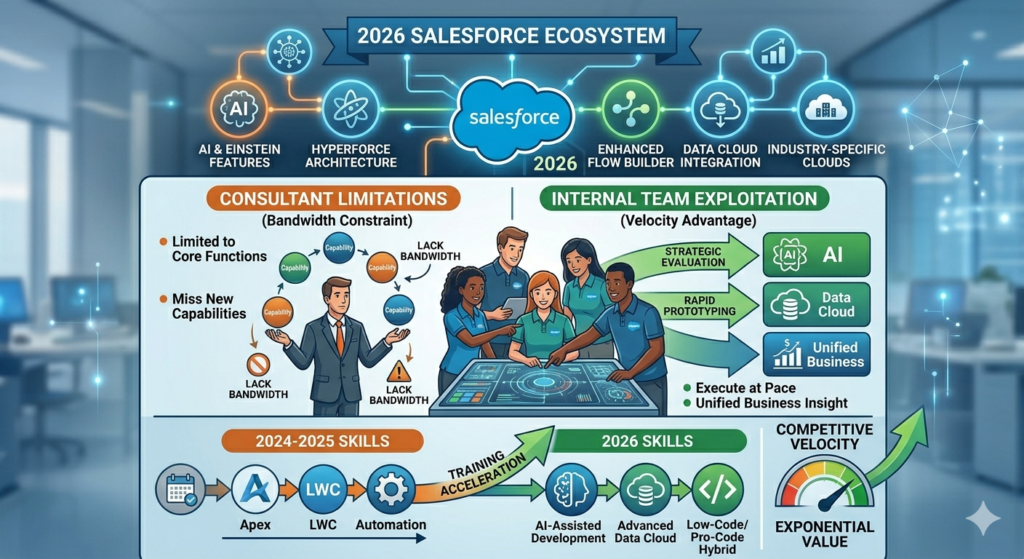
- AI and Einstein features requiring new development approaches
- Hyperforce architecture changes affecting deployment strategies
- Enhanced Flow Builder capabilities that shift traditional Apex use cases
- Data Cloud integration opportunities demanding new technical skills
- Industry-specific clouds with specialized development patterns
External consultants typically specialize in core Salesforce functionality but lack the bandwidth to master every new capability across your specific use cases. When you upskill SF devs internally, you create a team that can strategically evaluate new features against your actual business requirements.
Platform complexity is your competitive advantage—if you can exploit it. Companies with trained internal teams can rapidly prototype new Salesforce capabilities, test them against real workflows, and deploy improvements at a pace consultants simply cannot match.
Consider the Salesforce developer training ROI in this context: a developer trained in 2024-2025 might focus primarily on Apex, Lightning Web Components, and standard automation. That same developer trained in 2026 gains exposure to AI-assisted development, advanced Data Cloud manipulation, and new low-code/pro-code hybrid approaches that dramatically accelerate delivery.
The platform's evolution also means your Salesforce instance becomes increasingly central to business operations. Sales, service, marketing, commerce, and analytics increasingly unify in Salesforce environments. Having developers who understand both the platform AND your business creates exponential value that no consultant relationship can replicate.
Your competitive position in 2026 depends on velocity—how quickly you can implement, test, and scale Salesforce-enabled processes. Internal expertise is the only sustainable path to this agility.
3. The Talent Acquisition Crisis: Build vs. Buy
The Salesforce talent market in 2026 faces a fundamental supply-demand imbalance. The Salesforce ecosystem will need 9.3 million workers by 2026 according to IDC research, but talent production cannot keep pace with demand.
Hiring challenges include:
- Salary inflation: Experienced Salesforce developers command $120,000-$180,000 in competitive markets
- Limited candidate pools: Only 28% of organizations report "easy" Salesforce developer recruitment
- Cultural fit uncertainty: Hired specialists may have technical skills but lack alignment with your business values
- Onboarding duration: New hires require 3-6 months to reach full productivity in your specific environment
- Retention risk: High demand means developers receive constant recruiting outreach
Training existing employees flips this equation entirely. When you invest in Salesforce developer training for current team members, you gain:
- Pre-validated cultural fit: These employees already understand your company, values, and ways of working
- Business context: They know your customers, processes, and strategic priorities
- Loyalty impact: Training investments significantly improve retention—employees who receive development opportunities are 94% more likely to stay with their employer
- Faster productivity: Developers who already know your business reach productivity 40-60% faster than external hires
- Cost predictability: Training costs are fixed and budgetable, unlike the escalating salaries required for competitive hiring
The benefits of training Salesforce team members become particularly apparent when you calculate total talent costs. A comprehensive Salesforce developer training program costs $8,000-$15,000 per employee. Compare this to:
- Recruiting costs for a new hire: $15,000-$30,000
- Salary premium for experienced developers: $20,000-$40,000 above internal rates
- Productivity gap during onboarding: equivalent to 15-25% of first-year salary
- Risk of poor fit requiring repeat hiring: potentially doubling these costs
The 2026 labor market reality is that you cannot hire your way to Salesforce capability at scale. Organizations need 3-8 Salesforce developers depending on platform usage scope. Building this capability internally through training represents the only economically sustainable and strategically reliable path.
4. Measurable Productivity Gains and Business Velocity
Abstract arguments about training value don't convince CFOs. Hard metrics do. Organizations that upskill SF devs report quantifiable productivity improvements:
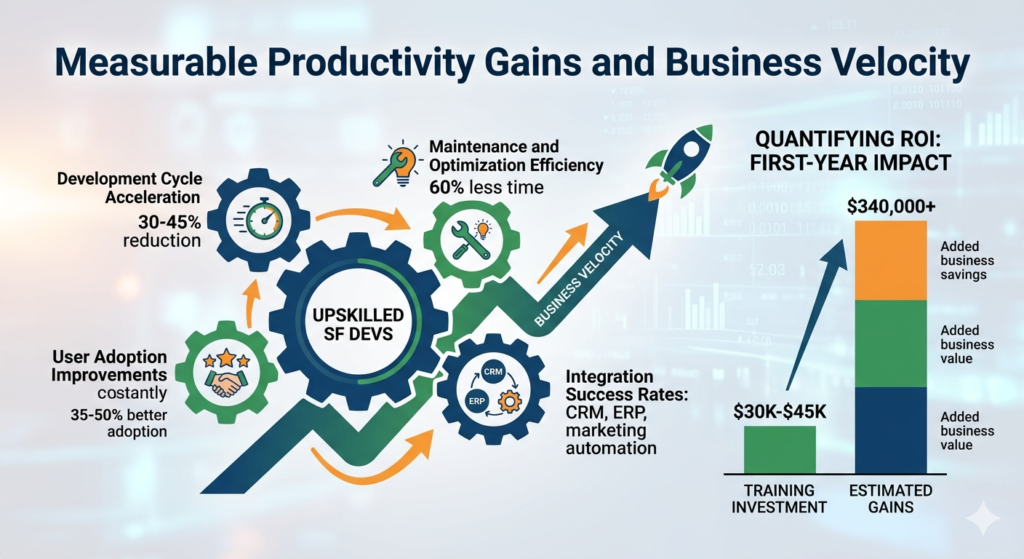
Development cycle acceleration: Trained internal teams reduce average project completion times by 30-45% compared to consultant-dependent approaches. Why? Elimination of scheduling delays, vendor coordination overhead, and knowledge transfer friction.
Maintenance and optimization efficiency: Companies with trained developers spend 60% less time on platform maintenance because these developers understand the existing codebase, can quickly diagnose issues, and make targeted fixes rather than working around legacy implementations.
User adoption improvements: Internal developers who understand both Salesforce and your business create solutions that match actual user workflows. This yields 35-50% better user adoption rates, which directly impacts your Salesforce investment return.
Integration success rates: Salesforce rarely operates in isolation. Trained internal developers integrate your CRM with ERP, marketing automation, customer service, and analytics platforms. These integrations succeed more consistently and maintain better long-term stability when built by teams who understand your complete technology ecosystem.
Quantifying Salesforce developer training ROI for productivity:
Assume your company completes 12 Salesforce projects annually averaging $25,000 each in consultant costs (total: $300,000). After investing in training:
- Project costs decrease by 40% as internal team handles work: $120,000 annual savings
- Project completion time decreases by 35%, enabling 4 additional projects annually: $150,000 in additional business value
- Reduced maintenance costs from better-quality implementations: $40,000 annual savings
- Decreased consultant dependency for minor updates and bug fixes: $30,000 annual savings
Total first-year impact: $340,000 from a training investment of $30,000-$45,000 for 3 developers.
The productivity equation becomes even more favorable in years two and beyond as developers gain experience and as you avoid the recurring consultant costs that never deliver compounding returns.
Business velocity matters because markets don't wait. When sales leadership needs a new CPQ workflow, when customer service requires case routing optimization, or when marketing demands better lead scoring—internal developers respond in days rather than weeks. This responsiveness translates to competitive advantages that financial models struggle to capture but that every business leader recognizes as crucial.
5. Knowledge Retention and Institutional Capability Building
Perhaps the most undervalued aspect of Salesforce developer training is the institutional knowledge accumulation that occurs when capability resides internally.
The consultant knowledge problem: Every consultant engagement follows a predictable pattern—initial discovery, development, documentation, handoff, and departure. Even with thorough documentation, crucial context about why decisions were made, what alternatives were considered, and what business nuances shaped the solution leaves with the consultant.
Six months later when you need to modify that implementation, you're starting partially from scratch. You can read the code and documentation, but the reasoning isn't fully captured. This knowledge gap creates:
- Modification hesitancy: Fear of breaking existing functionality when context is unclear
- Inefficient debugging: Longer troubleshooting when historical context is missing
- Suboptimal enhancements: New features that work around rather than integrate with existing solutions
- Repeated consultant dependency: Calling back the original consultant or hiring new ones to interpret previous work
When you invest in Salesforce developer training for internal teams, you create a living knowledge base. Your developers build solutions, document them, maintain them, and enhance them. They understand the complete evolutionary history of your Salesforce instance.
The benefits of training Salesforce team members for knowledge retention include:
- Continuous optimization: Internal developers constantly refine implementations based on user feedback and changing requirements
- Proactive platform management: Trained teams identify and address technical debt before it becomes critical
- Mentorship capacity: Senior trained developers mentor new team members, creating sustainable knowledge transfer
- Documentation quality: People who will maintain their own code create better documentation
- Strategic platform planning: Deep platform knowledge enables better long-term architectural decisions
Knowledge compounds in ways consultant relationships cannot replicate. A developer trained in 2026 will be exponentially more valuable to your organization in 2028 because they'll understand not just Salesforce generally but your specific Salesforce instance intimately.
This institutional capability becomes a strategic asset during periods of business change—mergers, acquisitions, new market entries, or business model evolution. Your trained Salesforce team can rapidly adapt your CRM infrastructure to support these changes because they own complete context about current state and possibilities.
6. Risk Mitigation and Business Continuity
Consultant dependency creates structural business risk that rarely appears on risk registers but can severely impact operations.
Consultant availability risk: Your strategic Salesforce projects queue behind the consultant's other clients. When you need urgent changes, you're competing for time slots. One client surveyed their consultant dependency and discovered they'd delayed 8 high-priority projects over 18 months due to consultant scheduling conflicts, representing approximately $2.3 million in delayed revenue opportunities.
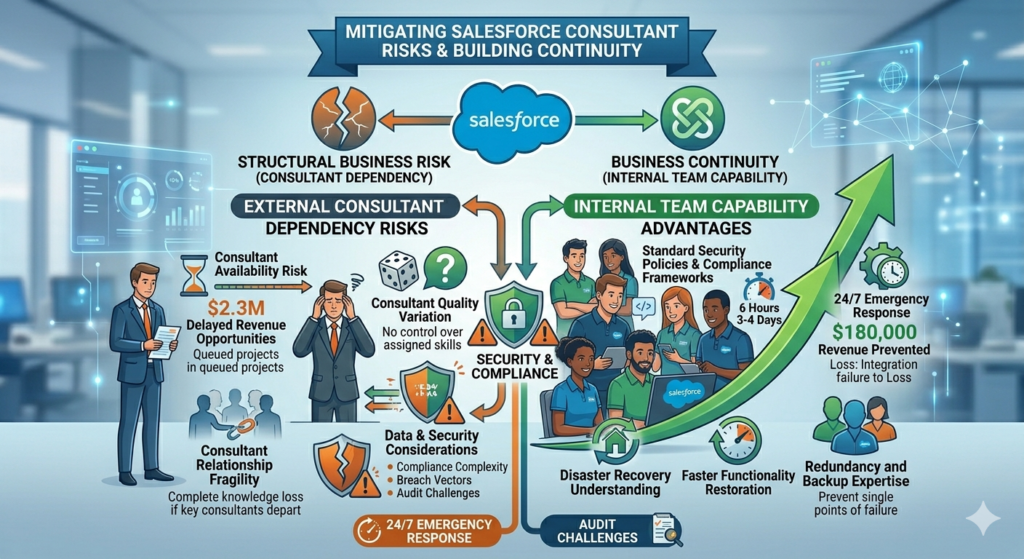
Consultant quality variation: Consulting firms staff projects with whoever is available. Your project might get their top developer or their newest junior resource. You have limited control over this assignment. When you upskill SF devs internally, you control quality through hiring, training, and performance management.
Consultant relationship fragility: Consultants leave firms, firms change focus areas, or consultant-client relationships deteriorate. Companies have experienced complete knowledge loss when key consultants departed mid-project or when consulting firms decided to deprioritize their account size.
Data and security considerations: Every external consultant requires access to your Salesforce instance, often including sensitive customer data, revenue information, and strategic business processes. This creates:
- Compliance complexity: Managing data access for multiple external parties
- Security vulnerabilities: Each consultant relationship represents a potential breach vector
- Audit challenges: Demonstrating appropriate data governance with contractor access
Trained internal employees present fundamentally lower risk profiles. They're subject to your standard security policies, compliance frameworks, and data governance practices.
Business continuity planning also benefits enormously from internal Salesforce capability. When your CRM is business-critical (which it is for most companies), having trained internal developers means:
- 24/7 emergency response capability: Internal teams can address critical issues immediately
- Disaster recovery understanding: Developers who built and maintain your instance can restore functionality faster
- Redundancy and backup expertise: Multiple trained team members prevent single points of failure
The Salesforce developer training ROI includes risk mitigation value that's difficult to quantify but easy to appreciate when incidents occur. One company calculated that having trained internal developers prevented approximately $180,000 in lost revenue during a critical sales quarter when an integration failure would have taken 3-4 days to resolve through consultants but took their internal team 6 hours.
2026 regulatory environment continues tightening around data privacy, AI governance, and customer consent management. Internal teams trained in these requirements can build compliant solutions from the start rather than discovering compliance gaps after consultant handoff.
7. Future-Proofing Your Organization's Salesforce Investment
Most companies significantly underutilize their Salesforce investment. You're paying for Sales Cloud, Service Cloud, Marketing Cloud, maybe Commerce Cloud or CPQ—representing $200,000-$2,000,000 in annual licensing depending on organization size. Yet many organizations use perhaps 40-60% of available functionality.
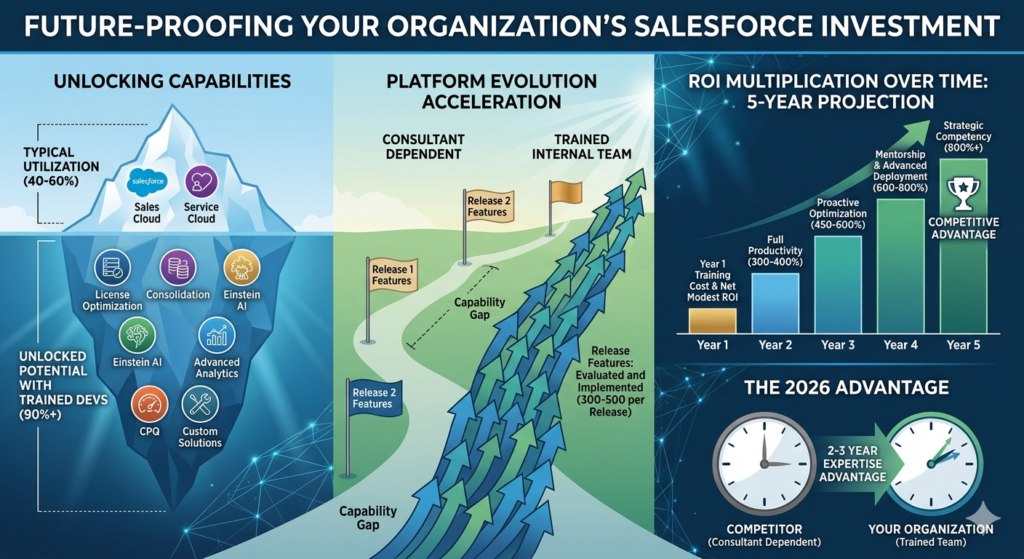
The capability gap isn't about Salesforce limitations—it's about your team's ability to implement available features. When you invest in Salesforce developer training, you unlock:
- License optimization: Trained developers can implement features you're already paying for but not using
- Consolidation opportunities: Replacing third-party tools with native Salesforce capabilities
- Advanced feature adoption: Einstein AI, advanced analytics, and industry-specific functionality that requires development expertise
- Custom solutions: Building precisely tailored functionality instead of accepting generic compromises
Platform evolution acceleration means the gap between what Salesforce offers and what your organization uses will widen without internal expertise. Each Salesforce release includes 300-500 new features and enhancements. External consultants cherry-pick features relevant to multiple clients. Internal trained developers evaluate every new capability against your specific business needs.
The benefits of training Salesforce team members for future-proofing include:
- AI readiness: As Salesforce integrates AI more deeply, trained developers can leverage these capabilities immediately
- Platform migration capability: When Salesforce architectural changes occur (like Hyperforce migration), internal teams manage transitions smoothly
- Integration evolution: APIs and integration patterns change; trained teams adapt your connections proactively
- Technical debt management: Internal developers recognize and address accumulating technical debt before it becomes critical
ROI multiplication over time is perhaps the most compelling financial argument. A consultant engagement delivers value once. A trained developer delivers increasing value year after year as their Salesforce expertise deepens and their business knowledge expands.
Consider a five-year projection when you upskill SF devs:
Year 1: Training cost ($12,000 per developer) plus modest productivity as new skills develop. Net modest positive ROI from reduced consultant dependency.
Year 2: Full productivity achieved. Developers handle most projects internally. ROI approximately 300-400%.
Year 3: Developers proactively optimize existing implementations and identify new opportunities. ROI 450-600%.
Year 4: Senior developers mentor new team members, expanding capability. Advanced Salesforce features deployed. ROI 600-800%.
Year 5: Salesforce development capability is core organizational competency. Strategic advantages compound. ROI 800%+.
The 2026 advantage: Companies that train developers now will have 2-3 year expertise advantages over competitors who continue consultant dependency. In markets where CRM agility provides competitive differentiation, this timing gap matters enormously.
8. Practical Implementation: Making Salesforce Developer Training Work
Understanding the value of Salesforce developer training and successfully implementing it are different challenges. Here's how leading organizations approach this investment:
Selecting the right candidates for training is crucial. Look for:
- Current technical team members: Developers, business analysts, or technical administrators who already understand software concepts
- Power users: Non-technical employees who deeply understand Salesforce from a user perspective and show technical aptitude
- High performers with growth potential: Employees you want to retain long-term who demonstrate learning ability
- Business process owners: Team members who combine process knowledge with technical interest
Training approach options in 2026 include:
- Salesforce Trailhead: Free self-paced learning platform with role-specific trails
- Formal certification programs: Structured paths toward Salesforce Developer certification
- Bootcamp-style intensive training: Accelerated programs (8-12 weeks) for faster capability building
- Mentorship programs: Pairing trainees with experienced Salesforce developers (internal if available, or temporary consultants)
- Hybrid approaches: Combining self-paced learning with instructor-led sessions and real project work
Investment levels vary based on approach:
- Self-directed Trailhead: Minimal cost beyond employee time ($2,000-$3,000 in opportunity cost)
- Certification prep courses: $1,500-$4,000 per certification
- Comprehensive bootcamps: $8,000-$15,000 per person
- Ongoing learning subscriptions: $500-$1,200 annually per developer
Most successful programs combine approaches—structured bootcamp or certification program for foundation, ongoing Trailhead and subscription learning for continuous skill development, and real project work for application.
Time allocation typically requires:
- Initial training phase: 8-12 weeks with 50-75% time allocation
- Project application phase: 3-6 months on supervised real projects
- Ongoing development: 5-10% time allocation for continuous learning
Maximizing Salesforce developer training ROI requires:
- Immediate application: Assign training developers to real projects quickly
- Mentorship: Pair new developers with experienced guides (consultant or senior internal developer)
- Progressive complexity: Start with smaller projects, gradually increase scope
- Documentation requirements: Have trainees document everything, building institutional knowledge
- Knowledge sharing: Create internal forums where developers share learnings
Retention strategies protect your investment:
- Career pathing: Show clear advancement opportunities for Salesforce specialization
- Certification support: Fund additional certifications (Advanced Developer, Architecture tracks)
- Competitive compensation: Adjust salaries to reflect new capabilities
- Challenging projects: Keep developers engaged with interesting technical challenges
- Community involvement: Support attendance at Salesforce events and local user groups
The benefits of training Salesforce team members only materialize if trained employees remain with your organization. Leading companies report 85%+ retention of employees who receive significant training investments when coupled with appropriate career development and compensation adjustments.
Conclusion
The question isn't whether to invest in Salesforce developer training—it's whether you can afford not to in 2026. The data is unambiguous: companies maintaining consultant dependency face escalating costs, knowledge drain, reduced agility, and structural competitive disadvantages that compound annually.
When you upskill SF devs within your organization, you're not simply adding technical capability. You're building a strategic asset that appreciates over time. Unlike consultant fees that deliver one-time value and disappear from your balance sheet, trained internal developers create compounding returns—each project deepens their institutional knowledge, each Salesforce release expands their capability to drive business value, and each year multiplies their contribution to your competitive positioning.
The Salesforce developer training ROI math is straightforward: initial investments of $8,000-$15,000 per developer generate $120,000-$340,000 in first-year value through reduced consultant costs, faster project delivery, better solution quality, and increased platform utilization. By year three, cumulative ROI typically exceeds 500%, and the strategic advantages—faster time-to-market, superior business alignment, and platform innovation capability—create value that financial models struggle to fully capture but every executive immediately recognizes.
The benefits of training Salesforce team members extend beyond economics. You gain developers who understand your customers, processes, and strategic context. You eliminate scheduling delays waiting for consultant availability. You build institutional knowledge that survives individual employee transitions. You create career development opportunities that improve retention. You establish technical capabilities that enable rather than constrain business strategy.
For CTOs, this represents the evolution from Salesforce as a vendor-managed tool to Salesforce as core infrastructure you control. For business owners, it's the difference between CRM as a cost center requiring constant external funding versus CRM as a growth engine managed internally. For HR leaders, it's a workforce development strategy that builds valuable capabilities while improving employee engagement and retention.
The 2026 market reality is unforgiving: Salesforce talent shortages will intensify, consultant rates will continue rising, and platform complexity will accelerate. Organizations that invest now in building internal Salesforce development capability will operate with speed, efficiency, and strategic flexibility that consultant-dependent competitors cannot match.
The companies that dominate their markets in 2028 and beyond won't be those with the largest Salesforce consulting budgets. They'll be the organizations that recognized in 2026 that sustainable competitive advantage requires owning your critical capabilities—and acted decisively to build them.
Your next step is clear: evaluate your current Salesforce spending, identify high-potential internal candidates for developer training, and build the business case for this strategic investment. The ROI timeline is measured in months, not years. The competitive advantage compounds indefinitely. And the cost of inaction—continued consultant dependency, escalating expenses, and strategic limitations—grows more expensive every quarter you delay.
The question for your organization isn't whether Salesforce developer capability matters. It's whether you'll build it internally and capture the value, or continue outsourcing it and paying perpetually for someone else's expertise applied to your business.
Invest in your team. Build the capability. Own the advantage.
About RizeX Labs
At RizeX Labs, we specialize in delivering cutting-edge Salesforce solutions tailored for modern businesses. From custom development using Apex and Lightning Web Components (LWC) to scalable enterprise integrations, we help companies unlock the full potential of the Salesforce ecosystem.
Our team combines deep technical expertise with real-world implementation experience to build high-performance, secure, and future-ready applications. We enable organizations to move beyond basic CRM usage and create powerful, customized solutions that drive efficiency, automation, and innovation.
Internal Links:
- Salesforce Admin course page
- Salesforce Flows vs Apex: When Should You Use Code vs No-Code Automation?
- Salesforce Data Cloud Explained — What It Is and Why It Matters
- AI Tools for Salesforce Development in 2026 — Cursor AI, Copilot and More
- Generative AI in ITSM — How ServiceNow Is Using AI to Transform IT
- Salesforce Named Credentials: What They Are and How to Use Them Safely
- Prompt Engineering for Salesforce Agentforce — Beginner's Guide
External Links:
McKinsey Sales Growth Reports
Gartner Sales Automation Insights