
Introduction: Why AI is Reshaping the Salesforce Ecosystem in 2026
Artificial Intelligence is no longer a futuristic concept in the world of CRM — it is the present, and Salesforce is leading the charge. Over the past few years, Salesforce has made enormous strides in embedding AI across its platform, transforming how sales reps close deals, how service agents resolve tickets, and how marketers personalize campaigns at scale.
But with great innovation comes great confusion. As Salesforce rolls out more sophisticated AI tools, one question keeps coming up in admin forums, developer communities, and boardroom conversations alike:
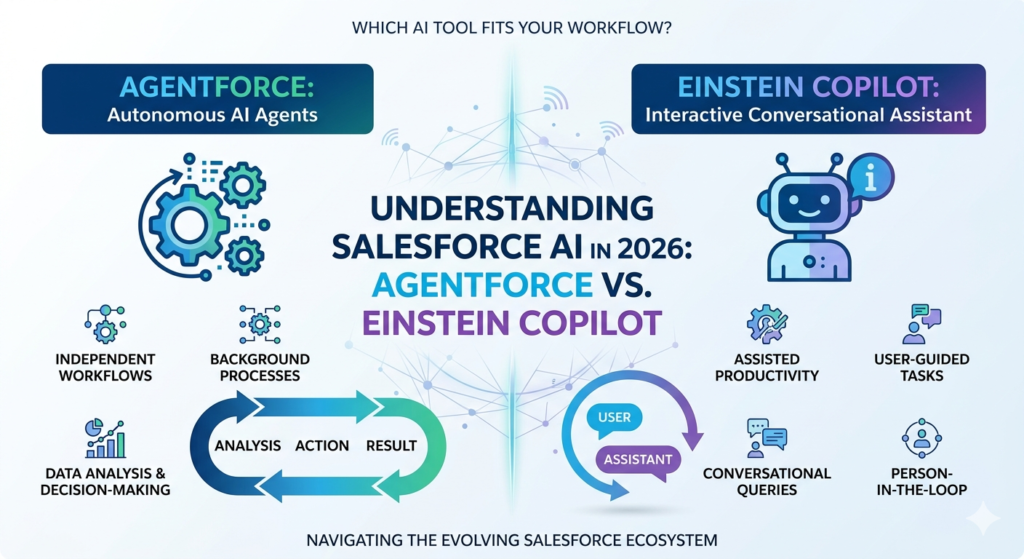
"What exactly is the difference between Agentforce and Einstein Copilot — and which one should I be using?"
This is a fair and important question. In 2026, both Agentforce and Einstein Copilot are prominent players in Salesforce's AI portfolio, but they serve distinctly different purposes and are designed for different users and workflows. Choosing the wrong tool — or worse, not knowing which one you have — can mean leaving serious productivity gains on the table.
Whether you are a Salesforce admin setting up your org for the first time, a developer building custom automation, or a business user trying to understand what your team just purchased, this guide is designed for you.
In this post, we will break down:
- What Agentforce is and what makes its features unique
- What Einstein Copilot is and where it fits in real-world business scenarios
- A head-to-head Salesforce AI products comparison that is easy to digest
- A practical "When to Choose What" framework based on your role
- Real-world examples, a detailed FAQ, and much more
Let us dive in.
Section 1: What is Salesforce Agentforce?
Understanding Agentforce at Its Core
Salesforce Agentforce is an autonomous AI agent platform that allows organizations to build, deploy, and manage AI-powered agents that can independently take actions — without needing a human to supervise every step.
Think of Agentforce as your behind-the-scenes AI workforce. These agents do not just answer questions or suggest the next best action — they actually execute tasks, make decisions within defined guardrails, and interact with systems, data, and customers on your behalf.
Launched and significantly expanded through 2024 and into 2025, Agentforce represents Salesforce's bold vision of agentic AI — a paradigm shift where AI systems act as autonomous employees rather than passive assistants.
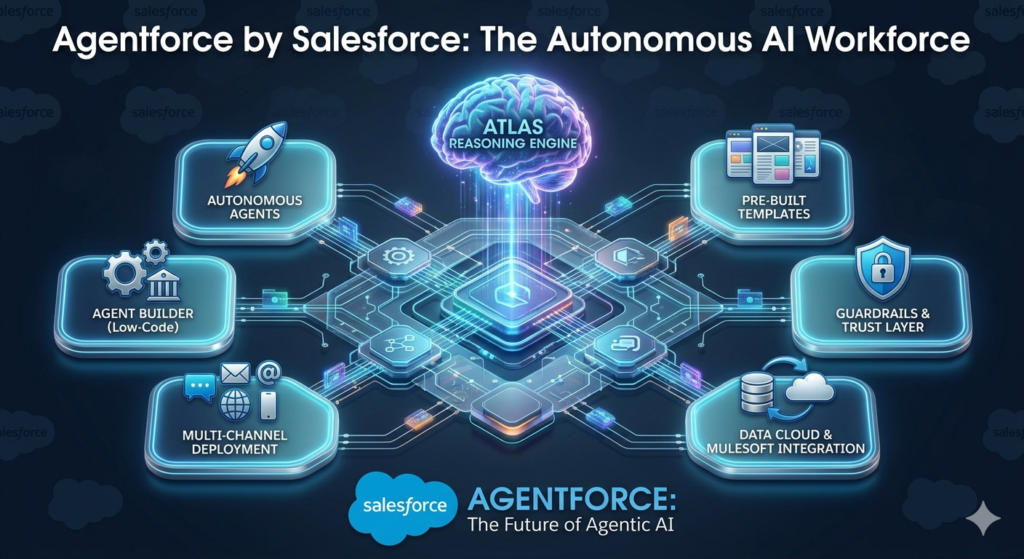
Key Agentforce Features You Should Know
Understanding the agentforce features in detail is essential for evaluating whether this tool fits your organization's needs. Here is a comprehensive breakdown:
1. Autonomous AI Agents
Agentforce agents can independently execute multi-step tasks. For example, an agent can qualify an inbound lead, update Salesforce records, send a personalized email, schedule a meeting, and log the interaction — all without human intervention.
2. Agent Builder (Low-Code Configuration)
Agent Builder is Agentforce's intuitive interface that allows admins and developers to create custom agents using a drag-and-drop, low-code approach. You define the agent's role, scope, instructions, and guardrails, and Agentforce handles the rest.
Real-World Example: A retail company builds a "Returns Processing Agent" using Agent Builder. The agent autonomously processes customer return requests, checks order history in Salesforce Commerce Cloud, initiates the return in the ERP system, and sends a confirmation email — without any human involvement.
3. Pre-Built Agent Templates
Salesforce provides ready-made agent templates for common use cases such as:
- Sales Development Representative (SDR) Agent — qualifies leads and books meetings
- Customer Service Agent — resolves tier-1 support tickets autonomously
- Field Service Agent — schedules and dispatches technicians
- HR Onboarding Agent — guides new employees through onboarding workflows
These templates dramatically reduce time-to-value.
4. Multi-Channel Deployment
Agentforce agents can be deployed across multiple channels simultaneously, including:
- Salesforce Experience Cloud portals
- WhatsApp and SMS
- Web chat widgets
- Slack
- Voice (via telephony integrations)
5. Atlas Reasoning Engine
One of the most powerful agentforce features is its underlying Atlas Reasoning Engine. This is the "brain" that allows agents to:
- Understand complex, multi-part requests
- Break tasks into logical steps
- Retrieve relevant data from Salesforce records
- Make contextual decisions
- Escalate to human agents when confidence thresholds are not met
6. Guardrails and Trust Layer
Agentforce includes a built-in AI Trust Layer powered by Einstein Trust Layer, which ensures that:
- Sensitive data is masked before being sent to LLMs
- All agent actions are logged and auditable
- Agents operate within defined ethical and business boundaries
- Human escalation is triggered when needed
7. MuleSoft and Data Cloud Integration
Agentforce connects seamlessly with Salesforce Data Cloud (formerly known as Customer Data Platform) and MuleSoft, giving agents access to unified, real-time customer data from across your enterprise — not just within Salesforce.
8. Action Library
Agents can be configured with a library of pre-built "actions" — such as sending emails, updating records, querying databases, generating documents, or calling APIs — which they can chain together to complete complex workflows.
Real-World Agentforce Use Cases
To make this more concrete, here are industry-specific scenarios where Agentforce features shine:
Financial Services: A bank deploys an Agentforce agent to handle loan pre-qualification. The agent collects applicant data via a chat interface, checks credit eligibility via API, updates Salesforce Financial Services Cloud, and routes qualified leads to a human loan officer.
Retail: An e-commerce brand uses a Customer Service Agent to handle "Where is my order?" queries at scale, autonomously checking logistics APIs, updating case records, and resolving 80% of inquiries without human intervention.
Healthcare: A healthcare provider uses an Agentforce HR Onboarding Agent to automate new hire onboarding, including sending documents, scheduling orientation sessions, and provisioning access — reducing HR workload by 60%.
Section 2: What is Einstein Copilot?
Understanding Einstein Copilot
While Agentforce is about autonomous execution, Einstein Copilot is about intelligent assistance. Einstein Copilot is Salesforce's conversational AI assistant that is embedded directly into the Salesforce interface. It works alongside your users — not instead of them.
Think of Einstein Copilot as a highly intelligent co-worker sitting next to your sales rep, service agent, or marketer, ready to answer questions, generate content, summarize data, and surface recommendations — all through a natural language conversation interface.
Launched as part of the Einstein 1 Platform, Einstein Copilot is natively grounded in your Salesforce data, meaning it understands your specific business context rather than giving generic AI responses.
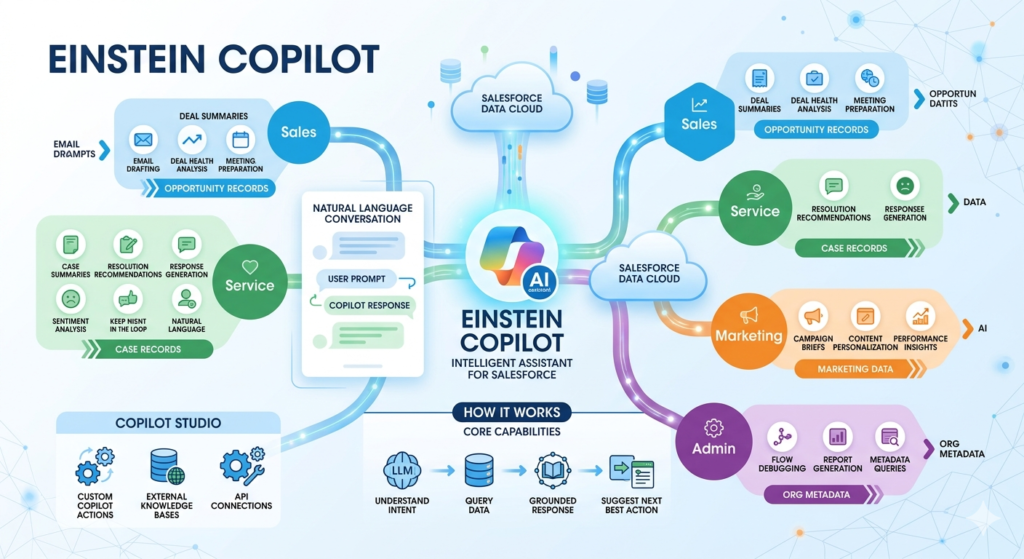
How Einstein Copilot Works
Einstein Copilot operates through a conversational sidebar embedded in Salesforce CRM pages. A user can type or speak a natural language prompt, and Copilot will:
- Understand the intent using a large language model (LLM)
- Query the relevant Salesforce records, Data Cloud profiles, or external knowledge bases
- Return a contextualized response grounded in the user's actual data
- Suggest the next best action or create content for the user
Importantly, Einstein Copilot always keeps a human in the loop. It makes recommendations and generates content, but the user decides what to do with the output.
Einstein Copilot Use Cases Across Business Functions
Here is where Einstein Copilot truly comes alive. The einstein copilot use cases span virtually every department that uses Salesforce:
Einstein Copilot Use Cases in Sales
- Opportunity Summarization: A sales rep opens an opportunity record and asks Copilot, "Summarize the history of this deal and what the customer's main concerns are." Copilot reads emails, call logs, and notes to generate a concise summary.
- Email Drafting: A rep asks Copilot to "Write a follow-up email to this prospect based on our last meeting notes." Copilot generates a personalized, professional email that the rep can review and send.
- Deal Health Analysis: "Which deals in my pipeline are at risk this quarter?" Copilot surfaces at-risk opportunities based on engagement signals, forecast categories, and activity data.
- Meeting Preparation: Before a customer call, the rep asks Copilot for a brief on the account. Copilot summarizes the account's history, open cases, recent purchases, and news about the company.
Einstein Copilot Use Cases in Customer Service
- Case Summarization: A service agent handling a complex case asks Copilot, "Summarize this case and the steps taken so far." Copilot provides a clear summary, reducing the time spent reading long case histories.
- Resolution Recommendations: Copilot suggests the most relevant knowledge base articles or past case resolutions based on the current issue description.
- Response Generation: Agents ask Copilot to draft a customer-facing response. Copilot generates a draft grounded in the case details and company tone.
- Customer Sentiment Analysis: Copilot flags high-frustration cases and suggests priority escalation.
Einstein Copilot Use Cases in Marketing
- Campaign Brief Generation: A marketer asks Copilot to "Draft a campaign brief for our Q3 product launch targeting mid-market SaaS companies." Copilot generates a structured brief using existing customer segmentation data from Data Cloud.
- Content Personalization: Copilot generates personalized email copy variations for different customer segments based on behavioral data.
- Performance Insights: "Why did our last email campaign underperform?" Copilot analyzes campaign metrics and provides a natural language explanation with recommendations.
Einstein Copilot Use Cases in Salesforce Administration
- Flow Debugging: An admin asks Copilot, "Why is this Salesforce Flow failing?" Copilot analyzes the flow structure and error logs to suggest a fix.
- Report Generation: "Create a report showing our top 10 accounts by revenue in the last 90 days." Copilot generates the report directly within Salesforce.
- Metadata Queries: Admins can ask Copilot questions like, "What custom fields exist on the Lead object?" without digging through setup menus.
Copilot Studio: Customizing Einstein Copilot
Salesforce provides Copilot Studio — a configuration interface where admins can:
- Create custom copilot actions tailored to their org
- Define topic-specific instructions
- Connect Copilot to external knowledge bases or APIs
- Configure which users or roles have access to which Copilot capabilities
This makes Einstein Copilot highly extensible without requiring deep development skills.
Section 3: Salesforce AI Products Comparison — Agentforce vs Einstein Copilot
Now that we understand each tool individually, let us put them side by side in a structured Salesforce AI products comparison table.
Detailed Comparison Table
| Comparison Criteria | Agentforce | Einstein Copilot |
|---|---|---|
| Primary Purpose | Autonomous task execution by AI agents | Conversational AI assistance for human users |
| Operating Mode | Autonomous (works independently) | Assistive (works alongside humans) |
| Human Involvement | Minimal; agents work independently within guardrails | High; human reviews and approves all outputs |
| Interaction Style | Programmatic and event-driven | Conversational (natural language chat) |
| Target Users | Operations teams, IT, business process owners | Sales reps, service agents, marketers, admins |
| Primary Interface | Agent Builder, deployed across channels (chat, email, SMS, voice) | Conversational sidebar within Salesforce UI |
| Automation Level | High — end-to-end workflow automation | Medium — generates and recommends, human executes |
| Key Features | Atlas Reasoning Engine, Agent Builder, multi-channel deployment, action library, pre-built templates | Natural language queries, content generation, summarization, next best action, Copilot Studio |
| Use Cases | Lead qualification at scale, case resolution automation, onboarding workflows, field service dispatch | Opportunity summarization, email drafting, case insights, report building, admin Q&A |
| Best For | Repetitive, high-volume, process-driven tasks | Complex, judgment-heavy, creative, or insight-driven tasks |
| Data Integration | Deep integration with Data Cloud and MuleSoft for real-time enterprise data | Integrated with Salesforce CRM data, Data Cloud, and knowledge bases |
| Customization | Agent Builder (low-code), custom actions, custom agent templates | Copilot Studio (custom actions, custom topics, external API connections) |
| Deployment Channels | Web, SMS, WhatsApp, email, Slack, voice, Experience Cloud | Salesforce desktop and mobile UI (embedded sidebar) |
| Escalation to Humans | Built-in escalation when agent confidence is low | Always human-in-the-loop by design |
| Learning and Reasoning | Atlas Reasoning Engine for multi-step reasoning | Powered by LLMs grounded in real-time Salesforce data |
| Security and Trust | Einstein Trust Layer (data masking, audit logs) | Einstein Trust Layer (same foundation) |
| Licensing Model | Consumption-based (per conversation or action) | Included in select Salesforce editions; add-ons available |
| Technical Complexity | Moderate to high — requires careful design of agent flows and guardrails | Low to moderate — accessible via configuration in Copilot Studio |
| Analytics and Monitoring | Agentforce Analytics dashboard for agent performance | Standard Salesforce reporting; Copilot usage analytics in Copilot Studio |
| Ideal Company Size | Mid-market to enterprise with high transaction volumes | SMB to enterprise — broadly applicable |
Section 4: Agentforce vs Einstein Copilot — The Key Differences Explained
Let us distill the most critical distinctions in this agentforce vs einstein copilot breakdown.
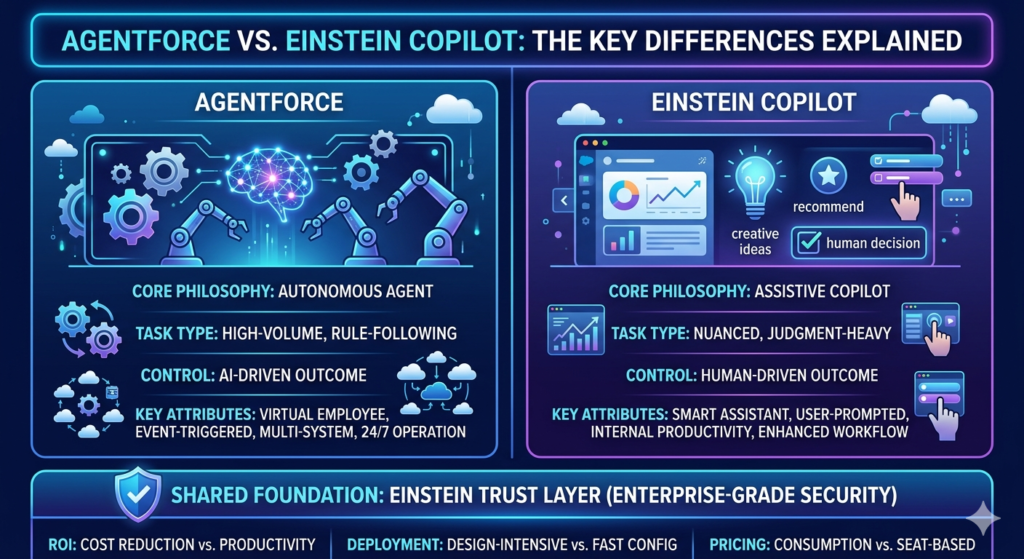
Core Philosophy: Autonomous vs. Assistive
- Agentforce operates on an agentic paradigm — the AI works independently to complete goals, with humans setting the strategy and guardrails but not supervising every action.
- Einstein Copilot operates on a copilot paradigm — the AI supports human decision-making but never acts without human approval.
Task Complexity and Type
- Agentforce excels at repetitive, high-volume, rule-following tasks where the process is well-defined (e.g., processing 10,000 return requests per day).
- Einstein Copilot excels at nuanced, judgment-heavy, creative tasks that benefit from AI assistance but require human expertise (e.g., preparing a tailored pitch for a strategic enterprise account).
Who Controls the Outcome
- With Agentforce, the AI controls the outcome (within guardrails). The agent decides and acts.
- With Einstein Copilot, the human controls the outcome. The AI recommends; the human decides.
Key Differences at a Glance
- Agentforce functions like a virtual employee; Einstein Copilot functions like a smart assistant
- Agentforce is initiated by events or triggers (e.g., a form submission, a new lead, a case created); Einstein Copilot is initiated by a user prompt
- Agentforce is better suited for customer-facing automation at scale; Einstein Copilot is better suited for internal user productivity
- Agentforce requires more upfront design work to define agent behaviors and guardrails; Einstein Copilot is faster to configure and deploy
- Agentforce creates measurable ROI through cost reduction and capacity scaling; Einstein Copilot creates measurable ROI through individual productivity improvements
- Agentforce works 24/7 without fatigue; Einstein Copilot enhances the working hours of human employees
- Agentforce agents can operate across multiple systems and channels simultaneously; Einstein Copilot is primarily a within-Salesforce tool
- Both tools share the Einstein Trust Layer, ensuring enterprise-grade data security
- Both are configurable without heavy coding for standard use cases, but both support extensibility for developers
- Agentforce pricing tends to be consumption-based; Einstein Copilot access is often edition-based or seat-based
Section 5: When to Choose What — A Role-Based Decision Guide
This is perhaps the most practical section of this guide. Use this framework to decide which tool fits your specific situation in the agentforce vs einstein copilot decision.
For Salesforce Admins
Choose Einstein Copilot if:
- You want to help your team work faster inside Salesforce without building complex automations
- You need to generate reports, summarize records, or answer org-related questions quickly
- You want a tool that is quick to deploy with minimal configuration
- Your users need AI support but the tasks require human judgment
Choose Agentforce if:
- You are responsible for automating a high-volume business process end-to-end
- You want to build self-service bots for your Experience Cloud portal
- You need to connect Salesforce workflows to external systems via MuleSoft autonomously
- You are tasked with reducing the volume of routine support tickets handled by your team
Scenario: An admin at a telecom company receives 5,000 "billing inquiry" chat messages per week. They deploy an Agentforce Customer Service Agent to handle 80% of these autonomously, freeing the human support team to focus on complex escalations. Meanwhile, the same admin uses Einstein Copilot personally to quickly pull reports and debug Flows without navigating through dozens of setup menus.
For Salesforce Developers
Choose Agentforce if:
- You are building custom agent behaviors using Apex, Flow, or external APIs
- You want to create complex, multi-system workflows that operate autonomously
- You are developing industry-specific AI solutions for clients
- You need fine-grained control over agent reasoning steps, actions, and escalation paths
Choose Einstein Copilot if:
- You are extending Copilot with custom actions via Copilot Studio or Apex
- You want to surface domain-specific AI recommendations within existing Salesforce pages
- You are integrating external knowledge sources into a user-facing assistant
- Your goal is to improve developer or admin productivity within the platform
Scenario: A Salesforce ISV developer builds a custom "Contract Review Agent" using Agentforce for a legal tech client. The agent autonomously analyzes uploaded contract PDFs, flags non-standard clauses, and routes contracts to the appropriate reviewer. At the same time, they configure Einstein Copilot custom actions for the legal team's users so they can ask natural language questions about specific contracts directly in Salesforce.
For Business Users (Sales Reps, Service Agents, Marketers)
Choose Einstein Copilot if:
- You want AI help while working your daily deals, cases, or campaigns
- You need to generate emails, summaries, or reports without leaving Salesforce
- You want conversational access to insights about your accounts, pipeline, or customers
- You are looking for a tool that feels like a natural extension of how you already work
Choose Agentforce if:
- You lead a team that handles high volumes of repetitive customer interactions
- You want to deploy customer-facing automation for lead qualification, appointment scheduling, or service resolution
- You are a manager looking to scale your team's capacity without adding headcount
- You need 24/7 customer engagement coverage that your human team cannot provide alone
Scenario: A regional sales manager at a SaaS company uses Einstein Copilot daily to prepare for customer calls, draft follow-up emails, and get pipeline health summaries. Meanwhile, they work with their ops team to deploy an Agentforce SDR Agent that autonomously qualifies inbound trial sign-ups, sends personalized welcome sequences, and books demo calls — handling 300+ leads per week without adding sales headcount.
For C-Suite and Business Decision Makers
| Business Goal | Recommended Tool |
|---|---|
| Scale customer service without adding headcount | Agentforce |
| Improve sales rep productivity and win rates | Einstein Copilot |
| Automate lead qualification at scale | Agentforce |
| Help marketing teams create personalized content faster | Einstein Copilot |
| Build 24/7 self-service customer portals | Agentforce |
| Reduce time spent on CRM data entry and reporting | Einstein Copilot |
| Automate onboarding or compliance workflows | Agentforce |
| Enable data-driven decision-making for individual contributors | Einstein Copilot |
Section 6: Can You Use Both Together? (The Power Combination)
Here is a question many organizations eventually ask: Do I have to choose one or the other?
The answer is: No — and in many cases, using both together is the ideal strategy.
Agentforce and Einstein Copilot are designed to be complementary, not competing. They address different layers of AI capability within your organization:
- Agentforce handles the volume — the high-frequency, repeatable, customer-facing work that would otherwise consume enormous human capacity.
- Einstein Copilot handles the nuance — the complex, judgment-dependent, relationship-driven work where human expertise is irreplaceable but AI can amplify effectiveness.
A Real-World "Both Together" Scenario
Company: A B2B software company with a 50-person sales team
Challenge: Inbound leads are growing fast, but the team cannot qualify and engage every lead promptly. Sales reps spend too much time on non-selling activities like data entry, email drafting, and meeting preparation.
Solution:
- They deploy an Agentforce SDR Agent to handle all inbound lead qualification — the agent engages leads within minutes, qualifies them using a conversational flow, updates Salesforce records, and books meetings for qualified prospects.
- Their human sales reps use Einstein Copilot to prepare for every booked meeting — getting AI-generated account briefs, deal summaries, and suggested talk tracks before each call.
- After each call, reps use Einstein Copilot to auto-generate call summaries, update opportunity stages, and draft follow-up emails.
Result: The team effectively doubles their capacity — Agentforce handles the top-of-funnel volume, while Copilot makes each human conversation more productive and informed.
Section 7: Pricing Overview
Pricing for both tools can vary significantly based on your Salesforce edition, contract negotiation, and usage volume. Here is a general guidance:
Einstein Copilot Pricing
- Einstein Copilot is available as part of the Einstein 1 Sales and Einstein 1 Service editions
- It can also be added as an Einstein Add-On to existing Sales Cloud, Service Cloud, or other cloud licenses
- Pricing is generally seat-based (per user per month)
- As of 2025–2026, expect pricing in the range of $75 per user per month for Einstein add-on capabilities, though this varies by bundle
Agentforce Pricing
- Agentforce primarily follows a consumption-based model
- Pricing is structured per conversation (each autonomous agent interaction counts as a conversation)
- Salesforce has offered entry-level pricing starting around $2 per conversation for standard agents
- Volume discounts apply for enterprise deals
- Some Agentforce capabilities are also bundled into certain Einstein 1 editions
Important Note: Salesforce pricing changes frequently and varies by region, edition, and negotiation. Always consult with your Salesforce Account Executive for the most current pricing relevant to your specific contract.
Conclusion: Which Tool is Right for You?
We have covered a lot of ground in this agentforce vs einstein copilot breakdown, so let us bring it all together with clear, actionable takeaways.
Choose Agentforce when:
- Your goal is to scale operations autonomously — handling high volumes of leads, cases, or customer interactions without growing your headcount
- You need 24/7 AI-driven execution across customer-facing channels
- You are solving a process automation problem rather than a productivity problem
- You have well-defined workflows that an AI agent can follow with minimal ambiguity
Choose Einstein Copilot when:
- Your goal is to make individual contributors more productive within their daily Salesforce workflows
- You need AI that can generate, summarize, analyze, and recommend while keeping humans in control
- You are solving a productivity and insight problem for users who need to do more with less time
- Your use cases require nuance, creativity, and relationship context that pure automation cannot capture
Choose Both when:
- You are a mid-market or enterprise organization looking to transform your entire go-to-market motion with AI
- You want to automate the volume at the top of your funnel while amplifying the effectiveness of your human team throughout the funnel
- You are ready to invest in a comprehensive AI transformation strategy rather than a single point solution
The reality of AI in Salesforce in 2026 is this: these tools are not rivals — they are allies. The companies that will win are the ones that understand when to let the AI work autonomously (Agentforce) and when to put powerful AI in the hands of their best people (Einstein Copilot).
Understanding this distinction is not just a technical decision — it is a strategic competitive advantage.
About RizeX Labs
At RizeX Labs, we specialize in delivering cutting-edge Salesforce AI solutions, helping businesses leverage the power of intelligent automation through tools like Agentforce and Einstein Copilot. Our expertise combines deep technical knowledge, industry best practices, and real-world implementation experience to help organizations adopt AI-driven workflows and enhance productivity.
We empower organizations to transform their business operations—from manual processes to AI-powered intelligent systems—enabling smarter decision-making, automation, and scalable growth.
Internal Links:
- Link to your Salesforce AI training page
- How to Build a Salesforce Portfolio That Gets You Hired (With Project Ideas)
- Salesforce Admin vs Developer: Which Career Path is Right for You in 2026?
- Wealth Management App in Financial Services Cloud
- Agentforce course page
External Links:
- Salesforce official website
- Salesforce AI overview
- Einstein Copilot overview
- Salesforce AppExchange
- Salesforce Help Docs
Quick Summary
The comparison between Agentforce and Einstein Copilot highlights the evolution of AI within Salesforce. Both tools are designed to enhance productivity, automate tasks, and provide intelligent assistance, but they serve different purposes and user needs.
Agentforce focuses on autonomous AI agents that can perform tasks, automate workflows, and act independently across business processes. It emphasizes advanced automation, decision-making, and scalable AI-driven operations.
On the other hand, Einstein Copilot acts as an AI assistant embedded within Salesforce applications, helping users with content generation, summarization, CRM insights, and guided actions across sales, service, and marketing workflows.
Understanding the key differences between these tools helps businesses choose the right AI solution based on their goals—whether it's automation with Agentforce or productivity enhancement with Einstein Copilot.