
Salesforce Trailhead vs Paid Training — which actually gets you a job in India in 2026?
Let me start with a reality you’ve probably already lived.
Rahul, a 2024 B.Com graduate from Pune, spent eight months grinding through 150+ Trailhead badges. His LinkedIn looked impressive on the surface. But after applying to 200+ jobs, he got just three interview calls — and zero offers.
Meanwhile, his cousin Priya, stuck in a BPO role, took a different route. She joined a paid Salesforce bootcamp, built two real-world projects, got interview training, and landed a ₹5.2 LPA Salesforce Administrator role within four months.
So what’s the conclusion?
Trailhead is useless? Paid courses are magic?
No. That’s the wrong question — and that’s exactly why most people stay stuck.
The real question is this:
Which path actually builds skills that companies in India are willing to pay for in 2026?
Because here’s the uncomfortable truth —
Recruiters don’t care how you learned Salesforce. They care what you can do with it.
And this guide breaks that down — no fluff, no course-selling bias, no fake motivation.
If you're serious about getting a Salesforce job, not just collecting badges, read this carefully.
Why This Debate Matters More in 2026 Than Ever Before
The Indian Salesforce ecosystem is at an interesting inflection point right now. Here's what's happening:
- Salesforce has 2,000+ open partner positions in India across companies like Deloitte, Accenture, Cognizant, Infosys, and hundreds of mid-size consultancies.
- The global Salesforce economy is projected to create 9.3 million jobs by 2028 (IDC report), with India being the second-largest talent hub after the US.
- At the same time, the entry-level market is brutally competitive. For every junior Salesforce Admin role posted on Naukri or LinkedIn, there are 300-500 applicants.
- AI features like Einstein GPT, Agentforce, and Data Cloud are changing what employers expect even from freshers.
In this landscape, the question "Is Salesforce Trailhead enough for job?" isn't academic — it's the difference between months of unemployment and a career launch.
And the answer? It depends on how you use it. Let me explain.
What Exactly Is Salesforce Trailhead?
Before comparing, let's make sure we're on the same page.
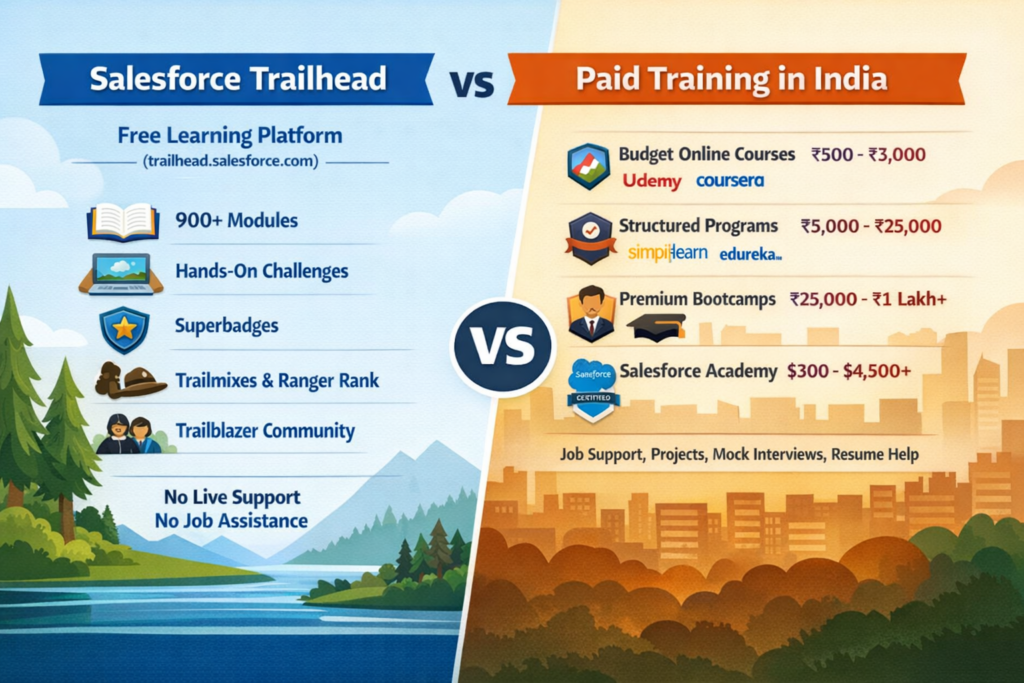
Salesforce Trailhead (trailhead.salesforce.com) is Salesforce's official, free learning platform. Launched in 2014, it has become one of the most comprehensive free tech learning platforms in the world.
What Trailhead Offers (For Free):
- 900+ modules covering Admin, Developer, Marketing Cloud, Sales Cloud, Service Cloud, and more
- Hands-on challenges in free Developer Edition orgs (called Trailhead Playgrounds)
- Superbadges — scenario-based projects that simulate real-world tasks
- Trailmixes — curated learning paths for specific roles (Admin, Developer, Consultant)
- Ranger rank — a status you earn after completing a certain number of badges and points
- Trailblazer Community — forums, groups, and events for networking
- Credential preparation — study material aligned with certification exams
What Trailhead Does NOT Offer:
- Live instructor support
- Real-world, end-to-end project experience
- Interview preparation or mock interviews
- Resume building or LinkedIn optimization
- Job placement assistance
- Mentorship or career guidance
- Peer collaboration on projects
- Deep-dive troubleshooting of complex business scenarios
This distinction is critical. Remember it as we move forward.
What Do "Paid Training" Options Look Like in India?
When people say "paid training," they could mean wildly different things. Let's categorize:
1. Budget Online Courses (₹500 – ₹3,000)
Platforms: Udemy, Coursera, Skillshare
These are recorded video courses, often created by independent instructors. Quality varies dramatically. Some Udemy courses are genuinely excellent (like those by certain well-known Salesforce instructors). Others are outdated recordings with robotic narration.
Best for: Supplementing Trailhead with video explanations.
2. Mid-Range Structured Programs (₹5,000 – ₹25,000)
Platforms: Simplilearn, Intellipaat, Edureka, Great Learning
These offer recorded + some live sessions, assignments, and a certificate. Some include capstone projects. Mentor access is often limited to doubt-clearing sessions.
Best for: Structured learning with deadlines and a curriculum.
3. Premium Bootcamps & Training Institutes (₹25,000 – ₹1,00,000+)
Types: In-person coaching centers (Ameerpet in Hyderabad, Marathahalli in Bangalore), premium online bootcamps, or specialized Salesforce training companies.
These typically offer live instruction, real org access, project work, mock interviews, resume help, and sometimes placement assistance.
Best for: Career switchers who need hand-holding and accountability.
4. Salesforce Official Training (Trailhead Academy)
Cost: $300–$4,500 per course (₹25,000 – ₹3,75,000)
Salesforce's own paid, instructor-led training. Extremely high quality but priced for corporate budgets. Companies usually sponsor employees for these. Not practical for most freshers.
Best for: Working professionals whose employers are willing to pay.
The Core Comparison: Salesforce Trailhead vs Paid Course
Let's put this head-to-head. And I'm going to be honest — not diplomatic.
Comparison Table
| Criteria | Salesforce Trailhead (Free) | Paid Training (Mid to Premium) |
|---|---|---|
| Cost | ₹0 | ₹3,000 – ₹1,00,000+ |
| Content Quality | Excellent (official Salesforce content) | Varies wildly (some great, some terrible) |
| Content Currency | Updated regularly by Salesforce | Often outdated by 6-12 months |
| Hands-On Practice | Trailhead Playgrounds (limited scenarios) | Real-world projects, client simulations |
| Learning Structure | Self-paced (no deadlines, no accountability) | Structured timeline with milestones |
| Depth of Topics | Broad but sometimes surface-level | Can go deep into specific areas |
| Instructor Support | None (community forums only) | Live instructors, doubt resolution |
| Real Projects | Superbadges (structured, not open-ended) | End-to-end project builds |
| Interview Preparation | Not available | Mock interviews, HR prep (premium only) |
| Resume/LinkedIn Help | Not available | Available in premium programs |
| Placement Assistance | Not available | Available (quality varies greatly) |
| Certification Prep | Good foundation, not sufficient alone | Focused prep with practice exams |
| Networking | Trailblazer Community (online) | Batch mates, alumni networks, instructor connections |
| Credential Value | Badges (low hiring value) | Course certificates (also low value without certification) |
| Completion Rate | Very low (~8-12% estimated) | Higher due to financial commitment (~40-60%) |
| Best For | Self-motivated learners with discipline | Career switchers needing structure and support |
The Brutal Truth About Trailhead Badges (That No One Tells You)
Here's what the Trailhead marketing won't say, and what most "Salesforce influencers" on LinkedIn won't admit:
Truth #1: Badges Don't Get You Jobs
I need you to read this twice. Trailhead badges, by themselves, have almost zero hiring value. Recruiters at Indian IT companies don't care if you have 100 badges or 500. They don't filter resumes by Trailhead rank. The "Ranger" status that takes months to earn? It tells a recruiter you can follow instructions on a learning platform — nothing more.
Why? Because badges test knowledge recall, not application. The gap between "I completed the Approval Process module" and "I can design a multi-step approval workflow for a real client's procurement process" is massive.
Truth #2: Trailhead Teaches You WHAT, Not HOW or WHY
Trailhead is exceptional at teaching what Salesforce features exist and how to click through them. But it rarely teaches:
- Why you'd choose one approach over another
- How to gather requirements from a confused client
- What happens when the standard solution doesn't fit
- How to handle data migration with 500,000 messy records
- Why that validation rule you built broke the entire lead conversion process
These are the things that come up in real jobs and in good interviews. Trailhead can't teach them because they require context, experience, and human judgment.
Truth #3: Self-Paced Learning Has a Brutal Dropout Rate
Let's be real about human psychology. When something is free and has no deadline, most people don't finish it. I've seen this pattern hundreds of times in Salesforce communities:
Week 1: "Starting my Salesforce journey! 🚀 #Trailhead #SalesforceOhana"
Week 4: "Just earned my 20th badge!"
Week 8: Radio silence
The gamification (badges, points, ranks) works for a while. But when you hit complex topics like Apex triggers, Lightning Web Components, or Flow Builder logic, the dopamine hits stop and the real work begins. Without accountability — a cohort, an instructor, a financial investment — most people quit.
Truth #4: Trailhead IS Enough... But Only for Exceptionally Self-Disciplined People
Here's the other side. I personally know at least a dozen people who got Salesforce jobs using only Trailhead and free resources. Every single one of them shares these characteristics:
- They treated Trailhead as a starting point, not the entire journey
- They supplemented Trailhead with YouTube tutorials, documentation, and community forums
- They built real projects on their own (not just Superbadges)
- They got certified (Admin, PD1, or both)
- They were active in the Trailblazer community, attended events, and networked aggressively
- They spent 3-6 months in focused, daily study (4-6 hours/day)
- They practiced interview questions relentlessly
Can you do this? Honestly assess yourself. If you have the discipline of a monk and the self-motivation of an entrepreneur, Trailhead alone can work. If you're being honest and know you need structure, deadlines, and guidance — that's not a weakness, that's self-awareness.
The Brutal Truth About Paid Training (That Institutes Won't Tell You)
Now let me balance the scales. Paid training has its own set of problems in India.
Truth #1: Most "Placement Guarantees" Are Lies
Let me be direct: 90% of placement guarantees in Indian IT training are misleading. Here's what actually happens:
- Institute claims "100% placement assistance"
- "Assistance" means they share your resume with some companies
- The roles they place you in might be contract positions, 3-month projects, or roles at ₹2-3 LPA
- Many institutes count "mock interviews" as "placement assistance"
- Some count "interview opportunity" (not job offer) in their statistics
Before joining any paid program, ask:
- How many students from the last 3 batches got placed?
- Can I speak to 3-4 placed students directly?
- What's the average CTC of placed students?
- What companies hired them?
- Were these full-time roles or contract positions?
If they dodge these questions, run.
Truth #2: Expensive Doesn't Mean Better
A ₹80,000 program is not necessarily better than a ₹15,000 one. I've seen coaching centers in Ameerpet, Hyderabad charge ₹30,000 and deliver better practical training than ₹1,00,000 programs from well-known edtech companies. Why? Because the Ameerpet instructor has 10 years of Salesforce project experience and teaches 15 students. The edtech company has a junior instructor reading from slides to 500 students.
What to evaluate:
- Instructor's real-world Salesforce experience (check their LinkedIn)
- Student-to-instructor ratio
- Hands-on project quality
- Post-training support and community access
Truth #3: A Certificate Without Certification Is Worthless
Many paid courses give you a "course completion certificate." Please understand: this has zero value in the job market. The only credentials that matter in Salesforce hiring are:
- Salesforce Official Certifications (Admin, Platform Developer I, etc.)
- Demonstrable project experience (portfolio, GitHub, case studies)
- Practical knowledge demonstrated in interviews
A Simplilearn or Udemy certificate does not substitute for a Salesforce certification. Period.
Truth #4: You Still Need Trailhead Even If You Pay for Training
Here's the irony: even the best paid training programs use Trailhead modules as part of their curriculum. Trailhead is the foundational resource. You cannot escape it. The paid program's value comes from what it adds on top of Trailhead — projects, mentorship, interview prep, and community.
So Which Should You Choose? A Decision Framework
Instead of giving you a one-size-fits-all answer, let me give you a decision framework based on your actual situation.
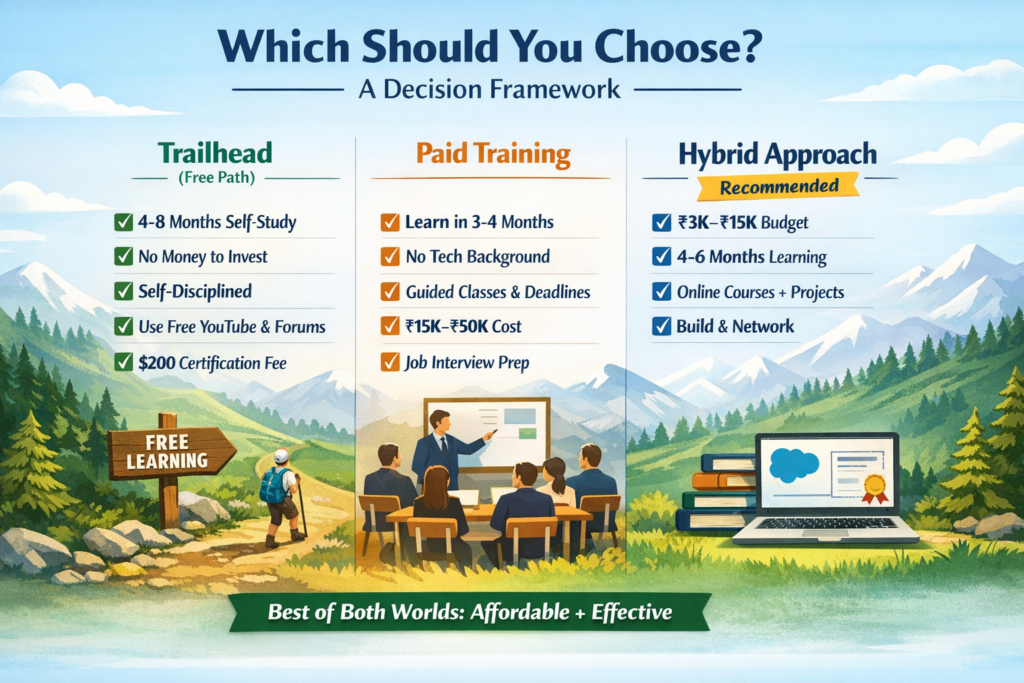
Choose Trailhead (Free Path) If:
✅ You have 4-8 months of dedicated time to self-study
✅ You're currently employed/studying and can't invest money
✅ You're naturally self-disciplined and can maintain consistency without external accountability
✅ You can supplement Trailhead with free YouTube tutorials (there are excellent Salesforce YouTube channels)
✅ You have basic English proficiency (Trailhead content is in English)
✅ You're willing to build projects independently and figure things out through Stack Exchange, Reddit, and Trailblazer Community forums
✅ You can afford the Salesforce certification exam fee ($200 / ~₹17,000, though Salesforce often offers discounts and sometimes free vouchers for community events)
Choose Paid Training If:
✅ You're a career switcher who needs to learn fast (3-4 month timeline)
✅ You don't have a tech background and need concepts explained by a human being
✅ You know you struggle with self-paced learning and need deadlines
✅ You can afford ₹15,000-50,000 (don't take loans for Salesforce training — the ROI is uncertain)
✅ You want structured project experience to showcase in interviews
✅ You need interview preparation and resume help (especially if you've never worked in IT)
✅ You value networking with a batch of peers who are on the same journey
Choose a Hybrid Approach (RECOMMENDED) If:
✅ You want the best ROI on your time and money
✅ You can invest ₹3,000-15,000 (budget Udemy courses + certification fee)
✅ You have 4-6 months of dedicated learning time
✅ You're willing to do the hard work of building projects and networking on your own
The hybrid approach is what I recommend for 80% of people reading this. Let me outline exactly what this looks like.
The Actionable Roadmap: How to Actually Get a Salesforce Job in India (2026)
This is the section you should screenshot. This is a month-by-month plan that combines free and low-cost resources to maximize your chances of landing a Salesforce job.
Phase 1: Foundation (Month 1-2)
Goal: Understand Salesforce fundamentals, decide your track (Admin vs Developer)
Week 1-2: Orientation
- Create a Salesforce Developer Edition org (free)
- Complete these Trailhead trails:
- "Salesforce Platform Basics"
- "Data Modeling"
- "Data Management"
- "CRM for Lightning Experience"
- Watch 5-6 "What is Salesforce" YouTube videos to understand the ecosystem and career paths
- Join the Trailblazer Community and 3-4 Salesforce LinkedIn groups
Week 3-4: Choose Your Track
Admin Track (Recommended for freshers, non-tech backgrounds):
- Complete Trailhead modules on: Security, Automation (Flow Builder), Reports & Dashboards, Sales Cloud, Service Cloud
- Start the "Admin Beginner" trail and "Admin Intermediate" trail
Developer Track (Recommended if you have programming background):
- Complete Trailhead modules on: Apex Basics, SOQL, Lightning Web Components, Triggers
- Start the "Platform Developer Beginner" trail
Week 5-8: Deep Dive
- Continue Trailhead modules for your chosen track
- Buy a Udemy course (₹400-600 during sales) for structured video learning. Look for courses by reputable instructors with high ratings and recent updates.
- Start practicing in your Developer org — don't just click through challenges, experiment!
- Complete at least 2 Superbadges relevant to your track
Important: Maintain a learning journal. Write down every concept you learn, every question you have, every "aha moment." This becomes interview gold later.
Phase 2: Build Real Projects (Month 3-4)
This is where 90% of Trailhead-only learners fail. They skip this phase entirely, which is why they can't answer practical interview questions.
Goal: Build 3 portfolio projects that demonstrate real-world Salesforce skills.
Project 1: Recruitment Management System (Admin-focused)
Scenario: A mid-size IT company wants to track job applications, schedule interviews, and manage hiring decisions in Salesforce.
What you'll build:
- Custom objects: Job Posting, Application, Interview, Candidate
- Relationships between objects (lookup, master-detail)
- Record types for different job categories (Full-time, Contract, Intern)
- Page layouts and Lightning Record Pages
- Validation rules (e.g., interview date must be after application date)
- Approval process for final hiring decisions
- Flow Builder automation: send email notification when application status changes
- Reports: applications by source, time-to-hire by department, interview-to-offer conversion rate
- Dashboard for the HR manager
Why this project matters: It covers 80% of what a Salesforce Admin does daily — object creation, automation, security, reporting.
How to present it: Write a 2-page case study document. Take screenshots of your org. Record a 5-minute Loom video walking through the solution. Upload everything to a Google Drive folder or your personal website.
Project 2: Sales Pipeline Tracker (Sales Cloud focused)
Scenario: A B2B SaaS company wants to manage their sales pipeline, track deals, forecast revenue, and automate follow-ups.
What you'll build:
- Customized Opportunity stages aligned with the company's sales process
- Lead scoring using custom fields and formulas
- Lead assignment rules based on geography and company size
- Web-to-Lead form for the company website
- Automated task creation when opportunity stage changes (using Flow)
- Email alerts for deals stuck in a stage for more than 7 days
- Opportunity reports: pipeline by stage, revenue forecast by quarter, win/loss analysis
- Role hierarchy and sharing rules (sales reps can only see their own deals, managers see their team's)
Why this project matters: Sales Cloud is the bread and butter of most Salesforce implementations. Every interview for Admin/Consultant roles will ask Sales Cloud questions.
Project 3: Customer Support Portal (Service Cloud focused)
Scenario: An e-commerce company wants to manage customer complaints, track case resolution times, and provide a self-service knowledge base.
What you'll build:
- Case management with auto-assignment rules
- Escalation rules (unresolved cases after 24 hours go to senior agents)
- Email-to-Case setup
- Knowledge Base with articles organized by category
- Case auto-response rules
- Entitlements and milestones (SLA management)
- Service Console app for agents
- Reports: average case resolution time, cases by priority, customer satisfaction metrics
Why this project matters: Service Cloud is the second most common Salesforce product. Having this project shows versatility.
For Developer Track Students — Additional Project:
Project 4: Integration Dashboard
What you'll build:
- Apex class that calls an external REST API (use a free public API)
- Apex trigger that prevents duplicate records
- Lightning Web Component that displays API data in a custom UI
- Batch Apex for processing large data volumes
- Test classes with 90%+ code coverage
Phase 3: Get Certified (Month 4-5)
Goal: Pass the Salesforce Administrator Certification (or Platform Developer I if on the dev track)
The certification is NON-NEGOTIABLE. Let me repeat: in India's Salesforce job market, certification is the minimum barrier to entry. It's your ticket to having your resume considered. Without it, most recruiters won't even look at you — regardless of how many Trailhead badges or paid course certificates you have.
Preparation Strategy:
- Study Trailhead's official exam guide — download the exam outline from Salesforce's certification page
- Use Trailhead modules aligned with each exam topic
- Purchase a practice exam set (Focus on Force or Salesforce Ben's practice exams — ₹2,000-3,000). This is the one investment I consider absolutely essential.
- Join a study group — check Trailblazer Community for certification study groups in your city or online
- Take at least 5 full practice exams before the real thing. Aim for 80%+ consistently before booking the exam.
- Book the exam through Webassessor — look for discount vouchers (Salesforce regularly offers them during Dreamforce, TrailblazerDX, and community events)
Exam tips:
- The pass mark is 65% for Admin, but aim for 75%+
- Focus heavily on: Security/Access, Automation, Sales/Service Cloud features, Reports/Dashboards
- Read each question twice — Salesforce cert questions are famous for tricky wording
- Eliminate obviously wrong answers first
- Time management: you have roughly 90 seconds per question
Phase 4: Job Hunting (Month 5-7)
This is where your approach matters more than your credentials.
Step 1: Build Your Salesforce-Optimized Resume
Your resume should scream "I can do this job on Day 1." Here's the structure:
Header: Name, Phone, Email, LinkedIn, Trailhead Profile Link, Salesforce Certification credentials
Summary (3 lines): "Salesforce Certified Administrator with hands-on project experience in Sales Cloud, Service Cloud, and Flow Builder automation. Built 3 end-to-end Salesforce solutions managing recruitment workflows, sales pipelines, and customer support operations. Actively seeking an entry-level Salesforce Admin/Consultant role."
Certifications: List your Salesforce certifications with the credential verification link
Projects: Describe your 3 projects using this format:
- Project Name | Your Role
- Business problem you solved (1 line)
- Key features you implemented (3-4 bullet points)
- Results/impact (if measurable)
Technical Skills: Salesforce Admin, Sales Cloud, Service Cloud, Flow Builder, Process Automation, Reports & Dashboards, Data Loader, Data Import Wizard, SOQL (if applicable), Apex (if applicable), Lightning Web Components (if applicable)
Trailhead: Mention your rank, number of badges, and specific Superbadges completed
Education: Keep it brief — degree, college, year
Step 2: Optimize Your LinkedIn Profile
- Professional headshot (not a selfie, not a group photo)
- Headline: "Salesforce Certified Administrator | Sales Cloud | Service Cloud | Seeking Opportunities"
- Banner image: Create one using Canva with your Salesforce credentials
- About section: Tell your career story — why Salesforce, what you've learned, what you're looking for
- Featured section: Link to your project case studies, Trailhead profile, and certification verification
- Experience section: Add your projects as experience entries (yes, even though they're self-initiated)
- Skills section: Add every relevant Salesforce skill and get endorsements from your study group
Step 3: Apply Strategically (Not Randomly)
Where to apply:
| Platform | Strategy |
|---|---|
| Search "Salesforce" + "fresher" or "junior" or "0-2 years." Set job alerts. Apply within 24 hours of posting. | |
| Naukri | Create a Salesforce-specific profile. Use keywords: Salesforce Admin, Salesforce Developer, CRM, Sales Cloud |
| Indeed | Similar to Naukri — focus on "Salesforce" keyword variations |
| Salesforce Talent Alliance | Salesforce's own job board for partner companies seeking talent — highly underutilized in India. Visit talent.salesforce.com |
| Company Career Pages | Apply directly to Salesforce consulting partners: Deloitte, Accenture, Cognizant, Wipro, Persistent Systems, AbsyzTech, Girikon, CloudVandana, Varasi, JEEVI, etc. |
| Twitter/X | Follow Salesforce recruiters and community leaders. Many jobs are posted there before LinkedIn. |
| Trailblazer Community | Job board, community groups, and local user groups often share openings |
Application volume: Aim for 10-15 targeted applications per day (not 50 spray-and-pray applications). Customize your resume summary for each application based on the job description.
Step 4: Network Like Your Career Depends On It (Because It Does)
In India's Salesforce job market, referrals account for 40-60% of hires at partner companies. Cold applications through job portals have a success rate of 1-3%. Referrals have a success rate of 15-25%.
Networking tactics:
- Attend Salesforce Community Events: Every major Indian city has a Trailblazer Community Group that meets monthly. Hyderabad, Bangalore, Pune, Mumbai, Delhi, Chennai — find your local group. Attend every meetup. Introduce yourself. Exchange LinkedIn connections.
- Engage on LinkedIn daily: Comment thoughtfully on posts by Salesforce professionals. Share your learning journey. Post about your projects. Write about concepts you've learned. This creates visibility.
- DM strategy: Reach out to Salesforce professionals at companies you want to work for. Don't ask for a job in your first message. Ask for advice: "I'm preparing for a Salesforce career. Could I ask you 2-3 questions about your experience at [Company]?" Most people will respond. Build the relationship. When a relevant role opens, ask if they'd be willing to refer you.
- Contribute to the community: Answer questions on Salesforce Stack Exchange or Trailblazer Community. This builds your reputation and shows up when recruiters Google your name.
Step 5: Prepare for Interviews (Relentlessly)
Salesforce interviews in India typically follow this pattern:
Round 1: Technical Screening (30-45 min)
- Object relationships (lookup vs. master-detail — know the differences cold)
- Record Types, Page Layouts, Profiles, Permission Sets
- Sharing rules, OWD, Role Hierarchy
- Flow Builder scenarios (the most common question area in 2025-2026 interviews)
- Reports and Dashboards
- Data management (Data Loader, Import Wizard, duplicate management)
- Sales Cloud: Lead conversion process, Opportunity stages, Campaign management
- Service Cloud: Case management, Escalation rules, Knowledge Base
Round 2: Scenario-Based (45-60 min)
"A client wants to automate their lead assignment based on geography and industry. How would you approach this?"
This is where your project experience shines. Walk through your approach:
- Understand the requirement (ask clarifying questions — interviewers love this)
- Evaluate standard vs. custom solutions
- Design the solution (assignment rules, Flow, or custom code)
- Discuss testing and validation
- Mention deployment considerations
Round 3: HR/Cultural Fit (20-30 min)
- Why Salesforce?
- Tell me about your learning journey
- How do you handle pressure/deadlines?
- Salary expectations (research market rates — ₹3-5 LPA for fresher Admin, ₹4-7 LPA for fresher Developer)
Interview Prep Resources:
- Salesforce Ben's interview questions (free)
- Salesforce Trailhead module: "Interview Strategies"
- YouTube: Search "Salesforce Admin interview questions India 2025/2026"
- Practice with your study group — do mock interviews every week
Real Talk: What Employers Actually Look For in 2026
I've spoken with hiring managers at Indian Salesforce consulting companies. Here's what they consistently say they evaluate:
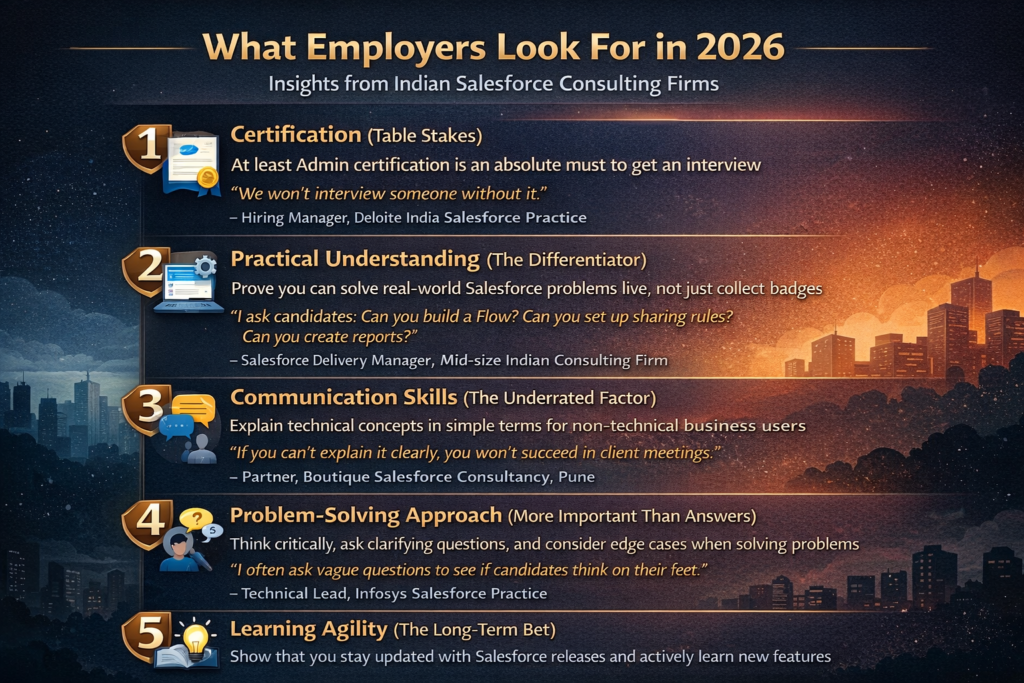
1. Certification (Table Stakes)
"We won't interview someone without at least Admin certification. It's the minimum filter." — Hiring Manager, Deloitte India Salesforce Practice
2. Practical Understanding (The Differentiator)
"I don't care about badges. I ask candidates to open a Salesforce org and solve a problem in front of me. Can they build a Flow? Can they set up sharing rules? Can they create a report? Most 'certified' candidates freeze when asked to do these things live." — Salesforce Delivery Manager, Mid-size Indian Consulting Firm
3. Communication Skills (The Underrated Factor)
"Salesforce is a client-facing career. If you can't explain your solution to a non-technical business user in simple language, I can't put you on a project. Many freshers have great technical knowledge but can't communicate." — Partner, Boutique Salesforce Consultancy, Pune
4. Problem-Solving Approach (More Important Than Answers)
"I often ask intentionally vague questions to see how candidates think. Do they ask clarifying questions? Do they consider edge cases? Do they mention governor limits? The approach matters more than the final answer." — Technical Lead, Infosys Salesforce Practice
5. Learning Agility (The Long-Term Bet)
"Salesforce releases 3 major updates per year. Whatever you know today will be partially outdated in 6 months. I need people who are genuinely curious and enjoy learning. I check if candidates know about upcoming features, if they follow Salesforce blogs, if they're active in the community." — Salesforce Architect, Cognizant
The Cost-Benefit Analysis: Real Numbers
Let's talk money. Because ultimately, this is an investment decision.
Free Path (Trailhead + Free Resources)
| Item | Cost |
|---|---|
| Trailhead | ₹0 |
| YouTube tutorials | ₹0 |
| Developer Edition org | ₹0 |
| Trailblazer Community | ₹0 |
| Certification exam (Admin) | ~₹17,000 (with standard pricing) |
| Practice exams (Focus on Force) | ~₹2,500 |
| Internet (6 months) | ~₹3,000 |
| Total | ~₹22,500 |
Time investment: 6-8 months (4-6 hours/day)
Risk: Higher dropout rate, longer job search due to lack of interview prep and networking support.
Hybrid Path (Trailhead + Budget Paid Resources)
| Item | Cost |
|---|---|
| Trailhead | ₹0 |
| Udemy courses (2-3 courses) | ₹1,500 |
| Practice exams | ₹2,500 |
| Certification exam (Admin) | ~₹17,000 |
| LinkedIn Premium (3 months for job search) | ₹5,000 |
| Internet (6 months) | ₹3,000 |
| Total | ~₹29,000 |
Time investment: 5-7 months
Risk: Moderate. Still requires strong self-discipline.
Premium Paid Path (Bootcamp + Certification)
| Item | Cost |
|---|---|
| Paid training program | ₹30,000 – ₹80,000 |
| Certification exam | ~₹17,000 |
| Practice exams | ₹2,500 |
| Internet (4 months) | ₹2,000 |
| Total | ₹51,500 – ₹1,01,500 |
Time investment: 3-5 months
Risk: Financial risk if the institute is low quality. Lower dropout rate due to accountability.
Expected ROI (First Year Salary)
| Role | Fresher CTC Range (India, 2026) |
|---|---|
| Salesforce Administrator | ₹3.5 – 6 LPA |
| Salesforce Developer (Apex/LWC) | ₹4.5 – 8 LPA |
| Salesforce Consultant (Junior) | ₹4 – 7 LPA |
| Salesforce QA/Tester | ₹3 – 5 LPA |
Even at the lowest range, your entire investment is recovered in 1-3 months of employment. The ROI on Salesforce learning — whether free or paid — is excellent compared to most tech certifications in India.
Common Mistakes Indian Freshers Make (And How to Avoid Them)
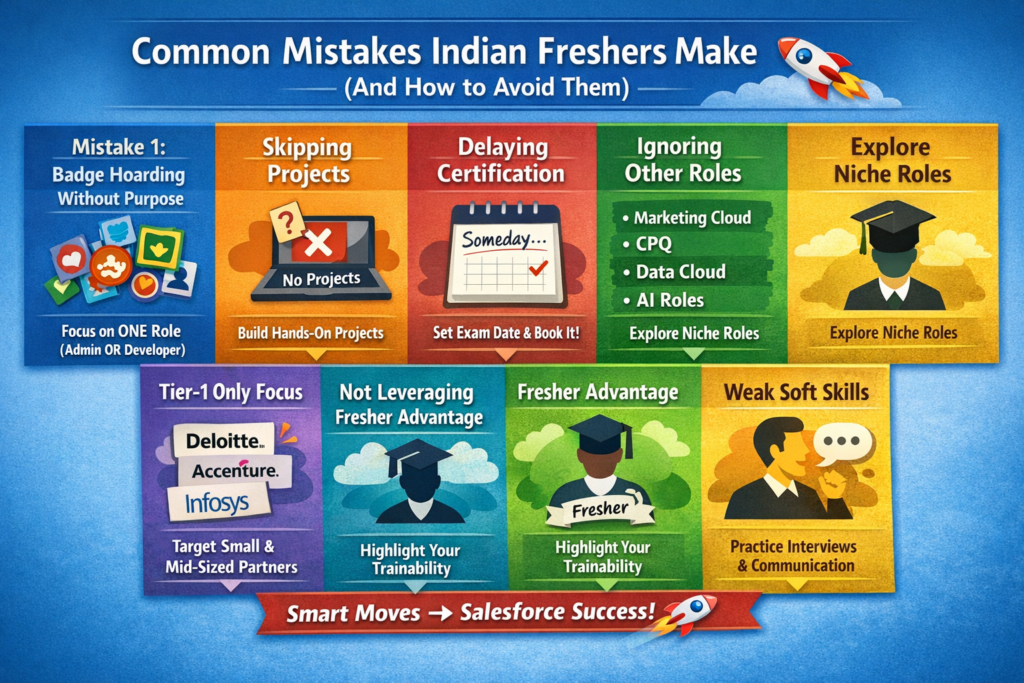
Mistake 1: Badge Hoarding Without Purpose
Problem: Completing random Trailhead modules in every topic without focusing on a career track.
Fix: Focus on one role (Admin OR Developer). Complete only relevant modules. Depth beats breadth.
Mistake 2: Skipping Projects
Problem: Going straight from learning to job applications without building anything.
Fix: Follow the project roadmap in Phase 2. No exceptions.
Mistake 3: Delaying Certification
Problem: "I'll get certified when I feel 100% ready." You'll never feel 100% ready.
Fix: Set a certification date 2 months from now and book the exam. The deadline forces preparation.
Mistake 4: Ignoring the Ecosystem Beyond Admin/Developer
Problem: Everyone rushes to Admin or Developer roles, creating fierce competition.
Fix: Consider less crowded niches:
- Salesforce Marketing Cloud (email marketing, journeys — fewer candidates, good demand)
- Salesforce CPQ (Configure, Price, Quote — specialized, high paying)
- Salesforce Data Cloud (analytics, data management — emerging demand)
- Salesforce AI / Agentforce (cutting-edge — early movers will have massive advantages)
- Salesforce Industries (Health Cloud, Financial Services Cloud — vertical specialization)
Mistake 5: Not Leveraging the "Freshers Advantage"
Problem: Thinking that being a fresher is only a disadvantage.
Fix: Many consulting companies actually prefer freshers because:
- You have no "bad habits" from other CRM platforms
- You're trainable and adaptable
- You're cost-effective for bench-to-project models
- Companies get Salesforce partner credits for hiring certified talent
Frame your freshness as eagerness, adaptability, and up-to-date knowledge (especially about latest Salesforce releases that experienced admins might not know).
Mistake 6: Applying Only to Tier-1 Companies
Problem: Everyone wants Deloitte, Accenture, Infosys. The competition for these is insane.
Fix: Target small and mid-size Salesforce consulting partners. There are 200+ Salesforce partners in India that most freshers have never heard of. These companies are often more willing to hire freshers, offer better learning opportunities (you'll work on real projects from Day 1), and provide faster career growth. Search "Salesforce Partner" on the Salesforce AppExchange partner directory and filter by India.
Mistake 7: Neglecting Soft Skills
Problem: Having strong technical knowledge but failing in interviews due to poor communication or lack of confidence.
Fix: Practice explaining Salesforce concepts out loud — to your mirror, to your family, to your study group. Record yourself answering interview questions and watch the recordings. Join Toastmasters or practice public speaking. In a client-facing career, this matters as much as technical skills.
The 2026 Landscape: What's Changing and Why It Matters
AI Is Reshaping Entry-Level Expectations
Salesforce's aggressive push into AI (Einstein GPT, Copilot, Agentforce, Data Cloud) means that even fresher-level expectations are shifting. In 2026, interviewers are increasingly asking:
- "Do you know what Agentforce is?"
- "How would you use Einstein for lead scoring?"
- "What's the difference between predictive and generative AI in Salesforce?"
Action item: Complete the "AI for Salesforce" and "Agentforce Basics" trails on Trailhead. These are free and will differentiate you from candidates who only know "classic" Salesforce.
Flow Builder Is the New Apex (For Admin Roles)
Salesforce is pushing hard toward low-code/no-code automation. Flow Builder has become incredibly powerful — and complex. Many problems that previously required Apex code can now be solved with Flows.
Action item: Become a Flow Builder expert. Build complex flows — screen flows, scheduled flows, record-triggered flows, autolaunched flows. This is the #1 skill tested in Admin interviews in 2025-2026.
Multi-Cloud Knowledge Is Becoming Mandatory
Companies no longer want "just an Admin" or "just a Developer." They want people who understand the Salesforce ecosystem broadly. Even for entry-level roles, knowing the basics of Sales Cloud, Service Cloud, and at least one additional cloud (Marketing Cloud, Experience Cloud, or Commerce Cloud) gives you an edge.
Remote Work Has Expanded the Competition
The rise of remote Salesforce work means you're no longer competing only with people in your city. A candidate in Jaipur is now competing with candidates in Bangalore, Hyderabad, and Pune for the same remote role. This makes differentiation even more important.
Final Verdict: Is Salesforce Trailhead Enough for Job? The Honest Answer
Trailhead alone is not enough for most people to get a Salesforce job in India in 2026. But it's not because Trailhead's content is inadequate — it's because getting a job requires more than content consumption. It requires projects, certification, networking, interview skills, and consistent effort. Trailhead provides the knowledge foundation, but you need to build everything else on top of it.
Paid training alone is also not enough. A course completion certificate without certification, projects, and genuine understanding won't get you hired either. Too many people pay ₹50,000+ for training and then wait for the "placement team" to magically find them a job. That's not how it works.
The winning formula in 2026:
Trailhead (for knowledge) + Targeted Paid Resources (for depth and structure) + Certification (for credibility) + Real Projects (for proof) + Networking (for access) + Interview Prep (for conversion) = Salesforce Job
Remove any one element, and your probability drops significantly. Include all of them, and you're in the top 10% of candidates — because 90% of aspirants don't do all six.
Quick Reference: Your Weekly Schedule (For Working Professionals / Students)
If you're balancing studies or a current job with Salesforce learning, here's a realistic weekly schedule:
| Day | Activity | Time |
|---|---|---|
| Monday | Trailhead modules (theory) | 1.5 hours |
| Tuesday | Udemy/YouTube video lessons | 1.5 hours |
| Wednesday | Hands-on practice in your Dev org | 2 hours |
| Thursday | Project building | 2 hours |
| Friday | Trailhead modules + Superbadge work | 1.5 hours |
| Saturday | Deep project work + community engagement | 3-4 hours |
| Sunday | Mock interview prep + LinkedIn activity | 1-2 hours |
Total: 13-15 hours/week — challenging but doable for anyone serious about a career switch.
Resources I Actually Recommend (No Affiliate Links)
Free Resources:
- Salesforce Trailhead — trailhead.salesforce.com
- Salesforce official documentation — developer.salesforce.com/docs
- Salesforce Stack Exchange — salesforce.stackexchange.com
- Salesforce Ben (blog) — salesforceben.com
- SFDC99 (blog, great for beginners) — sfdc99.com
- Apex Hours (YouTube channel) — Indian-focused, excellent for developers
- SalesforceChennai / SFDCFacts (YouTube) — good Hindi/English explanations
- Trailblazer Community Groups — find your local group
Budget Paid Resources (₹500-3,000):
- Udemy courses (buy only during sales, quality courses by top-rated instructors)
- Focus on Force practice exams (focusonforce.com) — THE best certification prep resource
- Salesforce Ben certification guides
Worth the Investment:
- Salesforce certification exam fee (~₹17,000, watch for discount codes)
- LinkedIn Premium (during active job search — 3 months max)
Closing Thoughts: The Career That Changed My Perspective
I want to end with this: Salesforce is one of the most accessible, high-paying, and rewarding career paths available to Indian freshers and career switchers in 2026. No other enterprise technology ecosystem offers:
- Free, world-class learning resources (Trailhead)
- A welcoming community that actively helps newcomers (#SalesforceOhana)
- Clear certification paths that don't require a CS degree
- Salaries that reach ₹15-25 LPA within 3-5 years for good professionals
- Remote work opportunities with global companies
- Constant innovation that keeps the career interesting
But none of this comes easy. The Salesforce job market in India rewards people who combine learning with action, knowledge with proof, and ambition with consistency.
Whether you use Trailhead, paid courses, or a combination — the platform doesn't matter. Your effort, strategy, and persistence do.
Stop scrolling LinkedIn looking for the "best Salesforce course." Start building. Start doing. Start today.
Your future self will thank you.
About RizeX Labs
At RizeX Labs, we specialize in delivering cutting-edge Salesforce solutions, including Contract Lifecycle Management (CLM) within Salesforce Revenue Cloud.
Our expertise combines deep technical knowledge, industry best practices, and real-world implementation experience to help businesses streamline processes, reduce risk, and accelerate growth.
We empower learners and organizations to move from theory to real execution—because in today’s job market, skills matter more than certificates.
Internal Links:
- Salesforce Field Service Lightning (FSL): Overview, Features & Career Scope
- How Long Does It Take to Learn Salesforce and Get a Job? Honest Timeline (India, 2026)
- How to Get Your First Salesforce Job with Zero Experience in India: The 2026 Reality Check
- How to Use Salesforce Reports & Dashboards: A Beginner's Practical Guide
- Salesforce Trailhead vs Paid Training: Which Is Better for Getting a Job in India (2026)?
- Top Companies Hiring Salesforce Professionals in Pune in 2026: Your Complete Career Guide
- Salesforce Flows vs Apex: When Should You Use Code vs No-Code Automation?
- Salesforce Nonprofit Cloud: Features, Use Cases, and Career Opportunities (2026 Guide)
- Salesforce Net Zero Cloud: What It Is and Why It's the Next Green Career Niche (2026 Guide)
- Salesforce Slack Integration: How It Works and What Developers Need to Know
- Salesforce Named Credentials: What They Are and How to Use Them Safely
- Salesforce Deployment Best Practices: Change Sets vs Salesforce CLI vs Gearset
External Links:
McKinsey Sales Growth Reports
Gartner Sales Automation Insights