
The ServiceNow ecosystem has evolved dramatically over the past decade, transforming from an IT service management tool into a comprehensive digital workflow platform that spans every department in modern enterprises. As organizations increasingly depend on ServiceNow to orchestrate critical business processes, the demand for specialized implementation expertise has skyrocketed. This is where the ServiceNow Certified Implementation Specialist (CIS) certification becomes a game-changer for IT professionals seeking to advance their careers and command premium compensation.
Unlike foundational certifications that validate broad platform knowledge, the ServiceNow CIS certification represents a specialized credential that proves deep technical expertise in implementing, configuring, and optimizing specific ServiceNow applications. For professionals who've mastered the basics with certifications like the Certified System Administrator (CSA), the CIS represents the next logical step—a specialization that positions you as an expert in high-demand technical domains.
But here's the challenge: ServiceNow offers multiple CIS tracks, each focusing on different application areas with distinct technical requirements, career trajectories, and market demand. Choosing the right ServiceNow implementation specialist path isn't just about passing an exam—it's a strategic career decision that can define your professional identity for years to come.
In this comprehensive guide, we'll dissect each ServiceNow cert track available under the CIS umbrella, examine the technical skills required, explore real-world implementation scenarios, and provide actionable insights to help you select the certification path that aligns with your career aspirations and market opportunities.
Understanding the ServiceNow CIS Certification Framework
Before diving into individual tracks, let's establish what makes the CIS certification distinctive within ServiceNow's credentialing ecosystem.
The ServiceNow Certified Implementation Specialist certification validates that you possess the technical knowledge and practical skills to successfully implement and configure specific ServiceNow applications in production environments. Unlike the CSA, which covers fundamental platform administration, CIS certifications require deep expertise in application-specific workflows, integrations, best practices, and configuration nuances.
Key Characteristics of CIS Certifications:
- Specialization-Focused: Each track concentrates on specific ServiceNow products or application families
- Implementation-Oriented: Emphasis on real-world deployment scenarios rather than theoretical knowledge
- Advanced Prerequisites: Most tracks require CSA certification and/or Mainline certification completion
- Practical Application: Exam scenarios reflect actual implementation challenges professionals encounter
- Career Acceleration: CIS credentials typically correlate with 15-30% salary increases compared to CSA-only professionals
The certification structure requires candidates to demonstrate proficiency in configuration, customization, integration, data migration, testing, and deployment within their chosen specialty area. Exam formats typically include multiple-choice questions, scenario-based problem-solving, and practical application exercises that simulate real implementation decisions.
The Complete ServiceNow CIS Track Portfolio
ServiceNow currently offers CIS certifications across nine distinct tracks, each aligned with major product families within the Now Platform. Let's examine each track in detail, including technical focus areas, ideal candidate profiles, and career implications.
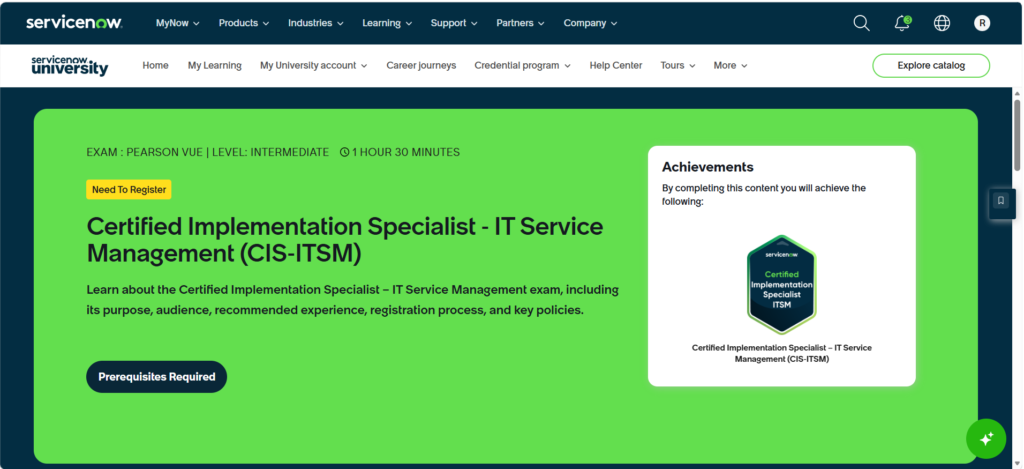
1. CIS - IT Service Management (ITSM)
Overview:
The ITSM track remains the most established and widely recognized ServiceNow implementation specialist certification. This track focuses on the core service management applications that originally defined the ServiceNow platform: Incident Management, Problem Management, Change Management, Service Catalog, Knowledge Management, and Service Level Management.
Technical Focus Areas:
- Incident and Problem workflow configuration and customization
- Change Management process implementation with approval workflows
- Service Catalog design including catalog items, record producers, and order guides
- Knowledge Management taxonomy and article lifecycle configuration
- Service Level Agreement (SLA) definition and retroactive SLA handling
- Configuration Management Database (CMDB) integration with service management processes
- Email notifications, business rules, and client scripts specific to ITSM applications
Real-World Implementation Scenario:
Consider a global financial services organization migrating from BMC Remedy to ServiceNow. An ITSM CIS professional would architect the incident categorization structure to align with the organization's 12,000+ configuration items, design a multi-tier approval process for standard, normal, and emergency changes that integrates with their existing Change Advisory Board (CAB) structure, and configure SLAs that account for business hours across seven time zones while meeting regulatory compliance requirements.
Ideal Candidate Profile:
- IT professionals with 2-5 years of service desk or ITIL experience
- Business analysts supporting IT operations
- Technical consultants focusing on enterprise IT service delivery
- Professionals holding ITIL Foundation or Practitioner certifications
Market Demand & Salary Impact:
ITSM remains the highest-volume implementation area, with approximately 65% of ServiceNow deployments starting with ITSM modules. Certified ITSM implementation specialists command average salaries of $85,000-$125,000 depending on experience and geography, with senior consultants exceeding $150,000 in major metropolitan markets.
2. CIS - Customer Service Management (CSM)
Overview:
The CSM track specializes in implementing ServiceNow's customer service applications, which extend the platform beyond internal IT into customer-facing service operations. This certification validates expertise in configuring customer service portals, case management, field service operations, and omnichannel engagement.
Technical Focus Areas:
- Customer service case management workflow design
- Service portal customization for external customer access
- Field service management including work order creation and dispatch
- Integration with telephony systems and chat platforms
- Customer community portal configuration
- Playbooks for guided customer service processes
- Service Level Management specific to customer commitments
- Advanced work assignment using predictive intelligence
Real-World Implementation Scenario:
Imagine implementing CSM for a telecommunications provider managing 3 million residential and business customers. A CSM CIS specialist would configure case routing that intelligently directs technical issues, billing inquiries, and service requests to appropriate teams; design a customer portal that integrates with the company's billing system to display account-specific information; implement field service dispatch that optimizes technician routing based on skill sets, geographic location, and appointment windows; and create playbooks that guide agents through complex troubleshooting procedures for various service tiers.
Ideal Candidate Profile:
- Customer service operations managers transitioning to technical roles
- CRM administrators with Salesforce Service Cloud or similar platform experience
- IT professionals supporting customer-facing departments
- Implementation consultants focusing on customer experience transformation
Market Demand & Salary Impact:
CSM implementations have grown 40% year-over-year as organizations digitize customer service operations. CSM specialists typically earn $90,000-$135,000, with consultants at major ServiceNow partners commanding premium rates due to the strategic nature of customer experience projects.
3. CIS - IT Operations Management (ITOM)
Overview:
The ITOM track represents one of the most technically demanding ServiceNow certifications, focusing on Discovery, Service Mapping, Event Management, Cloud Management, and infrastructure visibility. This certification validates deep technical knowledge of network protocols, infrastructure monitoring, and automated service topology mapping.
Technical Focus Areas:
- Discovery pattern configuration for identifying infrastructure components
- Service Mapping to create application dependency mapping
- Event Management including event correlation and alert intelligence
- Cloud Management for AWS, Azure, and Google Cloud Platform resources
- Orchestration workflow creation for automated infrastructure provisioning
- Integration with monitoring tools (Nagios, SolarWinds, Dynatrace, etc.)
- CMDB Health dashboard configuration and data quality management
- MID Server deployment and management in distributed environments
Real-World Implementation Scenario:
Consider a healthcare organization with 50+ hospital locations, hybrid cloud infrastructure across AWS and on-premises data centers, and regulatory requirements for maintaining accurate infrastructure documentation. An ITOM CIS professional would configure Discovery to automatically identify servers, network devices, databases, and applications across all locations; implement Service Mapping to visualize dependencies for critical applications like electronic health records systems; configure Event Management to aggregate alerts from multiple monitoring tools and use machine learning to reduce alert noise by 80%; and establish automated CMDB synchronization that maintains 95%+ accuracy for the 100,000+ configuration items in the environment.
Ideal Candidate Profile:
- Infrastructure engineers with networking or systems administration background
- Monitoring tool administrators (Nagios, SCOM, SolarWinds)
- IT operations professionals with DevOps or SRE experience
- Technical consultants with deep understanding of IT infrastructure
Market Demand & Salary Impact:
ITOM specialists are among the most sought-after ServiceNow professionals due to the technical complexity of implementations. Salaries range from $95,000-$150,000, with senior architects commanding $175,000+ in competitive markets. The shift toward AIOps and observability has created particularly strong demand for ITOM expertise.
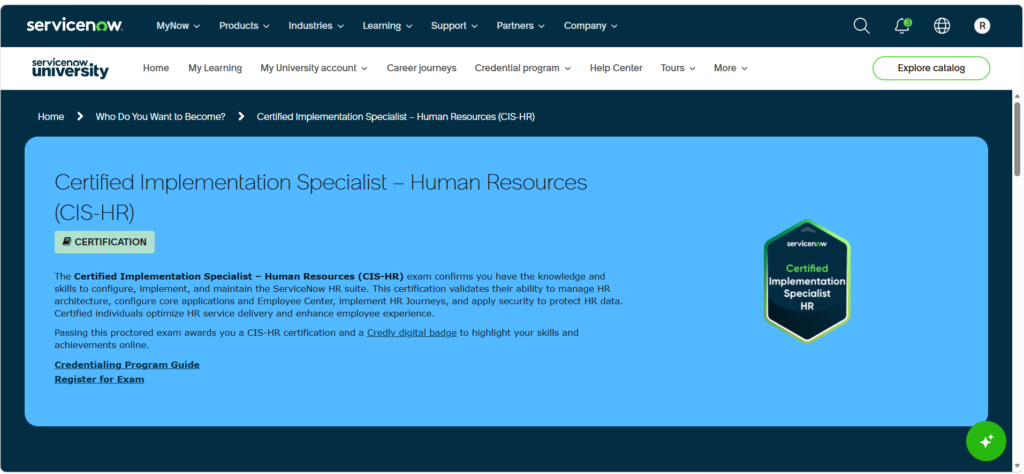
4. CIS - Human Resources Service Delivery (HRSD)
Overview:
The HRSD track focuses on implementing ServiceNow's HR Service Delivery applications, which bring service management principles to human resources operations. This certification covers employee lifecycle management, case and knowledge management for HR, and integration with core HR systems.
Technical Focus Areas:
- HR Service Portal configuration for employee self-service
- Employee lifecycle workflows (onboarding, transfers, offboarding)
- HR case management including privacy and confidentiality settings
- Integration with HRIS platforms (Workday, SuccessFactors, Oracle HCM)
- Document management and employee document generation
- Advanced analytics and reporting for HR metrics
- Workplace Service Delivery for facilities and workplace requests
- Employee relations case management
Real-World Implementation Scenario:
For a multinational manufacturing company with 25,000 employees across 15 countries, an HRSD CIS professional would implement onboarding journeys that automatically provision email accounts, schedule orientation sessions, assign training modules, and coordinate equipment delivery based on role and location; configure HR case management with field-level encryption for sensitive employee data to comply with GDPR and other privacy regulations; integrate with Workday to synchronize employee data and trigger ServiceNow workflows when employment status changes; and design self-service portals that enable employees to request parental leave, update benefits selections, or access HR knowledge articles in multiple languages.
Ideal Candidate Profile:
- HR technology specialists implementing HR systems
- Business analysts supporting human resources departments
- ServiceNow professionals expanding into non-IT workflow applications
- Implementation consultants focusing on employee experience
Market Demand & Salary Impact:
HRSD has emerged as a high-growth area as organizations recognize HR as a strategic differentiator for employee experience. HRSD specialists earn $85,000-$130,000, with particularly strong demand in enterprise organizations undergoing digital HR transformation. The combination of HR process knowledge and ServiceNow technical skills creates a valuable niche expertise.
5. CIS - Security Operations (SecOps)
Overview:
The SecOps track validates expertise in implementing ServiceNow's security operations applications, which integrate vulnerability management, threat intelligence, and security incident response into unified workflows. This certification addresses the growing intersection of IT operations and cybersecurity.
Technical Focus Areas:
- Security Incident Response workflow configuration
- Vulnerability Response integration with scanning tools (Qualys, Tenable, Rapid7)
- Threat Intelligence integration and indicator management
- Security orchestration and automated response workflows
- Integration with SIEM platforms (Splunk, QRadar, ArcSight)
- GRC (Governance, Risk, and Compliance) integration
- Prioritization of vulnerabilities using contextual risk scoring
- Security case management and collaborative response
Real-World Implementation Scenario:
For a financial services institution subject to rigorous cybersecurity regulations, a SecOps CIS specialist would integrate ServiceNow with their vulnerability scanning tools to automatically create vulnerability records, enriching them with CMDB data to understand which business services are affected; configure automated workflows that assign critical vulnerabilities to infrastructure teams with SLAs aligned to regulatory requirements; implement security incident response playbooks that guide analysts through investigation procedures while maintaining audit trails for compliance documentation; and create dashboards that provide real-time visibility into vulnerability remediation progress for executive stakeholders and external auditors.
Ideal Candidate Profile:
- Cybersecurity analysts and incident responders
- IT security engineers managing vulnerability management programs
- SOC (Security Operations Center) analysts and managers
- GRC professionals implementing security compliance frameworks
Market Demand & Salary Impact:
The cybersecurity talent shortage has created exceptional demand for SecOps specialists who understand both security principles and ServiceNow implementation. Salaries range from $100,000-$155,000, with senior security consultants earning significantly more. Organizations prioritizing cybersecurity maturity actively recruit SecOps-certified professionals.
6. CIS - IT Asset Management (ITAM)
Overview:
The ITAM track specializes in implementing ServiceNow's asset management capabilities, including hardware and software asset lifecycle management, license compliance, contract management, and procurement workflows. This certification addresses the critical challenge of managing technology assets across their entire lifecycle.
Technical Focus Areas:
- Hardware asset lifecycle management from procurement to disposal
- Software asset management and license compliance
- Normalization of software product data
- Contract management and vendor relationships
- Integration with procurement and finance systems
- Asset discovery and reconciliation with Discovery and ITOM
- Software compliance dashboard configuration
- True-down/True-up license optimization
Real-World Implementation Scenario:
For a technology company managing 40,000 hardware assets and hundreds of software licenses across global offices, an ITAM CIS professional would configure automated asset lifecycle workflows that trigger procurement requests when inventory falls below thresholds; implement software normalization to accurately identify all instances of Microsoft, Oracle, and Adobe products across the environment; configure license entitlement models that calculate actual versus licensed usage to identify both compliance risks and optimization opportunities; integrate with procurement systems to automatically update asset records when new equipment is purchased; and create executive dashboards showing total cost of ownership, compliance status, and upcoming contract renewals.
Ideal Candidate Profile:
- IT asset managers and procurement professionals
- Software license compliance specialists
- Technical business analysts supporting finance and IT
- Consultants focusing on IT financial management
Market Demand & Salary Impact:
ITAM specialists help organizations realize millions in cost savings through optimized asset utilization and license compliance. Professionals earn $80,000-$120,000, with particularly strong demand in regulated industries where asset documentation is critical for audits. The strategic value of asset optimization ensures consistent demand for ITAM expertise.
7. CIS - Application Portfolio Management (APM)
Overview:
The APM track focuses on implementing ServiceNow's capabilities for managing application portfolios, including application rationalization, cost transparency, and strategic planning for the application landscape. This certification addresses the challenge of managing hundreds or thousands of applications across enterprise portfolios.
Technical Focus Areas:
- Application inventory management and data collection
- Application assessment and scoring frameworks
- Cost allocation and transparency for application ownership
- Application rationalization and portfolio optimization
- Integration with enterprise architecture tools
- Demand management for application enhancements
- Application lifecycle management
- Business capability mapping to applications
Real-World Implementation Scenario:
For a retail organization that has grown through acquisitions and now manages 800+ applications with significant redundancy, an APM CIS specialist would implement structured data collection to inventory all applications with standardized attributes; configure assessment frameworks that score applications based on business value, technical health, and cost efficiency; design workflows that enable business and IT stakeholders to collaboratively evaluate the application portfolio; create rationalization recommendations identifying opportunities to consolidate, replace, or retire applications; and develop executive dashboards showing application spending by business capability, enabling strategic decisions about technology investments.
Ideal Candidate Profile:
- Enterprise architects and application portfolio managers
- IT financial management professionals
- Strategic planning analysts
- Consultants focusing on application rationalization and cloud migration strategies
Market Demand & Salary Impact:
APM specialists are valued for their ability to drive strategic decision-making and cost optimization. Salaries range from $90,000-$140,000, with particularly strong demand in large enterprises managing complex application landscapes. The strategic nature of APM work positions professionals for advancement into architecture and leadership roles.
8. CIS - Field Service Management (FSM)
Overview:
The FSM track validates expertise in implementing mobile field service capabilities, including work order management, dispatch optimization, mobile workforce enablement, and parts inventory management. This certification addresses the needs of organizations with distributed service delivery models.
Technical Focus Areas:
- Work order creation and lifecycle management
- Dispatch optimization and intelligent work assignment
- Mobile Field Service application configuration
- Crew and contractor management
- Parts and inventory management
- Field service scheduling with calendar integration
- Return Management Authorization (RMA) workflows
- Integration with IoT and connected products
Real-World Implementation Scenario:
For a commercial HVAC service provider with 200 technicians serving enterprise clients, an FSM CIS professional would configure work order creation from customer service cases, IoT alerts from connected equipment, and scheduled preventive maintenance; implement dispatch optimization that considers technician skills, certifications, geographic location, parts inventory in their vehicles, and customer priority to maximize daily productivity; design mobile experiences that enable technicians to access equipment history, troubleshooting guides, and parts catalogs while onsite; configure parts management that tracks inventory across warehouse, vehicle, and customer locations; and create customer-facing portals that provide real-time visibility into appointment status and technician arrival times.
Ideal Candidate Profile:
- Field service operations managers
- Technical professionals supporting field operations
- Implementation consultants with manufacturing or utility industry experience
- Mobile application specialists
Market Demand & Salary Impact:
FSM implementations are critical for organizations with distributed service delivery models. Specialists earn $85,000-$130,000, with strong demand in telecommunications, utilities, manufacturing, and healthcare equipment servicing industries. The growing Internet of Things (IoT) trend creates additional opportunities for FSM professionals integrating connected device data.
9. CIS - Software Asset Management (SAM)
Overview:
While closely related to ITAM, the SAM track provides deeper specialization in software license management, compliance, and optimization. This certification focuses specifically on the complexities of modern software licensing models across cloud, subscription, and perpetual license types.
Technical Focus Areas:
- Software entitlement and rights management
- License compliance calculation and reporting
- Software discovery and usage metering
- Publisher-specific license models (Microsoft, Oracle, SAP, etc.)
- Cloud software license tracking (SaaS applications)
- Software audit preparation and response
- License optimization and harvest opportunities
- Integration with software discovery tools
Real-World Implementation Scenario:
For a multinational corporation facing a Microsoft Enterprise Agreement audit, a SAM CIS professional would configure comprehensive software discovery integrating ServiceNow with endpoint management tools to identify all Microsoft products; implement license entitlement models that calculate compliance for complex products like SQL Server with core-based licensing and virtualization rights; configure usage analytics to identify unused licenses that could be harvested and reassigned; create audit-ready compliance reports showing installed software versus license entitlements with documentation of user assignments; and establish ongoing compliance monitoring with automated alerts when installation counts approach license thresholds.
Ideal Candidate Profile:
- Software asset managers and license compliance specialists
- Procurement professionals managing software vendors
- IT governance professionals
- Consultants specializing in software license optimization
Market Demand & Salary Impact:
SAM specialists deliver measurable ROI through license compliance and optimization. Professionals earn $85,000-$135,000, with particularly strong demand preceding major software audits. Organizations facing audits from publishers like Microsoft, Oracle, or IBM actively seek SAM expertise to minimize financial exposure.
Strategic Considerations for Choosing Your CIS Track
Selecting the right ServiceNow implementation specialist certification requires balancing multiple factors including current experience, career goals, market demand, and personal interests. Here's a strategic framework for making this decision:
Assess Your Current Experience and Skills
Technical Background Alignment:
- Infrastructure/Networking Experience: ITOM or SecOps naturally leverage your existing knowledge
- Service Desk/ITIL Background: ITSM provides the most direct path to specialization
- Customer Service Operations: CSM aligns with customer-facing process expertise
- HR Systems Experience: HRSD leverages HR technology knowledge
- Asset/License Management: ITAM or SAM builds on procurement and compliance expertise
Domain Knowledge Transfer:
Consider certifications that leverage domain expertise you've already developed. A professional with five years of SAP licensing experience will accelerate into SAM certification more rapidly than completely unfamiliar territory.
Evaluate Market Demand in Your Geography and Industry
Market demand varies significantly by region and industry vertical. Research job postings in your target geography to identify which certifications employers prioritize:
- Major metropolitan markets (San Francisco, New York, London) show strong demand across all tracks
- Financial services organizations particularly value ITOM, SecOps, and ITAM
- Healthcare organizations prioritize ITSM, ITOM, and increasingly HRSD
- Telecommunications and utilities sectors value CSM and FSM
- Technology companies often seek ITAM, SAM, and APM specialists
Review job postings on platforms like LinkedIn, Indeed, and specialized ServiceNow job boards to quantify demand. Track the frequency of each certification in job requirements and preferred qualifications.
Consider Certification Combinations and Career Progression
Strategic professionals often pursue multiple CIS certifications to differentiate themselves and expand implementation capabilities:
Powerful Certification Combinations:
- ITSM + ITOM: Comprehensive IT operations expertise
- CSM + FSM: Complete customer service and field operations capability
- ITAM + SAM: Total asset and license management authority
- SecOps + ITOM: Integrated security and infrastructure operations
- HRSD + CSM: Cross-functional employee and customer experience
Many professionals begin with the certification most aligned to current responsibilities, then add complementary certifications to broaden their marketability.
Assess Implementation Complexity and Learning Curve
CIS certifications vary significantly in technical complexity and preparation time:
Lower Complexity (200-250 hours preparation):
- ITSM
- CSM
- HRSD
Moderate Complexity (250-350 hours preparation):
- ITAM
- SAM
- FSM
Higher Complexity (350-500+ hours preparation):
- ITOM
- SecOps
- APM
Consider your available preparation time and learning style when selecting your initial certification. Many professionals begin with moderate complexity certifications to build confidence before tackling technically demanding tracks like ITOM.
Align with Long-Term Career Objectives
Different certifications position you for distinct career trajectories:
Technical Architecture Path: ITOM, SecOps, APM provide foundation for solution architect roles
Consulting and Implementation: ITSM, CSM, HRSD position for implementation consultant careers
Strategic Advisory: APM, ITAM prepare for advisory roles in portfolio rationalization
Specialized Expert: SAM, FSM create niche expertise commanding premium rates
Consider not just your next role but your five-year career vision when selecting specialization areas.
Preparing for Your CIS Certification: Best Practices
Once you've selected your target CIS track, strategic preparation maximizes your probability of first-attempt success:
Establish Strong Foundation Knowledge
Prerequisites:
Most CIS certifications require completion of:
- Certified System Administrator (CSA)
- Application-specific Mainline certification course
- Recommended hands-on experience (typically 6-12 months)
Ensure you've thoroughly mastered prerequisites before attempting CIS certification. Many candidates underestimate the importance of CSA fundamentals in CIS exam scenarios.
Leverage ServiceNow Official Training
ServiceNow offers comprehensive training for each CIS track through multiple delivery methods:
Instructor-Led Training (ILT): Immersive classroom or virtual instruction with hands-on labs
On-Demand Training: Self-paced digital courses with video instruction and lab exercises
Documentation: Detailed product documentation and implementation guides
While self-study is possible, official training significantly improves first-attempt pass rates. RizeX Labs offers specialized CIS certification training programs that complement official ServiceNow resources with real-world implementation scenarios and expert mentorship.
Gain Hands-On Experience in Personal Developer Instances
ServiceNow provides free Personal Developer Instances (PDIs) with full platform access. Dedicate significant preparation time to hands-on configuration:
- Replicate exam scenarios in your PDI
- Build implementations referenced in training materials
- Experiment with configurations beyond training scope
- Document your configuration decisions and outcomes
The CIS exams emphasize practical implementation knowledge. Hands-on practice differentiates candidates who merely memorize concepts from those who truly understand application behavior.
Study Real-World Implementation Scenarios
Supplement training materials with real-world case studies and implementation documentation:
- ServiceNow Community discussions of implementation challenges
- Technical blog posts from ServiceNow partners
- Case studies published by ServiceNow customers
- Industry-specific implementation guides
Understanding how organizations actually implement ServiceNow in production environments provides context that training materials alone cannot deliver.
Join Study Groups and Professional Communities
Collaborative preparation accelerates learning and provides diverse perspectives:
- ServiceNow Community forums specific to your certification track
- LinkedIn groups for ServiceNow professionals
- Local ServiceNow user group meetings
- Study groups organized through training providers
Explaining concepts to peers and learning from their experiences reinforces your own understanding while revealing knowledge gaps.
Take Practice Exams Under Timed Conditions
ServiceNow and training partners offer practice exams that simulate actual certification testing:
- Complete practice exams in testing conditions without reference materials
- Time yourself to ensure you can complete questions within exam duration
- Review incorrect answers to understand knowledge gaps
- Retake practice exams after additional study
Practice exams serve dual purposes: identifying weak areas requiring additional study and building comfort with exam format and time management.
The Business Case: ROI of CIS Certification
Organizations and individuals both realize substantial returns from CIS certification investments:
Individual Professional Benefits
Salary Impact: CIS-certified professionals earn 15-30% more than CSA-only peers
Career Acceleration: Specialized expertise opens senior consultant and architect opportunities
Job Security: Certified specialists face significantly lower unemployment during market contractions
Professional Recognition: Industry-recognized credential validates expertise to employers and clients
Consulting Opportunities: Independent consultants command $150-$250 hourly rates for specialized CIS expertise
Organizational Benefits
Implementation Quality: Certified specialists deliver faster, higher-quality implementations
Risk Reduction: Proper implementation reduces costly rework and production issues
Knowledge Retention: Certified employees provide sustainable internal expertise
Customer Confidence: Certifications demonstrate organizational competency to clients
Partner Status: ServiceNow partner requirements include certified professionals
Organizations increasingly recognize CIS certification as strategic investment rather than discretionary expense. Forward-thinking companies support certification through paid training time, exam fees, and financial bonuses upon completion.
Emerging Trends Shaping CIS Certification Paths
The ServiceNow platform continues evolving rapidly, creating new specialization opportunities:
AI and Automation Integration
ServiceNow's integration of AI capabilities through Predictive Intelligence and Now Assist is creating demand for implementation specialists who understand machine learning configuration, training data management, and automation design. Future CIS certifications may incorporate AI specialization tracks.
Industry-Specific Solutions
ServiceNow has introduced industry clouds for telecommunications, financial services, healthcare, and other verticals. Industry-specific implementation expertise combining CIS certification with domain knowledge represents emerging differentiation opportunity.
Integration Architecture
As ServiceNow becomes central to enterprise architecture, implementation specialists with deep integration expertise (REST/SOAP APIs, IntegrationHub, MuleSoft) command premium positioning. Integration specialization complements traditional CIS tracks.
Low-Code/No-Code Development
ServiceNow's emphasis on citizen development through App Engine and Flow Designer creates demand for implementation specialists who can enable business users while maintaining governance and best practices.
Stay current with ServiceNow's roadmap and beta programs to anticipate emerging specialization areas before they become mainstream.
Taking the Next Step: Your CIS Certification Journey
The ServiceNow Certified Implementation Specialist certification represents a career-defining investment in specialized technical expertise. Whether you choose ITSM, CSM, ITOM, HRSD, SecOps, ITAM, SAM, APM, or FSM, you're positioning yourself for meaningful career advancement in one of technology's fastest-growing ecosystems.
The key to certification success extends beyond technical knowledge to strategic career planning. Assess your current skills, research market demand, align with long-term objectives, and commit to comprehensive preparation. The certification journey requires significant time and effort, but the professional and financial returns justify the investment.
Ready to accelerate your ServiceNow career with CIS certification?
Contact RizeX Labs Today to discuss customized CIS certification training programs designed for working professionals. Our expert instructors bring decades of real-world ServiceNow implementation experience, providing not just exam preparation but practical expertise you'll apply immediately in production environments.
Explore Our ServiceNow Training Programs to discover comprehensive certification preparation courses across all CIS tracks, delivered through flexible formats including instructor-led virtual classes, on-demand video courses, and intensive bootcamp programs.